
Ah, Japan. To many, it's a land of bullet trains, bustling neon cities, and ancient temples nestled amidst manicured gardens. And yes, as a former Kintetsu train conductor, I can attest to the sheer marvel of our public transport system. It is a symphony of precision, a ballet of efficiency, whisking you from metropolis to major sight with effortless grace. But here's a secret, a truth whispered by the wind through remote cedar forests and echoed by the gentle lapping of waves against forgotten coastlines: the true soul of Japan, its 'Secret Japan,' lies just beyond the reach of the turnstiles and ticket gates. It’s a Japan that unveils itself only to those adventurous enough to seek it out on their own terms, with the open road as their guide and a spirited machine at their command.
Imagine, for a moment, the freedom. From the vibrant, pulsating heart of Osaka, your gateway to the Kansai region, a world of boundless exploration unfurls. Forget the curated, often crowded, paths of conventional tourism. Picture yourself not as a passive observer, but as an active participant, charting your own course through landscapes that time seems to have forgotten. This is not about merely getting from point A to point B; it’s about the journey itself – a dynamic dance between driver, machine, and the ever-unfolding tapestry of the Japanese countryside. The train offers a fleeting glimpse, a framed postcard view; a car, especially a finely-tuned JDM marvel like the Toyota 86 or Subaru BRZ, offers an embrace, a deep, visceral connection to the land.
There's an undeniable philosophy to driving in Japan that transcends mere transportation. It's about liberation. It's about the exhilarating sensation of the tarmac feeding directly into your fingertips through the leather-wrapped steering wheel, the guttural growl of the horizontally opposed boxer engine echoing off ancient stone walls, the scent of damp earth and blooming wildflowers carried on the breeze through an open window. This is the Japan that doesn’t feature in travel brochures, the one where serendipitous discoveries await around every bend: a tiny, family-run soba shop serving exquisite regional delicacies, a moss-covered shrine tucked away in a grove of towering trees, or a panoramic vista over a shimmering valley that takes your breath away. These moments, these precious, unscripted encounters, are the true treasures of Japanese travel.
As a conductor, I knew every curve of the track, every scheduled stop. But it was on four wheels, traversing this archipelago, often with an older JDM classic humming beneath me, that I truly fell in love with Japan's boundless, untamed spirit. The rail lines are arteries, yes, but the roads are the capillaries, reaching into every hidden nook and cranny, allowing for an intimacy with the land that is simply impossible on a fixed itinerary. From the neon glow of Dotonbori to the serene tranquility of Nara’s ancient cycling paths, the contrast is stark, the transition seamless in the capable hands of an 86 or BRZ. This is your invitation to peel back the layers of the guidebook and truly feel the heartbeat of this ancient land, to chase the light, to follow your intuition, and to discover the Japan that speaks only to those who dare to drive its winding roads.
Nara Cycling & Asuka Road: The 2-Day Itinerary: Deep Dive
Day 1: From Osaka's Urban Pulse to Ancient Kashihara and Asuka's Serenity
09:00 - 10:00: The Osaka Escape & Expressway Symphony
The morning sun, still a gentle caress, begins to paint the skyscrapers of Osaka in hues of molten gold as you slide into the low-slung cabin of your chariot – the magnificent Toyota 86 (or its Subaru BRZ twin). The tactile sensation of the leather-wrapped steering wheel, cool and alive, feels like a direct conduit to the asphalt beneath your tires. With a confident twist of the key, the horizontally opposed boxer engine barks to life, a deep, guttural growl that sends a thrill coursing through your veins. This isn't just a car; it's an extension of your adventurous spirit, eager to devour the miles that separate you from ancient history.
We navigate the initial urban sprawl, the 86's precise steering and compact dimensions making light work of city traffic, before smoothly merging onto the Kinki Expressway. Here, the true character of this machine begins to shine. The tachometer needle dances playfully as you shift through the gears, each click of the short-throw shifter a satisfying mechanical affirmation. The twin exhaust pipes sing a melodious symphony as the RPMs climb, a rich, resonant tone that speaks of pure, unadulterated driving pleasure. The road, impeccably smooth, stretches out before us, a ribbon of possibility. You feel the subtle nuances of the tarmac through the responsive suspension, a constant feedback loop that connects you intimately with the journey. Keep your eyes peeled for the fleeting glimpses of the Ikoma mountains to the east, their verdant slopes promising the cooler, fresher air of the countryside we're rapidly approaching. This isn't just getting from A to B; it's a dynamic ballet between driver, car, and the open road, a feeling of exhilaration that public transport simply cannot replicate.
10:00 - 11:00: Entering Nara Prefecture & Anticipation of Antiquity
As the expressway effortlessly carries us further east, the urban landscape gradually gives way to a more rural charm. The concrete canyons recede, replaced by endless expanses of rice paddies, meticulously tilled fields, and charming traditional homes with their dark, sweeping tiled roofs. The air, noticeably crisper now, carries the subtle scent of damp earth and distant forests. The 86, a perfect companion for such transitions, maintains its poised composure, its engine note a confident thrum as we cruise at highway speeds. You might notice the distinctive contours of the Yamato Sanzan – the three sacred mountains of Yamato (Unebiyama, Kagamiyama, Amanokagu-yama) – beginning to appear on the horizon, silent sentinels guarding the ancient heartland of Japan. These aren't just hills; they are geological marvels, formed millions of years ago by volcanic activity, their peaks now softened by eons of erosion and lush vegetation. Their presence serves as a gentle reminder that we are entering a land steeped in history, where the very ground beneath our tires holds secrets stretching back to the dawn of the Japanese nation. The seamless efficiency of the ETC card system at the toll gates further emphasizes the smooth flow of the journey, a small but significant detail that enhances the driving experience.
11:00 - 12:00: Arrival in Kashihara & Imperial Roots
We smoothly exit the expressway, the 86 eagerly responding to the tighter turns of the local roads. The landscape around us is now undeniably ancient, permeated with a profound sense of history. We arrive in Kashihara, a city whose very name resonates with imperial power and mythological origins. This is the legendary birthplace of Japan’s first emperor, Emperor Jimmu, who is said to have ascended the throne here in 660 BC. The gravity of this historical fact settles over you as you park the 86 – its modern lines a striking contrast to the timeless surroundings – near Kashihara Jingū. This grand Shinto shrine, built in 1890, stands on the very site where Emperor Jimmu is believed to have established his first palace. The air here is thick with reverence, the towering torii gates and solemn approach embodying centuries of tradition. The powerful energy of this place, the foundation of a nation, is almost palpable. Take a moment to walk the sacred grounds, to feel the meticulously raked gravel beneath your feet, and to witness the serene beauty of the shrine architecture. This is where Japan began, a fact that imbues every step with profound meaning.
12:00 - 13:30: Lunch in Kashihara & Local Flavors
After absorbing the solemn history of Kashihara Jingū, it’s time to nourish the body. We seek out a local eatery, a place often discovered by the discerning driver rather than the guidebook tourist. Look for a modest establishment, perhaps with a simple noren (traditional curtain) flapping gently in the breeze, indicating a menu focused on regional Nara specialties. Today, we might savor the subtle delights of kakinoha-zushi, a regional sushi dish where cured mackerel or salmon is pressed with vinegared rice and wrapped in a persimmon leaf, imparting a delicate, earthy flavor. Or perhaps a bowl of hearty miwa somen, thin wheat noodles from the nearby Miwa region, served either cold with a refreshing dipping sauce or warm in a light broth. The flavors are clean, honest, and reflect the agricultural bounty of the Yamato plain. The atmosphere is unpretentious, filled with the quiet murmur of local conversations, offering a genuine glimpse into daily Japanese life. The 86, patiently waiting, seems to hum with anticipation for the scenic drives ahead, its spirit attuned to the authentic experiences we are uncovering.
13:30 - 14:30: Scenic Drive to Asuka Village & Winding Delights
With renewed energy, we ease the 86 out of Kashihara, leaving the slightly more urbanized areas behind. The road now transforms into a driver's dream, a series of gentle curves and flowing straights that beckon the enthusiastic driver. This is where the 86 truly comes into its own. The responsive chassis eagerly carves through each bend, the steering offering precise feedback, allowing you to place the car exactly where you want it. The sound of the engine, a throaty growl, fills the cabin as you downshift for a corner, feeling the slight push-back from the road. The scenery unfolds like a traditional ink painting: verdant hills dotted with ancient burial mounds (kofun), shimmering rice paddies reflecting the sky like mirrors, and small, timeless villages where red-tiled roofs peek through groves of bamboo. The roads here are narrower, more intimate, demanding a focused yet exhilarating drive. This isn't about speed; it's about the pure joy of navigating, of feeling connected to the road and the surrounding landscape in a way that only a finely balanced sports car can offer. This is the tranquil journey to Asuka, a village lost in time.
14:30 - 16:30: Asuka Historical National Government Park & Ancient Mysteries
We arrive in Asuka, a place so rich in history that every stone seems to whisper tales of ancient emperors and powerful clans. Park the 86 in a designated area, and step out into a landscape that feels utterly removed from the modern world. The Asuka Historical National Government Park is not a single confined area, but a sprawling canvas dotted with archaeological wonders. Here, you'll encounter the whimsical Ishibutai Kofun, a massive megalithic tomb whose earth mound has long since eroded, leaving behind an astonishing chamber of colossal stone slabs. The sheer scale and precision of these ancient constructions are awe-inspiring, a testament to the engineering prowess of a bygone era. Further on, discover the playful Saruishi (Monkey Stones), enigmatic carved boulders whose origins and purpose remain shrouded in mystery, prompting delightful speculation. Wander through the rolling hills, past vibrant green tea fields, and imagine the court intrigues and cultural revolutions that unfolded here during Japan's Asuka Period (538-710 AD), a time when Buddhism arrived and profoundly reshaped the nation. The air here is imbued with a peaceful, almost spiritual quietude, disturbed only by the gentle rustle of leaves or the distant call of a bird. It’s a sensory journey back to the very roots of Japanese civilization.
16:30 - 18:00: Stroll Through Asuka & Ryokan Check-in
As the afternoon sun begins its slow descent, casting long, dramatic shadows across the ancient landscape, we take a leisurely stroll through the heart of Asuka village. This is a place where traditional farmhouses with their dark, thatched roofs stand proudly amidst meticulously tended gardens. The pace of life here is noticeably slower, a soothing balm after the exhilaration of the drive and the weight of history. You might stumble upon a small, family-run craft shop selling local pottery or textiles, or simply enjoy the quiet beauty of the village lanes. As dusk approaches, we make our way to our chosen accommodation – perhaps a charming, traditional ryokan or guesthouse. While I won't name specific establishments, imagine a place where the scent of tatami mats and cypress wood fills the air, where warm hospitality is a cherished art, and where a tranquil garden view invites contemplation. Check in, settle into your room, and let the gentle rhythm of rural Japan wash over you. The day's journey, both in mileage and in historical depth, has been profound, and the serene evening promises a peaceful respite.
18:00 - 20:00: Asuka Evening & Traditional Dinner
After a refreshing soak in a traditional Japanese bath (onsen or sento, if available), it’s time for dinner. Dinner in a ryokan is often an event in itself, a multi-course culinary journey known as kaiseki. Expect an exquisite array of seasonal dishes, meticulously prepared and beautifully presented, each a small work of art. The flavors will be subtle yet profound, celebrating fresh local ingredients, perhaps including mountain vegetables, river fish, or locally raised poultry. Each bite is a testament to the Japanese philosophy of seasonal eating and aesthetic appreciation. If dining outside the ryokan, seek out a small, unassuming local restaurant in the village. They might offer simple yet incredibly flavorful fare, such as handmade udon, local tempura, or a hearty bowl of regional stew. The conversation is hushed, the atmosphere warm and inviting. As you dine, reflect on the day’s journey, the roar of the 86’s engine momentarily replaced by the quiet sounds of a timeless village, a perfect end to an immersive day.
20:00 onwards: Starry Skies & Tranquil Sleep
With the day's adventures behind you, step outside into the night. Far from the light pollution of Osaka, the night sky over Asuka is often a breathtaking canvas of shimmering stars, a celestial spectacle rarely seen in urban environments. The air is cool and clean, carrying the faint scent of distant fields. The silence is profound, a balm for the soul. Retire to your futon, laid out on the tatami floor, and drift into a deep, restful sleep, dreams perhaps filled with ancient emperors, stone monkeys, and the satisfying growl of your 86. The anticipation of tomorrow’s cycling adventure, connecting with this ancient land on two wheels, adds a sweet note to your slumber.
Day 2: Cycling Through History & The Return Drive
08:00 - 09:00: Traditional Breakfast & Morning Light
Wake to the gentle sounds of the village, perhaps the chirping of birds or the distant crow of a rooster. A traditional Japanese breakfast awaits, typically featuring grilled fish, steamed rice, miso soup, pickles, and various small dishes. It’s a light yet nourishing meal, perfectly designed to prepare you for the day’s activities. Sip on green tea, gaze out at the garden, and feel the soft morning light filtering through the shoji screens. This quiet contemplation sets a peaceful tone for the day, a stark contrast to the rush of city mornings. The 86, still resting, seems to patiently await its turn, knowing that a different kind of adventure is about to unfold.
09:00 - 10:00: Rental Cycle Pick-up & Preparation
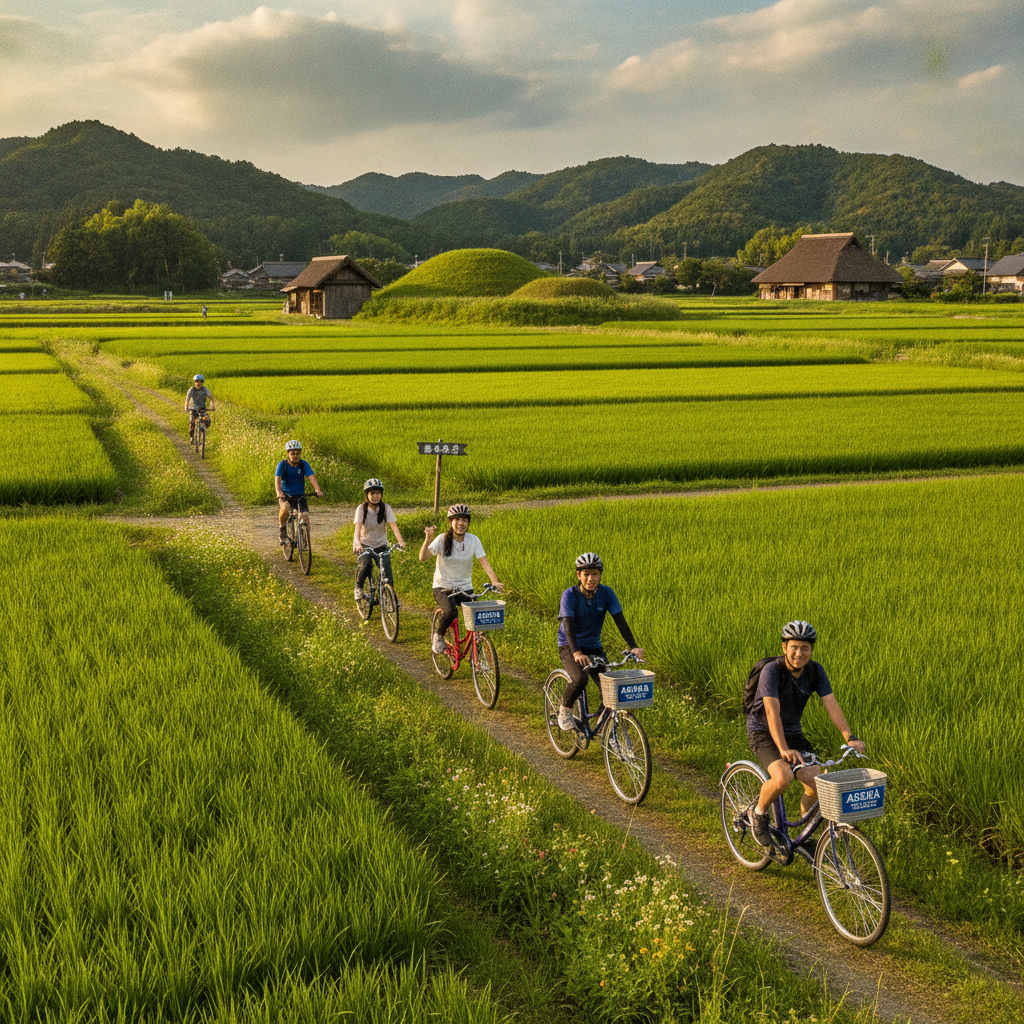
After breakfast, it’s time to transition from four wheels to two. Asuka is renowned for its excellent rental cycle facilities, making it incredibly easy to explore. Head to one of the conveniently located rental shops, often near major historical sites or train stations. The process is straightforward and efficient. Choose your preferred bicycle – perhaps a comfortable city bike with a basket, or an electric-assist model if you want a little extra boost for the gentle inclines. The staff are always helpful, providing maps and suggesting routes. Secure your bike, adjust the seat, and take a moment to breathe in the crisp morning air. The peaceful scenery of Asuka awaits, ready to be explored at a slower, more intimate pace. This duality of travel – the exhilaration of the 86 and the tranquility of a bicycle – offers a truly holistic Japanese experience.
10:00 - 12:30: Asuka Road Cycling: Tomb & Paddy Fields
Now, with the wind in your hair and the pedals beneath your feet, you embark on the true 'Asuka Road' experience. This is what you came for: the serene, picturesque cycling through a landscape steeped in antiquity. Follow the well-marked cycling paths that wind gently through the Asuka Historical National Government Park. Your first stop might be the Kitora Tomb, a remarkable circular kofun famous for its exquisite ancient murals depicting the constellations, celestial animals, and human figures (though the tomb interior is rarely open, the mound itself is impressive). Cycle on to the Takamatsuzuka Tomb, another circular kofun known for its vibrant wall paintings, especially of the 'Asuka Beauties' (again, internal access is restricted, but the site's significance is profound). The path takes you through a breathtaking patchwork of emerald green rice paddies, shimmering under the sun, interspersed with traditional farmhouses and groves of bamboo that sway gently in the breeze. The only sounds are the whirring of your bicycle chain, the distant calls of birds, and the occasional laughter of other cyclists. This is the epitome of 'peaceful scenery' – a gentle, immersive journey that allows you to feel the very texture of this ancient land. The absence of engine noise allows for a different kind of sensory input, a deeper connection to the natural environment.
12:30 - 13:30: Lunch in Asuka Village & Local Delights
After working up an appetite exploring the ancient landscape, pedal back into the heart of Asuka village for lunch. There are several charming cafes and small restaurants catering to cyclists and visitors. Look for a place offering a light, refreshing meal – perhaps a local specialty like chagayu (tea porridge), a comforting dish often served with pickles, or a simple yet delicious sandwich made with local ingredients. Many cafes here pride themselves on using fresh, seasonal produce from the surrounding fields. Enjoy a refreshing iced green tea or a freshly brewed coffee while you recount the morning’s discoveries. The atmosphere is relaxed, convivial, a perfect interlude before the final leg of your Asuka cycling adventure. The blend of physical activity and historical immersion makes every bite taste richer, every moment more profound.
13:30 - 15:00: Further Exploration & Return Cycle
With your energy replenished, you have time for a final loop. Perhaps visit the Asuka-dera Temple, one of Japan's oldest Buddhist temples, founded in 596 AD, home to a venerable bronze Buddha statue. Or cycle to the Gakuen-ji Temple, another ancient site offering tranquil beauty. Alternatively, simply lose yourself on the smaller paths, allowing the quiet beauty of the rice paddies and the charm of the rural landscape to guide you. Observe the farmers tending their fields, the children playing, the unchanging rhythm of life in this timeless village. This is the beauty of independent travel: the freedom to follow your curiosity. As the clock ticks, make your way back to the rental shop, feeling a deep sense of satisfaction. Return your bicycle, bid farewell to the friendly staff, and retrieve the keys to your 86. The transition back to the thrill of the JDM machine feels natural, a continuation of the same spirit of exploration.
15:00 - 16:30: Scenic Drive Back Towards Osaka & Foothill Detour
With the 86 purring contentedly, we begin our gentle journey back towards Osaka. Instead of immediately hopping back on the main expressway, consider a slightly more scenic route through the foothills surrounding Asuka and Kashihara. This allows for a final, lingering appreciation of the 'peaceful scenery' and offers another opportunity to experience the 86's dynamic capabilities on winding B-roads. You might trace a path that skirts the edge of the Yoshino mountains, even if not fully venturing into them, enjoying the elevated views over the Yamato basin. The roads here are less traveled, presenting a series of engaging curves and gentle inclines that the 86 handles with playful ease. The engine's note, a satisfying growl on acceleration, becomes a soothing hum as you cruise, reflecting on the ancient history and serene beauty you've just experienced. The sensory details – the shift of light through the trees, the changing scent of the air, the subtle vibrations from the road – are heightened in the intimate cockpit of the JDM sports car. This is not just a drive; it's a reflective winding down, a final act of communion with the Japanese countryside.
16:30 - 17:30: Expressway Return & Osaka Skyline
Eventually, we rejoin the expressway, the 86 seamlessly blending into the flow of traffic. The efficiency of the Japanese highway system ensures a smooth and steady return. As you approach Osaka, the landscape gradually transforms once more. The distant urban sprawl begins to resolve into the distinct silhouette of Osaka's iconic skyline, a glittering testament to modern Japan. The setting sun, now painting the sky in fiery oranges and purples, casts a dramatic glow over the city, a stark yet beautiful contrast to the ancient tranquility you experienced in Nara. The 86, having performed flawlessly, feels like a trusted companion, having delivered you safely and thrillingly through history and serene landscapes. The transition from the rural quietude to the vibrant energy of the city is swift, yet the memories of Asuka’s peaceful paths and Kashihara’s ancient roots remain vivid, a testament to the depth of your independent exploration.
17:30 - 18:00: Arrival in Osaka & The Lingering Thrill
Navigating the final stretches into Osaka city, the 86 handles the urban environment with the same precision it displayed on the winding country roads. The compact dimensions and agile handling make it surprisingly adept at city driving, a final reminder of its versatile capabilities. As you park, the engine sighs to a halt, and the silence that follows is profound. Yet, it’s not an empty silence; it’s filled with the lingering echoes of your journey. The scent of ancient forests, the whisper of history on the Asuka Road, the satisfying growl of the 86 – these sensations will stay with you long after the ignition is turned off. You’ve not just driven a car; you’ve driven into the heart of Japan, experienced its diverse soul, and returned with a wealth of unforgettable memories, a true adventurer's triumph.
Nara Cycling & Asuka Road: Expert Advice & Cultural Nuances

Having traversed Japan countless times, both on rail and road, I've gathered invaluable insights that can transform a good trip into an extraordinary one. When you're behind the wheel of a JDM machine like the 86 or BRZ, you're not just a tourist; you're an explorer. Here's how to truly immerse yourself.
The Michi no Eki (Roadside Station) Culture: More Than Just a Stop
Forget the soulless rest stops of other countries. Japan's Michi no Eki (道の駅) are cultural hubs, economic arteries of rural Japan, and essential components of any successful road trip. Each one is a microcosm of its region, a vibrant marketplace showcasing local produce, artisanal crafts, and often, unique culinary delights that you won't find anywhere else. Don't just pull in for a bathroom break. Take your time to browse: you might discover a rare regional sake, freshly picked seasonal fruits and vegetables, intricate ceramics, or a limited-edition snack that becomes your new obsession. Many Michi no Eki also feature small restaurants or food stalls serving delicious, unpretentious local dishes. It's a fantastic way to support local communities and taste the authentic flavors of the region. I’ve often found the best local coffee, or the most unique souvenir, not in a city department store, but at a bustling Michi no Eki, alive with the chatter of locals and travelers alike. It’s where the true pulse of rural Japan beats, offering a glimpse into the everyday lives of the people who cultivate these lands.
Unearthing Hidden Gems: The Local's Secret
The beauty of driving your own JDM car is the freedom it grants to deviate from the well-trodden path. To find those hidden local gems, you need to cultivate a keen sense of observation. Look for the subtle cues: a small, unassuming restaurant with a disproportionate number of local license plates parked outside (a sure sign of good, authentic food); a tiny, moss-covered shrine or temple tucked away on a side road, its beauty far exceeding its entry in any guidebook; a local farmer's stand selling produce from their own fields. Don't be afraid to pull over and explore, even if it's just a short walk down an intriguing lane. Sometimes, the most memorable experiences are those completely unplanned. While language can be a barrier, a polite smile and a few basic Japanese phrases (like 'Arigato gozaimasu' - thank you, or 'Kore wa nan desu ka?' - what is this?) can open doors to friendly interactions and unexpected discoveries. Embrace the spontaneity; it's the heart of the adventure. As a former conductor, I learned to read the landscape between the stations; as a driver, you learn to read the nuances between the towns.
Driving Etiquette & Safety: Navigating with Respect
Japanese roads are incredibly well-maintained, and driving here is generally a pleasure, but there are cultural nuances to observe. Remember, we drive on the left side of the road. Speed limits are strictly enforced, particularly in urban areas and residential zones; adhere to them. Politeness is paramount: avoid aggressive driving, flashing your lights unnecessarily, or honking. Japanese drivers tend to be exceptionally courteous, and a friendly nod or a subtle hand gesture of thanks goes a long way. Be particularly mindful on narrow village roads, where space can be tight and pedestrians or cyclists might be present. Always yield to pedestrians. Pay close attention to road signs; while many are bilingual, knowing key Japanese characters can be helpful. During your drive in the 86 or BRZ, you’ll appreciate the car's superb visibility and precise handling, making navigation through both bustling and serene landscapes a confident experience. Always remember, respectful driving enhances not just your safety, but your entire cultural immersion.
Nara Cycling & Asuka Road: Detailed Logistics & Pre-Trip Tips
Preparing for your Japanese road trip in a JDM legend like the 86 or BRZ is part of the adventure. Here's what you need to know to ensure a seamless and exhilarating journey, tailored for the discerning traveler in 2026.
Traffic & Road Conditions (2026 Perspective)
Japan's road network remains one of the finest in the world, with meticulously maintained expressways and well-marked local roads. While specific future traffic patterns are hard to predict, expect the general efficiency and orderliness to continue. Urban areas, particularly during rush hours (7-9 AM and 5-7 PM), will naturally be more congested, so planning your departure from Osaka outside these windows is advisable for a smoother start. Outside major cities, traffic is typically light, especially on the kind of scenic routes we've outlined for your Nara adventure. Road signage is generally excellent, with English translations commonplace on major routes and highways. Mountain passes and scenic B-roads, like those leading to Asuka, are designed for enjoyable driving, often featuring smooth asphalt and clear markings, making the most of your 86 or BRZ's dynamic capabilities.
The ETC Card System: Your Expressway Passport
An ETC (Electronic Toll Collection) card is an absolute game-changer for driving on Japan's extensive network of toll roads. Instead of fumbling for change or waiting in queues at toll booths, the ETC card allows for seamless, automatic payment. It's a small card that slots into a reader in your vehicle (which your rental provider will equip you with). As you approach an ETC gate (clearly marked in green), simply slow down, and the system automatically reads your card, opening the barrier without requiring you to stop. This significantly reduces travel time and stress, especially on longer journeys. Ensure your rental includes an ETC card and that you understand its usage. It transforms highway driving into an effortlessly smooth experience, allowing you to focus on the road and the thrill of your JDM ride.
Japanese Gas Stations: "Mantan!" and Attentive Service
Filling up your 86 or BRZ at a Japanese gas station is a unique cultural experience. Many stations still offer full service, meaning attendants will pump the gas, clean your windows, and even offer to clear your trash. While self-service stations are becoming more common, don't be surprised by this level of hospitality. The key phrase you'll want to remember is "Mantan o onegaishimasu!" (満タンお願いします!), which means "A full tank, please!" You'll likely need "レギュラー" (regular) or "ハイオク" (high-octane) gasoline, clearly indicated by color-coded nozzles. The attendants are often incredibly efficient and polite. Be prepared to park in a specific spot, sometimes facing a certain direction. It’s another small cultural interaction that adds to the richness of your journey, and you'll appreciate the clean, well-maintained facilities.
Parking Wisdom & JDM Precision
Parking in Japan, especially in cities or popular tourist spots, requires a bit of strategy. In urban centers, multi-story car parks (立体駐車場) and coin parking lots (コインパーキング) are abundant. These are usually clearly marked and operate on a pay-per-hour basis. Be mindful of parking space dimensions; they can be narrower than what you might be accustomed to, but your agile 86 or BRZ will handle them with ease. Always park in designated areas to avoid fines or towing; illegal parking is strictly enforced. In smaller towns like Asuka or near Michi no Eki, you'll often find ample free parking. The precise steering and compact size of your JDM sports car make maneuvering into even tight spots a satisfying exercise in driving skill, adding to the overall enjoyment of your trip.
The Pure Joy of Driving a JDM (MT) Car: The 86/BRZ Experience
For the true car enthusiast, there's nothing quite like piloting a JDM (Japanese Domestic Market) car, especially one with a manual transmission. The Toyota 86 or Subaru BRZ is a masterclass in driver engagement. Its naturally aspirated, high-revving boxer engine delights in being pushed, its power delivered smoothly and responsively. The short-throw shifter, with its satisfying mechanical engagement, allows for precise gear changes, perfectly complementing the car's balanced chassis. You'll feel every nuance of the road, every subtle input translated directly through the steering wheel. This isn't just a means of transport; it's a partner in exploration. The joy of rev-matching a downshift before carving into a perfect corner on a winding road, the exhilarating surge as the RPMs climb towards the redline – these are the moments that connect you intimately with the spirit of the machine and the landscape it navigates. It's an opportunity to rediscover the pure, unadulterated pleasure of driving, a dance between man and machine that elevates your journey to an art form.
Nara Cycling & Asuka Road: Comprehensive FAQ
To ensure your Japanese road trip is as smooth and worry-free as possible, here are answers to some of the most common questions our adventurous guests have.
Do I Need an International Driving Permit (IDP) to Drive in Japan?
Yes, absolutely. To legally drive in Japan, you will need an International Driving Permit (IDP) issued under the 1949 Geneva Convention. This IDP must be presented along with your valid domestic driver's license and your passport. Without all three documents, you cannot legally drive. Please ensure your IDP is valid for the entire duration of your trip to Japan. It is crucial to obtain your IDP in your home country before traveling, as they cannot be issued within Japan.
What About Car Insurance?
Basic liability insurance is mandatory for all vehicles in Japan and will be included with your rental. However, for complete peace of mind, we highly recommend opting for comprehensive coverage, which typically includes vehicle damage waiver (CDW) to cover potential damage to the rental car. This will protect you from significant financial responsibility in the event of an accident. Always clarify the scope of your insurance coverage with your rental provider before commencing your journey.
I'm Used to Automatic Cars. Should I Be Worried About Driving an MT (Manual Transmission) Car?
Not at all! While many cars today are automatic, driving a manual transmission car like the Toyota 86 or Subaru BRZ offers an incredibly engaging and rewarding experience. These cars are known for their user-friendly manual gearboxes, with a light clutch and precise, short throws, making them remarkably forgiving even for those who might be a little rusty. We encourage drivers to take a few minutes in a safe, open area to reacquaint themselves with the clutch and shifter before embarking on their main adventure. The joy of truly connecting with the car and controlling its power output manually is an integral part of the JDM driving experience and will deepen your immersion into the roads of Japan.
What Are the Winter Road Conditions Like in Nara and Surrounding Areas?
While our suggested Nara itinerary typically avoids the most extreme winter conditions, it's wise to be aware that some mountainous regions of Japan can experience significant snow and ice from late November to March. Specifically around Nara's ancient sites, heavy snowfall is rare, but freezing temperatures can lead to icy patches, especially on shaded roads or during early mornings. If you plan to travel during these months or venture into higher elevations (such as the more mountainous parts of Nara Prefecture or the Yoshino region), always check local road conditions and weather forecasts. If snow or ice is predicted, it's essential to ensure your vehicle is equipped with appropriate winter tires or chains. However, for most of the year, particularly during spring, summer, and autumn, road conditions in the Nara and Asuka areas are excellent.
Are There Any Other Licensing Requirements?
In addition to your IDP, valid domestic driver's license, and passport, please ensure that your IDP is a physical document and not just a digital copy. Also, confirm that your domestic license is valid throughout your rental period. There are no other specific additional licensing requirements beyond these standard international travel documents for most visitors under typical tourist visas.
Nara Cycling & Asuka Road: The Final Call: Your JDM Adventure Awaits!
You've journeyed through ancient landscapes, traced the path of emperors, felt the exhilarating thrill of a responsive JDM machine, and uncovered the serene, peaceful beauty of Nara's hidden corners. This isn't just a trip; it's a rebirth of your adventurous spirit, a deep dive into the heart of Japan that only a true road warrior can experience. The lingering scent of ancient forests, the whisper of history on the Asuka Road, the satisfying growl of the 86 or BRZ as it carves through a winding road – these memories will forge a permanent mark on your soul. You've seen Japan not as a tourist, but as an explorer, an adventurer, a connoisseur of authentic experiences.
Now, it's time to turn that inspiration into action. As someone who has spent a lifetime traversing this incredible country, both on rail and road, I know the profound difference a truly capable and engaging vehicle makes. At Omoshiro Rent-A-Car Osaka Chuo, we understand your passion for the open road and the thrill of a finely tuned machine. We are not just a rental agency; we are fellow enthusiasts, dedicated to providing you with the keys to your dream Japanese adventure.
We offer a meticulously curated fleet of JDM legends, including the exhilarating Toyota 86 and Subaru BRZ, many available with authentic manual transmissions and bespoke modifications that enhance their performance and driving pleasure. Forget the impersonal rental counter and the generic vehicles. Come to us, where passion for driving meets unparalleled local expertise, backed by an ex-Kintetsu conductor's unique understanding of Japan. Let us help you unlock your own 'Secret Japan' and create memories that will last a lifetime. Your ultimate JDM road trip awaits. Book your exhilarating experience with Omoshiro Rent-A-Car Osaka Chuo today and prepare to ignite your adventure!
