
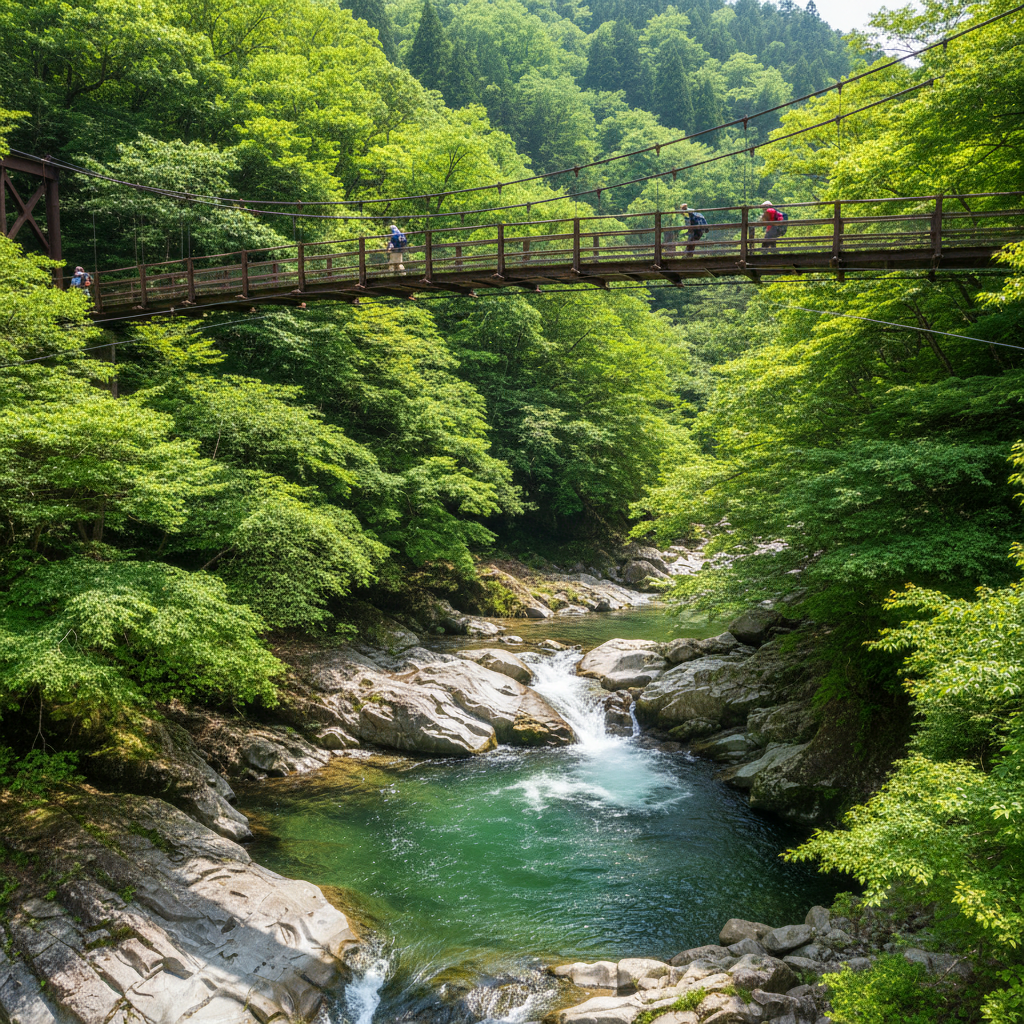
Mitarai Valley, Emerald Green, Suspension Bridge, Hiking – The Philosophy of Driving in Japan
As a former Kintetsu train conductor, I spent years navigating the intricate ballet of Japanese rail, witnessing the clockwork precision, the breathtaking speed, and the sheer efficiency that defines our public transport system. From the hallowed confines of the driver’s cabin, I saw countless passengers gaze out at the fleeting landscapes, always connected, yet always at a distance. And while Japan’s trains are a marvel, a testament to human ingenuity and communal harmony, they offer a very specific kind of journey – one bound by stations, schedules, and the predictable rhythm of the rails. But what if you yearn for something more? What if the standard itinerary, the well-trodden path, feels incomplete? This, my friends, is the “Secret Japan,” a Japan that can only be unlocked from behind the wheel of your own machine.
From the bustling heart of Osaka, a city synonymous with culinary delight and vibrant street life, lies a gateway to an entirely different realm. While the trains will whisk you to Kyoto’s ancient temples or Nara’s deer-filled parks, they will never, ever, deliver you to the secluded mountain roads where the air thins, the sounds of humanity recede, and nature reclaims its dominance. The magic of driving in Kansai, with Osaka as your launchpad, is the unparalleled freedom it affords. Imagine the exhilarating sensation of charting your own course, turning off the main highway onto a serpentine mountain pass, the engine of your JDM legend – say, a nimble 86 or a perfectly balanced BRZ – singing a mechanical symphony as you carve through ancient forests. This is not merely transportation; this is an extension of yourself, a direct conduit to the pulse of the land.
Public transport, for all its merits, dictates. It guides you to the well-known, the heavily photographed, the “must-sees.” But “Secret Japan” doesn’t live by those rules. It hides in the folds of verdant valleys, whispers from the depths of emerald gorges, and unfurls along forgotten prefectural roads. It’s the tiny, unassuming ramen shop nestled deep in the mountains, the waterfall accessible only after a scenic drive and a short hike, the remote onsen town whose healing waters have drawn pilgrims for centuries. These are the places that stir the soul, offering not just a sight, but an experience – an immersion. The car allows you to chase the shifting light on distant peaks, to follow the scent of pine through a sun-dappled forest, to pull over spontaneously and simply breathe in the sublime silence. It’s a journey of discovery, where every bend in the road reveals a new facet of this complex, enchanting nation. And for a destination like Mitarai Valley, with its otherworldly emerald waters and challenging mountain trails, a JDM machine isn't just a vehicle; it's the key to unlocking an unforgettable adventure.
Mitarai Valley, Emerald Green, Suspension Bridge, Hiking – The 2-Day Itinerary: Deep Dive
Prepare yourself, for this is not just a drive; it’s an odyssey. An immersive, two-day pilgrimage into the heart of “Secret Japan,” where the asphalt ribbons and the mountain trails beckon, promising an experience that will etch itself into your memory. From the moment your hands grip the leather-wrapped steering wheel of your chosen JDM legend – a precision-engineered 86 or a responsive BRZ – in Osaka, you’ll feel the transformation. This is the Japan that travel guides merely hint at, the Japan of raw, untamed beauty, demanding to be explored with passion and purpose.
Day 1: The Ascent to Emerald Dreams
8:00 AM - The Awakening in Osaka: Your JDM Awaits
The dawn breaks over Osaka, a city still stirring to life, but your adventure begins now. At our central Osaka location, the air crackles with anticipation as you approach your steed for the next 48 hours. Is it the iconic Toyota 86, with its perfectly balanced chassis and responsive throttle, or the Subaru BRZ, renowned for its taut suspension and direct steering feel? Whichever you choose, its low-slung profile and purposeful stance speak volumes. Slide into the bolstered seat, adjust the mirrors, and feel the cold metal of the shift knob – if you’ve opted for the manual, you know the symphony of gears awaits. The distinctive scent of a well-maintained performance car fills the cabin, a mix of leather, plastic, and the faint, exciting aroma of engine oil. A quick check of the navigation, a mental note of the route – you’re ready. The thrum of the horizontally opposed engine, a characteristic growl, signals the start of your journey.
8:30 AM - The Urban Escape: Osaka to the Open Road
With a smooth engagement of the clutch and a precise shift into first gear, you pull out into the awakening city streets. The initial kilometres are a gentle ballet through Osaka’s urban landscape, a warm-up for both driver and machine. You’ll navigate the Hanshin Expressway, a concrete serpent weaving through towering buildings, a stark contrast to the natural beauty that awaits. The 86/BRZ feels surprisingly composed, its compact dimensions making light work of the city traffic, yet its eagerness is palpable, a coiled spring waiting to unleash its potential. As you transition onto the Meishin Expressway, heading east before turning south towards Nara Prefecture, the urban tapestry slowly unravels, replaced by more open skies and distant green hills. The hum of the tires on the asphalt, the minimal wind noise, allows you to appreciate the quality of your JDM companion.
9:30 AM - Bridging Prefectures: Into Nara’s Embrace
The transition from the Meishin to the slower, more scenic routes towards Yoshino is seamless. The pace slows slightly, allowing you to absorb the shifting landscape. From my conductor’s vantage, I often observed how the flat plains of Osaka gradually give way to the undulating hills of Nara, and it’s precisely in this transition that the “Secret Japan” begins to reveal itself. The fields become greener, the houses more traditional, the air noticeably fresher. This area, historically significant as Japan’s first permanent capital, is a land steeped in legend and natural grandeur, particularly famed for its cherry blossoms. Even outside of spring, the mountains here hold a profound beauty, their slopes cloaked in a thousand shades of green.
10:30 AM - The Winding Ascent: Engaging the Machine
Now, the real driving experience begins. You’ll leave the wider prefectural roads for narrower, more challenging routes that hug the contours of the mountains. This is where your 86/BRZ truly comes alive. The precise steering feeds every nuance of the road surface directly to your fingertips. The short-throw shifter clicks satisfyingly into each gear as you climb, the engine’s revs building with a purposeful growl on the inclines, then settling into a refined burble as you crest a rise. Each corner is an invitation, a dance between machine and driver. You’ll feel the grip of the tires, the subtle weight transfer, the pure mechanical connection that only a well-engineered, lightweight sports car can provide. The “Secret Japan” isn't just about the destination; it's about the journey – the exhilarating process of getting there. The air, crisp and cool, streams through your open window, carrying the scent of damp earth and pine.
12:00 PM - Rustic Lunch: A Taste of the Mountains
By now, the mountain air and the focused driving will have sharpened your appetite. As you delve deeper, you’ll stumble upon one of those delightful “Michi no Eki” (Roadside Stations) or a small, unassuming local eatery – the kind you’d never find on a tour bus itinerary. Pull your 86/BRZ into a parking spot, admiring its lines against the backdrop of ancient cedars. Inside, the rustic charm is palpable. Imagine a “soba-ya” (soba noodle shop) serving handmade noodles, each strand perfectly chewy, bathed in a rich, umami-laden dashi broth, perhaps topped with crispy tempura or wild mountain vegetables. The taste is clean, wholesome, a direct reflection of the pristine environment. The warm “oshibori” (wet towel) offered with sincere politeness, the chatter of local patrons – it’s an authentic slice of Japanese mountain life, a welcome pause before your main adventure.
1:30 PM - Arrival at Mitarai Valley: The Emerald Revelation
Refreshed and eager, you continue your journey, the roads becoming even more dramatic as you approach Mitarai Valley. The final stretch is a descent into a deeply carved gorge, where the trees lean in, forming a verdant tunnel. And then, without warning, the world shifts. Through a break in the canopy, you catch your first glimpse: the water. An unbelievable, incandescent emerald green, flowing with a mesmerizing clarity that seems to defy reality. It’s not just a colour; it’s a sensation, a vivid punctuation mark in the forest’s deep greens and earthy browns. Park your 86/BRZ carefully, the engine ticking softly as it cools, its mission for this leg complete. The geological forces that carved this valley over millennia – the relentless flow of the Tenkawa River, eroding the ancient bedrock – have created a masterpiece. The unique mineral composition and the play of light filtering through the dense foliage combine to produce this ethereal hue, a sight that must be seen to be believed.
2:00 PM - The Mitarai Gorge Hiking Trail: An Immersion
Step out of your car and into a world of primal beauty. The air is cool and moist, filled with the scent of damp earth and verdant growth, underscored by the constant, soothing murmur of the river. The Mitarai Gorge trail is not an arduous trek, but an intimate communion with nature. The path, sometimes paved, sometimes a natural dirt track, winds along the riverbank, offering continuous, breathtaking views of the emerald waters. You’ll pass “fuchi” (deep pools) of astonishing clarity, where you can see every pebble on the riverbed, and “taki” (waterfalls) that cascade gracefully over ancient rocks, contributing to the river’s vibrant life. My years as a conductor taught me the beauty of efficiency, but here, inefficiency is the charm – taking your time, savoring each step, each breath.
2:30 PM - The Suspension Bridges: A Thrill Above the Abyss
The highlight of the Mitarai Valley hike, beyond the mesmerizing water, are the series of suspension bridges that span the gorge. Your heart will quicken a beat as you step onto the first one. The slight sway beneath your feet, the gentle creaking of the cables – it’s a primal sensation, a test of trust in engineering and nature. From the centre of these bridges, the views are absolutely spectacular. Below, the emerald green river rushes and swirls, its colour intensified by the depth and the surrounding shadows. Above, ancient trees reach for the sky, their roots gripping the steep, moss-covered banks. These bridges, built to connect communities and allow passage through challenging terrain, now serve as perfect vantage points for photographers and adventurers alike. Imagine capturing the vibrant hues, the texture of the rocks, the sheer drama of the gorge from such a unique perspective. The cool mountain breeze whispers past, carrying with it the sounds of nature – birdsong, the rustling of leaves, the persistent voice of the river.
4:00 PM - Further Exploration & Reflection
Continue along the trail, discovering hidden nooks and smaller cascades. Each turn reveals a new perspective, a different interplay of light and shadow on the water. The deeper you venture, the more profound the sense of tranquility becomes. It’s easy to lose track of time here, enveloped in nature’s embrace. This is the antithesis of the crowded tourist spots, a place where you can genuinely disconnect and recharge. The geological history of this area – formed by millions of years of tectonic activity and fluvial erosion – is almost palpable beneath your feet. The layers of rock, the unique mineral deposits – it all contributes to the valley's distinct ecosystem and visual splendor.
5:30 PM - Journey to Dorogawa Onsen: Mountain Refuge
As the sun begins its gentle descent, casting long shadows across the valley, you’ll reluctantly make your way back to your 86/BRZ. The engine fires to life with a familiar roar, a comforting sound after the quiet contemplation of the gorge. Your destination for the night is the charming mountain onsen town of Dorogawa Onsen, just a short, scenic drive away. The road to Dorogawa is another delightful series of twists and turns, perfectly suited to the agile handling of your JDM machine. As you climb higher, the air grows cooler, and the scent of woodsmoke often drifts on the breeze. Dorogawa Onsen, with its traditional wooden buildings and tranquil atmosphere, has been a sanctuary for pilgrims and travelers for centuries, a true “Secret Japan” gem.
6:30 PM - Check-in & Onsen Bliss: Unwinding in Tradition
Check into your chosen ryokan or minshuku in Dorogawa Onsen. These traditional Japanese guesthouses offer a glimpse into a bygone era, with their tatami mat rooms, futon bedding, and impeccable “omotenashi” (hospitality). The first order of business after a day of driving and hiking? A soak in the onsen. The therapeutic waters, heated by the earth’s core and rich in minerals, will melt away any lingering fatigue. Imagine submerging yourself in the warm, restorative embrace, the steam rising around you, the gentle murmurs of fellow bathers – or perhaps the blissful silence of a private bath. From a conductor’s rigorous schedule, I always appreciated moments of profound relaxation, and this is one such moment – a complete reset for mind and body.
7:30 PM - Kaiseki Dinner: A Feast for the Senses
Dinner at a traditional ryokan is an experience in itself. A multi-course “kaiseki” meal, showcasing the freshest local ingredients – wild mountain vegetables, freshwater fish from the pristine rivers, high-quality local beef. Each dish is a work of art, meticulously prepared and beautifully presented. The delicate flavours, the varying textures, the vibrant colours – it’s a culinary journey that reflects the bounty of the surrounding mountains and rivers. You might taste “ayu” (sweetfish) grilled over an open flame, its subtle flavour a true delicacy, or “takenoko” (bamboo shoots) harvested from nearby groves. Paired with local “sake” or “umeshu” (plum wine), it’s a symphony of tastes that perfectly complements the day’s natural wonders. After dinner, step outside to gaze at the night sky. Far from the city lights, the stars blaze with an intensity rarely seen, a fitting end to a day of profound natural beauty.
Day 2: Serene Mornings and the Joy of the Return Drive

8:00 AM - Traditional Breakfast & Morning Serenity
Awake to the gentle sounds of the ryokan and the fresh mountain air. A traditional Japanese breakfast awaits, typically featuring grilled fish, miso soup, rice, and an array of small, savory dishes – a nourishing start to your second day. After breakfast, take a leisurely stroll through the quiet streets of Dorogawa Onsen. Admire the traditional wooden architecture, the gurgling streams, and the peaceful atmosphere. The village itself, nestled deep in the Omine mountain range, carries a spiritual significance as a base for “shugendo” ascetics, adding another layer of depth to your visit. Perhaps pick up a local craft or a unique sweet from a small shop, a tangible memory of this hidden haven.
10:00 AM - Farewell to Dorogawa: Embracing the Winding Roads Anew
With renewed energy, check out of your ryokan and return to your 86/BRZ. The engine hums to life, eager for the roads ahead. Today’s journey back towards Osaka won’t be a mere retracing of steps; it will be a conscious celebration of the drive itself. Take a slightly different route, or revisit those sections of road that particularly captivated you yesterday. The winding mountain passes are just as exhilarating in the morning light, perhaps even more so. The brilliant sunshine now illuminates details you might have missed – a delicate fern growing from a rock face, a distant waterfall shimmering in the light. The precise turn-in of your JDM machine, the feedback through the steering wheel, the satisfaction of a perfectly executed heel-toe downshift – these are the moments that truly connect you to the road and to Japan’s dramatic topography.
12:00 PM - Scenic Lunch Stop: Regional Delicacies
For your final mountain meal, seek out another local treasure. Perhaps “kakinoha-zushi,” a Nara specialty of pressed sushi wrapped in persimmon leaves, its subtle aroma and delicate flavour a perfect reflection of the region. Or a “yuba” (tofu skin) dish, common in areas with pristine water, offering a delicate texture and rich soy flavour. These culinary experiences, often found in humble settings, are the rewards of independent travel – a taste of the “Secret Japan” that cannot be replicated in a city restaurant. Enjoy the view from your lunch spot, perhaps overlooking a patchwork of rice fields or a serene river, savoring the last moments of mountain tranquility.
1:30 PM - The Homeward Bound Drive: Reflecting on the Journey
As you begin the gradual descent from the higher elevations, the landscape slowly transforms once more. The winding roads give way to broader prefectural highways, and eventually, the expressways that lead back to Osaka. But the return journey is not a dull affair. It’s a time for reflection, for reliving the emerald greens of Mitarai, the thrill of the suspension bridges, the warmth of the onsen, and the crisp mountain air. The effortless cruising capabilities of your 86/BRZ on the highway – its stable stance, its refined engine note – provide a comfortable environment for contemplation. You’ve not just visited a place; you’ve experienced it, driven through its heart, felt its pulse. The contrast between the pristine wilderness you’ve explored and the approaching urban sprawl of Osaka serves to highlight the profound escape you’ve just undertaken. As the familiar skyline of Osaka begins to emerge on the horizon, a sense of accomplishment settles over you. You’ve conquered the roads, embraced the culture, and discovered a “Secret Japan” that few ever witness.
4:00 PM - Return to Osaka: Mission Accomplished
With a final, satisfying drive, you guide your 86/BRZ back to our Osaka location. The engine idles smoothly, the journey complete. As you step out of the car, the memories of emerald waters, winding roads, and the pure joy of driving a JDM legend will linger. This wasn’t just a trip; it was an adventure, a personal revelation, made possible by the freedom of the open road and the perfect machine.
Mitarai Valley, Emerald Green, Suspension Bridge, Hiking – Expert Advice & Cultural Nuances
Embarking on a driving adventure through Japan’s “Secret Japan” is about more than just navigation; it’s about understanding the subtle rhythms and unspoken courtesies of the land. Having traversed these roads for decades, first as a Kintetsu conductor observing the landscape from a steel track, then as a driver exploring every conceivable asphalt ribbon, I’ve gleaned insights that can elevate your journey from a mere trip to an authentic immersion.
The “Michi no Eki” Phenomenon: More Than a Rest Stop
Forget the soulless rest areas you might be accustomed to. Japan’s “Michi no Eki” (Roadside Stations) are cultural hubs, vital arteries of rural life. As you drive your 86/BRZ through the countryside, keep an eye out for these beacons of local charm. They are meticulously clean, offer immaculate restroom facilities, and provide a window into the regional identity. You’ll find stalls overflowing with freshly harvested local produce – seasonal fruits, heirloom vegetables, and unique pickles – often sold directly by the farmers who cultivated them. There are craft shops showcasing artisan pottery, textiles, and wood carvings. You can sample regional snacks, from “mochi” (rice cakes) with local fillings to freshly baked pastries or unique ice cream flavours (wasabi or soy sauce, perhaps?). Many also feature local restaurants serving delicious, hearty meals that highlight regional ingredients. Think of them as miniature cultural museums, community centres, and culinary delights, all rolled into one. I’ve seen the trains pass these areas, their passengers unaware of the vibrant local life just beyond the station; the car grants you access to this delightful facet of Japan.
Unearthing Hidden Local Gems: The Art of Discovery
The true magic of “Secret Japan” lies in its unassuming treasures. How do you find them? The simplest advice is often the best: observe. Look for parking lots filled with local license plates, indicating a popular spot with residents. Pay attention to small, handwritten signs in Japanese (a quick photo translation app can be your best friend). These often point to family-run “izakaya” (pubs), quaint “kissaten” (coffee shops), or even a small temple or shrine not listed in any major guidebook. These are the places where genuine interactions happen, where the food tastes more authentic, and where you might be the only foreign face – an honour and an opportunity. Supporting these local businesses is not just an act of tourism; it’s an act of cultural exchange, sustaining the unique fabric of these communities.
Navigating with Grace: Driving Etiquette in Japan
Driving in Japan, especially in rural areas, demands a blend of confidence and courtesy. The roads, while generally well-maintained, can be narrow and winding, particularly in mountainous regions like those surrounding Mitarai Valley. Here are a few pointers from my years on both tracks and roads:
- Politeness is Paramount: Japanese drivers are generally incredibly polite. Be prepared for cars to yield to you, even when they have the right of way. Acknowledge these gestures with a slight bow or a flash of your hazard lights as a “thank you.” This courtesy makes for a far more relaxed driving experience.
- Speed Limits are Absolute: Unlike some countries where speed limits are treated as suggestions, in Japan, they are strictly enforced. Pay close attention to signs, especially in residential areas and on mountain roads where limits can drop significantly. The 86/BRZ is a joy to drive within limits, its handling and balance making even modest speeds exhilarating.
- Mountain Road Vigilance: These roads are a driver’s dream, but demand respect. Expect sharp, blind corners. Always stay in your lane, especially on tight turns where you might encounter oncoming traffic. Be mindful of potential wildlife – deer, monkeys, and wild boars are common in these areas, particularly at dawn and dusk. Drive defensively.
- Respect for Communities: When driving through small villages, slow down. Children may be playing near the roads, and elderly residents often walk. Your JDM machine might turn heads, but always drive with utmost consideration for the local population. The peacefulness of “Secret Japan” is sustained by this mutual respect.
- Parking Precision: In rural areas, parking can sometimes be limited. Utilize designated parking areas at attractions and Michi no Eki. Avoid parking on narrow roads or in private driveways.
By embracing these nuances, you won’t just be driving through Japan; you’ll be driving ‘with’ Japan, experiencing its roads and culture in the most respectful and rewarding way possible. The journey itself becomes as enriching as the destination.
Mitarai Valley, Emerald Green, Suspension Bridge, Hiking – Detailed Logistics & Pre-Trip Tips
To truly unlock the exhilaration of driving Japan’s hidden routes, especially to a gem like Mitarai Valley, you need to be prepared. From the unique nuances of Japanese traffic to the singular joy of driving a JDM manual, here’s what you need to know, straight from an ex-Kintetsu conductor who understands systems and precision.
Japan’s Roads in 2026: A Network of Efficiency
As of 2026, Japan’s road infrastructure remains among the best in the world. Highways are meticulously maintained, clearly signposted (often in English as well as Japanese), and generally efficient. Urban traffic, particularly in major cities like Osaka, can be dense during peak hours, but flows remarkably well due to disciplined driving and intelligent road design. Once you transition to prefectural and mountain roads, the quality remains high, though the lanes narrow, and the curves tighten – exactly what your 86 or BRZ craves. While modern GPS systems are excellent, always keep an eye out for “road closed” signs, especially in mountainous regions during severe weather (heavy rain or snow can cause temporary closures).
The ETC Card: Your Expressway Express Pass
If you plan to use Japan’s expressways – and for a trip from Osaka to Mitarai Valley, you will – an ETC (Electronic Toll Collection) card is an absolute necessity. Think of it as your seamless gateway. Instead of fumbling for change or cards at every toll booth, you simply drive through a dedicated ETC lane. The system automatically reads the card in your rental car’s unit, calculates the toll, and you’re off. It saves immense time, reduces stress, and often grants you access to discounted toll rates. As a conductor, I learned the value of smooth, uninterrupted movement; the ETC card embodies this efficiency on the roads. Ensure your rental company provides one; it’s worth its weight in gold.
Fueling Up: The Japanese Gas Station Experience
Pulling into a Japanese gas station is an experience in itself, particularly at a full-service station. Imagine the precision and customer focus of a well-oiled machine, much like a train operation. As you approach, attendants in crisp uniforms will often bow and guide you into a spot with precise hand signals, sometimes even using illuminated batons. Here’s a typical interaction:
- Attendant: “Irasshaimase! Nan desu ka?” (Welcome! What can I get you?)
- You: “Mantan, regyura onegaishimasu.” (Full tank, regular, please.) – “Mantan” (満タン) is the magic word for “fill ‘er up!” “Regyura” (レギュラー) is regular unleaded; “Haioku” (ハイオク) is high-octane.
- While your tank is being filled, they might offer to clean your windows, wipe down your mirrors, or even empty your ashtray (though most rental cars are non-smoking). It’s a level of service that speaks volumes about Japanese customer care. They’ll often hand you a small towel for your hands when you pay, a thoughtful touch. Pay attention, as some stations are self-service (“serufu” (セルフ) stands for self-service), which operate like any Western self-service station, but the full-service experience is a “Secret Japan” gem in itself.
Parking Prowess: Mastering the Art of the Stop
Parking in Japan requires a bit of foresight. In cities, coin parking lots (コインパーキング) are abundant and typically use automated systems. Look for signs indicating “P” or the kanji “駐” (chū). In rural areas and at attractions like Mitarai Valley, dedicated parking lots are common, often with a small fee. Always park within marked lines and avoid obstructing local businesses or residences. Japanese drivers are experts at precise parking in tight spaces, a skill you’ll quickly appreciate and perhaps even emulate with your compact 86/BRZ.
The JDM (MT Car) Experience: Pure Driving Exhilaration
This is where the rubber truly meets the road, quite literally. Driving a manual transmission (MT) JDM car like an 86 or BRZ in Japan is not just a mode of transport; it’s an integral part of the adventure. The direct connection to the drivetrain, the feeling of perfectly matching revs on a downshift, the subtle feedback from the clutch pedal, the precise click of the short-throw shifter – it transforms every curve into an engaging dance, every straight into an opportunity to feel the engine’s eager pull. On the winding mountain roads leading to Mitarai Valley, this mechanical intimacy amplifies the sensory experience. You’re not just observing the scenery; you’re an active participant, a conductor of your own automotive orchestra. The 86/BRZ, with its lightweight chassis and balanced power, provides an accessible yet immensely rewarding MT experience, making even novice manual drivers feel like seasoned pros. It’s a purity of driving that modern automatics simply cannot replicate, and it’s the ultimate way to truly feel the pulse of Japan’s asphalt veins.
Mitarai Valley, Emerald Green, Suspension Bridge, Hiking – Comprehensive FAQ
Planning an international driving adventure, especially one involving a JDM sports car and navigating Japan’s unique roads, naturally comes with questions. Here are comprehensive answers to common queries to ensure your trip is smooth and worry-free.
International Driving Permit & Licenses
To legally drive in Japan, you need an International Driving Permit (IDP) issued under the 1949 Geneva Convention, along with your original domestic driving license and your passport. Make sure your IDP is valid for the entire duration of your stay. Countries like Belgium, France, Germany, Monaco, Switzerland, and Taiwan issue their own Japanese translation instead of an IDP; ensure you have the correct documentation for your nationality. Always carry all three documents (IDP, domestic license, passport) when driving. It’s a strict requirement, and failure to comply can lead to significant legal issues.
What About Insurance?
All reputable rental car companies in Japan provide basic mandatory insurance as part of your rental package. However, I strongly advise considering additional, comprehensive insurance options. These typically cover a wider range of scenarios, reduce your liability (deductibles), and provide peace of mind in case of an unforeseen accident or damage to the vehicle. Given the narrow mountain roads and unfamiliar driving conditions, comprehensive coverage is a wise investment, allowing you to focus on the joy of the drive rather than potential financial risks.
I’m Anxious About Driving a Manual Transmission (MT) Car. Is it for Me?
It’s completely natural to feel a bit apprehensive if you’re not accustomed to driving a manual, especially in a foreign country. However, driving an MT JDM car like an 86 or BRZ is one of the most rewarding experiences you can have in Japan. These cars are known for their forgiving clutches and precise, short-throw shifters, making them relatively easy to drive even for those with moderate MT experience. If you’re comfortable with the basics, Japan’s well-maintained roads and generally polite drivers provide an excellent environment to hone your skills. Start slow, practice in less trafficked areas, and let the car’s inherent balance guide you. The mechanical connection to the road and the pure driving satisfaction will quickly overcome any initial anxiety. We also offer automatic options, but for the true enthusiast, the manual is unmatched.
What Are Winter Road Conditions Like Around Mitarai Valley?
Mitarai Valley is located in a mountainous region, and winter conditions can be challenging. From late November to early March, there is a possibility of snow and ice on the roads, particularly at higher elevations. If you plan a winter trip, it is absolutely essential to check local weather and road conditions immediately before and during your journey. Snow tires (スタッドレスタイヤ – sutaddoresu taiya) are often required or highly recommended during these months, and in severe conditions, snow chains (タイヤチェーン – taiya cheen) might be mandatory for certain passes. Some smaller roads to Mitarai Valley or deeper into the mountains might even be closed. Always prioritize safety and consider if a winter drive aligns with your comfort level and experience. For the emerald green experience, spring, summer, or autumn are generally ideal.
How Reliable is GPS in Japan?
Modern GPS systems, including popular smartphone apps like Google Maps, are generally very accurate and reliable in Japan. Most rental cars come equipped with in-car navigation systems that are often multilingual. While these can sometimes be a bit dated in their interface, they are excellent for searching by phone number (a common practice for businesses and attractions in Japan) or map code, which can be more reliable than address searches in some rural areas. Having both a smartphone GPS and an in-car system provides excellent redundancy. Ensure your smartphone has a reliable data plan or a portable Wi-Fi device for constant connectivity.
Mitarai Valley, Emerald Green, Suspension Bridge, Hiking – The Final Call: CTA
You’ve read the words, felt the passion, and perhaps, even heard the distant hum of an eager engine. You’ve imagined the breathtaking emerald greens of Mitarai Valley, felt the sway of the suspension bridges, and savoured the thought of carving through pristine mountain roads in a precision-engineered JDM machine. This isn’t just about seeing Japan; it’s about experiencing it – intimately, passionately, and on your own terms. It’s about trading the predictable for the profound, the crowded for the captivating. It’s about discovering the “Secret Japan” that only the adventurous, the curious, and the true driving enthusiast will ever truly know.
Your journey with a spirited 86 or a perfectly balanced BRZ isn't merely a drive; it's a narrative waiting to be written, an adventure sculpted by your own hands on the wheel. As a former Kintetsu conductor who once guided trains through this very land, and now a proud purveyor of these magnificent JDM machines, I can unequivocally tell you: the ultimate way to explore Japan’s unparalleled beauty, its hidden gems, and its soul-stirring landscapes, is from behind the wheel of a performance car. The freedom, the connection, the sheer joy – it’s an experience that will redefine your understanding of travel.
Are you ready to make that dream a reality? To unleash your inner adventurer and embark on an unforgettable journey into the heart of Japan? To feel the road beneath your fingertips and the rhythm of the engine as you chase the sunset over ancient mountains? Then your next stop is clear. The keys to your Secret Japan await. Visit Omohide Rental Car Osaka Chuo and reserve your gateway to unparalleled exploration.
