
Unveiling Nara's Secret Nature: A JDM Driving Odyssey to Soni Highlands & Beyond
The Philosophy of Driving in Japan
For decades, I navigated the intricate railway lines of Japan, a conductor for Kintetsu, witnessing the country's pulse from a perspective few ever experience. There’s an undeniable romance to the bullet train, a testament to Japanese efficiency and punctuality. Yet, from my unique vantage point, I came to understand a profound truth: the train, for all its marvels, inherently follows a fixed path. It connects cities, zips past landscapes, but it rarely—if ever—dives into the soul of Japan’s true, untamed beauty. It’s a wonderful way to see part of Japan, but to experience Japan, truly, intimately, you need to turn the wheel.
This is where the philosophy of driving in Japan truly comes alive. From Osaka, a vibrant metropolis that serves as the perfect launchpad for Kansai adventures, the possibilities explode. Public transport, while impeccable, confines you to predetermined routes, limiting your discovery to what’s easily accessible. But what about the ancient shrines tucked away on mist-shrouded mountain passes? The artisanal soba shop in a valley so remote, its existence is almost folklore? The panoramic vistas that unfold after a thrilling drive up a winding road, where the only sound is the growl of your engine and the whisper of the wind? These are the secrets of Japan, the “Secret Japan” that remains elusive to the casual traveler.
Imagine, if you will, the feel of the road beneath you, the crisp mountain air filling the cabin, the sun glinting off the polished hood of a meticulously tuned JDM legend like the Toyota 86 or Subaru BRZ. This isn’t just transportation; it’s an extension of your will, a partner in exploration. As a former railway man, I can tell you that while the trains move mountains, a car lets you conquer them. It's the difference between observing a painting from a distance and stepping into its vibrant landscape, becoming part of its story.
The journey from Osaka into the heart of Nara Prefecture, especially towards the Soni Highlands, is a prime example. This region, far from the well-trodden paths of Nara City's deer parks and grand temples, offers a raw, breathtaking beauty that demands a certain kind of pilgrimage—a driving pilgrimage. It’s here, on these less-traveled roads, that you truly connect with the land. The winding asphalt becomes a dance floor for your 86/BRZ, its perfectly balanced chassis and responsive engine transforming every curve into an exhilarating expression of freedom. You're not just driving; you're engaging in a dialogue with the landscape, creating an unforgettable symphony of speed, scenery, and soul. This is the Japan that calls to the adventurer, the car enthusiast, the one who seeks more than just a postcard memory. This is the Japan you discover, one thrilling mile at a time, behind the wheel of a JDM icon.
The 2-Day Itinerary: Deep Dive

Day 1: From Osaka's Pulse to Soni's Serene Heights
7:00 AM – The Urban Escape: Osaka’s Awakening
The eastern sky over Osaka barely shows a hint of orange as the city stirs. You’re already at the wheel of your chosen steed – an 86, perhaps its sleek lines reflecting the neon glow of the still-sleeping city. The Boxer engine rumbles to life with a satisfying purr, a promise of the adventures ahead. The city’s arteries, usually choked with traffic, are now yours to command. The first few kilometers are a familiar urban ballet, navigating boulevards, but soon you're merging onto the elevated expressways, the concrete jungle gradually giving way to glimpses of distant mountains. The air inside the cabin is charged with anticipation, the crisp morning scent of asphalt and distant foliage hinting at the natural wonders to come.
This initial segment, though highway-bound, is crucial. It’s the transition from the familiar to the extraordinary. You feel the precise steering of the 86, its taut suspension effortlessly absorbing the road’s imperfections. The hum of the tires on fresh tarmac creates a rhythmic soundtrack to your escape. As the cityscape recedes in your rearview mirror, replaced by rolling hills and scattered towns, you instinctively downshift, feeling the delightful snick of the manual gearbox, the engine responding with a joyful crescendo. This is not merely a drive; it's a rite of passage, shedding the urban skin for a taste of Japan's wild heart.
8:30 AM – Embracing the Ascent: Towards Nara's Interior
Leaving the main arteries, you venture onto Prefectural Route 309, a route that begins to shed the monotony of the highway for a more engaging dance. The roads become narrower, the bends more pronounced, and the verdant slopes of the mountains draw closer. This is where the 86 truly comes alive. Its low center of gravity and perfectly balanced weight distribution make cornering an intuitive pleasure. You brake, downshift, turn in, and accelerate out, each movement a seamless part of a larger, fluid motion. The engine sings, a mechanical chorus echoing off the tree-lined cliffs, a symphony only a JDM sports car can compose.
The scenery here is a tapestry of deep greens and earthy browns. Ancient cedars stand sentinel, their roots gripping the steep slopes. Rivers, clear and cold, tumble over rocks, their soothing murmur occasionally audible even over the engine’s song. You might pass through small, sleepy villages, their traditional wooden houses exuding an aura of timeless tranquility. It’s a stark contrast to Osaka’s dynamism, a gentle reminder that Japan is a land of profound contrasts, where bustling modernity and serene tradition coexist.
10:00 AM – A Glimpse of History: Muroji Temple's Seclusion
Your first significant stop, just before delving deeper into the Soni region, is Muroji Temple (室生寺). Tucked away amidst the forested peaks of the Muro Mountains, it offers a tranquil counterpoint to your spirited drive. The road leading to it, a narrow, winding path that follows the Muro River, is an absolute delight for the 86. The car feels perfectly at home here, responding crisply to every input as you navigate through the verdant tunnels of trees. This temple is unique, famously allowing women to enter during eras when many Buddhist temples restricted them. Its five-storied pagoda, the smallest outdoor pagoda in Japan, stands elegantly amidst ancient trees, its vermillion hues stark against the deep green foliage. The air here is thick with the scent of damp earth and old wood, infused with a sense of profound history and quiet reverence.
Walking through the temple grounds, climbing the stone steps lined with moss-covered lanterns, you feel a tangible connection to centuries past. The atmosphere is one of serene contemplation, a world away from the engine's roar. The sheer tranquility, the intricate wooden architecture, the subtle sounds of nature – it’s a meditative experience that recharges your spirit before the next leg of your journey. This isn't just a tourist spot; it's a spiritual anchor, a place where time slows, allowing you to appreciate the enduring beauty of Japanese craftsmanship and devotion, a hidden gem truly rewarding for those who seek it out by car.
12:30 PM – A Taste of Local Nara: Countryside Flavors
Leaving Muroji, a short, picturesque drive takes you to a small, unassuming local eatery. Far from any major tourist trap, this place is a testament to the region’s agricultural bounty. Expect simple, hearty fare: perhaps a steaming bowl of kake-udon with locally harvested wild mushrooms, or a delicate plate of soba made from buckwheat grown in nearby fields. The taste is pure, unadulterated Japanese countryside – fresh, wholesome, and deeply satisfying. The broth is rich yet clear, the noodles perfectly chewy. You might even find ayu (sweetfish) grilled over charcoal, its delicate flesh flaking away from the bone, a quintessential taste of Japan's mountain rivers. The ambiance is humble, perhaps just a few tables, a welcoming elderly couple running the place, their faces etched with the wisdom of years spent in harmony with nature. This is true culinary discovery, a reward for straying off the main highway.
2:00 PM – The Gateway to Grandeur: Ascending Soni Kogen
With satisfied stomachs and renewed energy, it’s time for the main event: the Soni Highlands. The drive from the valley floor begins subtly, then gradually intensifies as the road winds higher and higher. You'll navigate through dense forests, the sunlight dappling through the canopy, creating an ethereal glow. The 86/BRZ thrives on these roads, its precise handling allowing you to place the car exactly where you want it. Each hairpin bend is a challenge met with a grin, a testament to the engineering prowess of this JDM legend. The engine note, a distinctive thrumming growl, echoes through the valleys, a constant companion on your ascent.
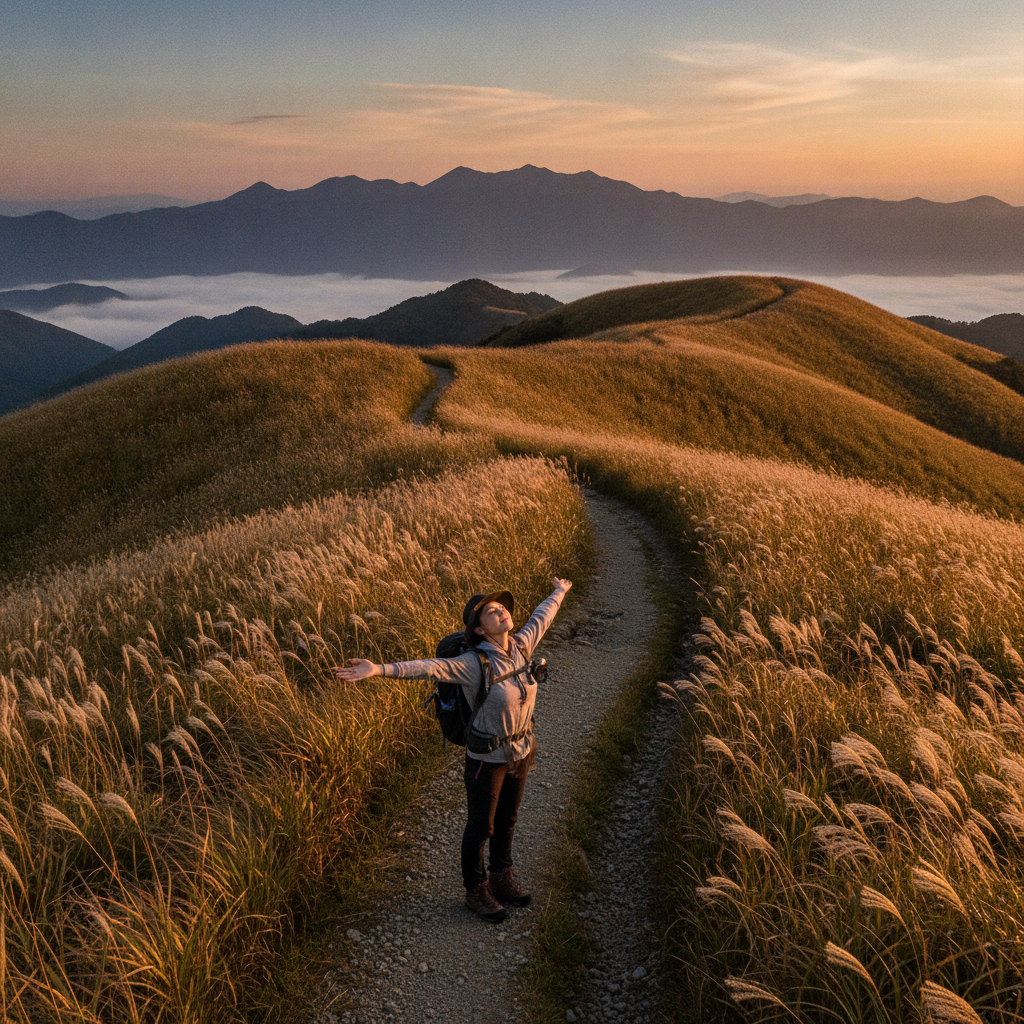
As you near the Soni Highlands, the trees begin to thin, giving way to an expansive, almost surreal landscape. The first glimpse is breathtaking: rolling hills carpeted in a sea of golden pampas grass (susuki), stretching as far as the eye can see. This isn't just a view; it's an immersive experience. The wind, ever-present, whispers through the tall grass, creating mesmerizing waves that shift and dance with the light. The geological features, remnants of ancient volcanic activity, rise majestically from the plateau – notably Mt. Kuroso and the iconic Yoroi-dake and Kabuto-dake peaks, their rugged forms adding a dramatic backdrop to the gentle undulations of the grass. The sheer scale and raw beauty here are profound, a natural masterpiece sculpted by millennia.
3:00 PM – Soni Kogen: A Hiking Immersion
Parking your 86/BRZ, its engine ticking softly as it cools, you step out into an entirely different world. The air is bracingly fresh, carrying the faint, earthy scent of the grasslands. The main hike up Soni Kogen is exhilarating. The well-maintained trails weave through the susuki, which can reach heights well over your head in autumn, creating a golden labyrinth. As you ascend, the panorama expands with every step. You’ll hear the rustle of the grass, the chirping of unseen insects, and the distant call of a hawk circling overhead. The colors are phenomenal: vibrant greens in summer, transitioning to a breathtaking spectrum of gold, amber, and russet in autumn, culminating in a stark, silvery beauty in winter.
The highlight of the hike is reaching the summit viewpoints. From here, the entire Soni plateau unfurls beneath you, a vast, undulating canvas of natural beauty. The distant mountains appear as hazy blue silhouettes against the horizon. The silence is profound, broken only by the elements. This is a place for quiet reflection, for absorbing the immense power and serenity of nature. The geological history of the area, shaped by volcanic eruptions, adds another layer of awe. You can almost feel the ancient forces that sculpted these dramatic landscapes. It’s a physically invigorating and spiritually uplifting experience, a reminder of Japan’s incredible natural diversity beyond its urban centers.
6:00 PM – Twilight Descends: Onsen & Local Delicacies
As the sun begins its descent, casting long, dramatic shadows across the grasslands, you make your way to your accommodation. In the Soni area, options range from charming family-run guesthouses (minshuku) to more traditional ryokan, many boasting their own natural hot springs (onsen). The ideal choice would be a traditional Japanese inn with an open-air bath. Imagine soaking in the mineral-rich waters, the cool evening air on your face, gazing up at the first stars appearing in the deepening twilight sky. The tension from the drive and hike melts away, leaving you feeling utterly relaxed and refreshed.
Dinner is a celebratory affair. You’ll be treated to a multi-course kaiseki meal featuring seasonal ingredients sourced from the surrounding mountains and rivers. Think delicate freshwater fish, locally grown vegetables prepared with exquisite care, and perhaps some lean, flavorful local beef or wild boar (inoshishi), a specialty of mountainous regions. Each dish is a work of art, a reflection of the region's culinary traditions and its connection to the land. Paired with local sake or a crisp, cold beer, it’s a feast for the senses. As night fully embraces the valley, the sky above Soni Highlands, far from any significant light pollution, transforms into a dazzling tapestry of stars. Stepping outside after dinner, the sheer brilliance of the Milky Way arching overhead is a spectacle rarely seen, a humbling and magical end to an extraordinary day.
Day 2: Serene Valleys, Scenic Drives & The Return Journey
8:00 AM – Morning Mists and Mountain Air
The crisp mountain air greets you as you awaken. Perhaps a final, rejuvenating dip in the onsen before a traditional Japanese breakfast of grilled fish, rice, miso soup, and pickled vegetables. The 86/BRZ, parked patiently, seems to beckon, ready for another day of exploration. The morning light paints the landscape in soft, ethereal hues, mist often clinging to the highest peaks, creating an almost mythical atmosphere. The engine awakens with a familiar growl, the smell of petrol and fresh mountain air mingling, a perfect start to the day.
9:30 AM – Waterfalls & Forest Paths: The Akame 48 Waterfalls (Optional, but Highly Recommended)
While slightly off the immediate Soni area, the Akame 48 Waterfalls (赤目四十八滝) are a worthwhile detour, offering a different kind of natural spectacle and a fantastic driving route. The journey there involves more delightful winding roads, traversing valleys and crossing small rivers. The 86/BRZ makes light work of the tight corners and elevation changes, providing a truly engaging drive.
Akame itself is a national park renowned for its series of beautiful waterfalls nestled deep within a lush, ancient forest. Legend says ninja once trained here, and indeed, the ethereal atmosphere feels ripe for such tales. A well-maintained hiking trail follows the river, leading you past numerous waterfalls, each with its own unique charm and name. The sound of rushing water is constant, a symphony of nature that cleanses the mind. Moss-covered rocks, towering trees, and the occasional glimpse of a giant salamander (Akame is famous for them) create a magical, almost primeval setting. It’s a refreshing change from the open grasslands of Soni, offering a dense, immersive forest experience that highlights another facet of Nara's natural beauty. The crisp, clean air and the scent of damp earth and verdant foliage are invigorating.
1:00 PM – Lunch in a Hidden Hamlet: Taste of Tradition
After the invigorating hike at Akame, you’ll be ready for another authentic culinary experience. Heading back towards the main route, seek out a small village known for its local specialties. This might be a place offering kuzukiri (arrowroot noodles), a refreshing, translucent delicacy, or perhaps a rustic restaurant serving game meat stewed with local vegetables. The emphasis is always on fresh, seasonal ingredients, prepared with a simplicity that allows the natural flavors to shine. These hidden spots, often frequented only by locals, offer a genuine insight into rural Japanese life and cuisine, a reward for the adventurous spirit behind the wheel of your 86/BRZ.
2:30 PM – The Scenic Route Home: Nara's Pastoral Heart
The journey back towards Osaka isn't merely a return; it's an opportunity to experience more of Nara's captivating rural landscapes. Instead of simply retracing your steps, choose a different route that takes you through the heart of the prefecture's pastoral beauty. Imagine long, sweeping curves that follow the contours of river valleys, flanked by meticulously cultivated terraced rice fields. Small, unassuming shrines and temples dot the landscape, ancient guardians of the land, their weathered roofs peeking through groves of cypress and bamboo. You'll pass through tranquil farming communities, where life seems to move at a slower, more deliberate pace.
The 86/BRZ, having proven its mettle on the tight mountain passes, now showcases its comfortable cruising capabilities. The engine purrs contentedly, a rhythmic background to the unfolding scenery. The changing light of the afternoon paints the landscape in softer, golden tones. You might spot farmers tending their fields, their movements a timeless ritual. This leg of the journey is about soaking in the everyday beauty of rural Japan, a gentle contrast to the dramatic landscapes of Soni and Akame. It’s a chance to reflect on the diverse beauty you’ve witnessed, all made possible by the freedom of having your own JDM car.
4:30 PM – A Final Glimpse: A Viewpoint Over Kansai
As you slowly edge closer to Osaka, consider one final, elevated stop. There are numerous viewpoints on the western edges of the Nara mountains that offer spectacular panoramic vistas overlooking the sprawling Kansai plain. From here, you can often see the faint outlines of Osaka and perhaps even the distant shimmer of Osaka Bay. It’s a poignant moment, a visual recap of your journey from the bustling city into the heart of nature, and now, back again. The scale of Japan, its seamless transition from urban intensity to untouched wilderness, is laid out before you. The setting sun, if your timing is right, will paint the sky in fiery oranges and soft purples, a fittingly dramatic end to your adventure.
6:00 PM – Return to Osaka: Memories and Anticipation
The bright lights of Osaka slowly reappear on the horizon, signaling the end of your extraordinary two-day odyssey. The transition back onto the wider expressways is smooth, but the world feels different. You carry with you not just memories, but a deeper understanding of Japan, forged on its winding roads and etched into your soul by the thrill of driving an 86/BRZ through unparalleled landscapes. The car, your faithful companion, has delivered you back, its engine now quiet, but its spirit lingering. This isn't just a trip; it's a transformation, a revelation of Japan’s secret heart, experienced in the most exhilarating way possible.
Expert Advice & Cultural Nuances
Navigating Japan by car offers a truly unique perspective, but it comes with its own set of cultural nuances and practical insights. As someone who's spent countless hours exploring every corner of this country by road, I can tell you that understanding these subtleties will elevate your trip from good to absolutely unforgettable.
First, let’s talk about the “Michi-no-Eki” or Roadside Stations. Forget everything you know about mundane rest stops. Japanese Michi-no-Eki are cultural hubs, often showcasing the best of local produce, crafts, and cuisine. They’re meticulously clean, often featuring unique regional delicacies that you won't find anywhere else. Look for freshly baked goods, locally grown fruits and vegetables, and artisanal souvenirs. Many have expansive views, unique local specialties (think wild boar meat products in mountain areas, or special types of miso), and clean, modern facilities. They’re a fantastic place to stretch your legs, grab a snack, and immerse yourself in the local flavor. Don't just drive past; stop, explore, and let them surprise you with their charm and offerings.
When it comes to food, my advice is to venture beyond the obvious. While convenience stores offer reliable sustenance, the true culinary gems are found in the smaller, unassuming local eateries. How to spot them? Look for places with a simple fabric curtain (noren) hanging at the entrance, often without extensive English signage. These are typically family-run establishments, where generations have perfected a few dishes. The menus might be entirely in Japanese, but a simple point-and-smile, or a quick Google Translate snapshot, can unlock incredible flavors. These are the places where the ramen broth has simmered for days, the soba noodles are handmade, and the fried chicken (karaage) is crispy perfection. Don't be afraid to try; the warmth and hospitality you'll receive will often be as memorable as the meal itself. Embrace the adventure of dining off the beaten path; it’s where you truly taste Japan.
Driving in Japan itself has its own unwritten rules. While highly organized, there’s a distinct politeness on the road. Always yield to pedestrians, even if they're not explicitly in a crosswalk. When someone lets you merge, a quick flash of your hazard lights is the standard way to say “thank you.” On narrow mountain roads, be mindful of oncoming traffic. Japanese drivers are generally cautious, and speeding is uncommon. Pay attention to the often-dense network of road signs, many of which are bilingual, but some may require quick interpretation. In rural areas, unexpected sharp turns or steep descents are common, making the responsive steering and braking of an 86/BRZ invaluable.
For those exhilarating mountain passes, a word of advice: utilize engine braking. Japan’s mountain roads can be long and winding, and relying solely on your friction brakes can lead to overheating. Downshifting and letting the engine slow the car not only preserves your brakes but also gives you greater control and a more connected driving experience, especially in a manual JDM car. And always be mindful of wildlife, particularly deer or wild boar, which can unexpectedly dart onto the road, especially at dawn or dusk in these natural areas. These small details, from appreciating a Michi-no-Eki to mastering mountain driving techniques, are what transform a simple road trip into a profound immersion into Japanese culture and landscape.
Detailed Logistics & Pre-Trip Tips
Venturing into the heart of Japan’s natural wonders with an 86/BRZ is an experience of a lifetime, but meticulous preparation is key. As of 2026, Japan’s traffic infrastructure remains among the best in the world, combining cutting-edge technology with traditional road networks. Here’s what you need to know to ensure a smooth, exhilarating drive.
One of the most crucial elements for efficient driving in Japan is the ETC (Electronic Toll Collection) card. Japanese expressways are tolled, and while you can pay with cash at manned booths, an ETC card dramatically speeds up your journey. Most rental companies offer ETC cards as an add-on, often with a flat rental fee or a pay-per-use system. When you approach an ETC gate, simply slow down and drive through; the sensor automatically reads the card and deducts the toll. It saves time, avoids fumbling for cash, and keeps the flow of traffic smooth. Ensure your rental car comes equipped with one; it's a game-changer for long-distance travel.
Refueling your JDM machine is another unique experience. Japanese gas stations are incredibly efficient and often full-service, especially outside major cities. When you pull up, an attendant will typically greet you. Here are a few essential phrases: for regular unleaded gasoline, say “Regyuraa, mantan onegai shimasu” (Regular, full tank please). For premium (high-octane) gasoline, which your 86/BRZ might prefer, it’s “Haioku, mantan onegai shimasu” (High-octane, full tank please). “Mantan” means full tank. If you need a specific amount, like ¥3,000 worth, you’d say “San-zen-en onegai shimasu.” The attendants are usually very friendly and will even clean your windows. Some stations are self-service (セルフサービス, serufu saabisu), where you operate the pump yourself, typically paying at a machine beforehand. They are usually well-marked with instructions, often with English options.
Parking in Japan, particularly in smaller towns and at popular natural sites, requires a bit of finesse. While Michi-no-Eki and major tourist destinations have ample parking, smaller attractions or local eateries might have limited spots. Always look for designated parking areas. Coin parking lots (コインパーキング) are abundant in urban fringes and even in some rural towns; they are self-service, requiring you to pay at a central machine before exiting. In scenic areas like Soni Highlands, follow signs to visitor parking. Never park illegally on narrow roads or in front of private residences; it's not only disrespectful but also can lead to fines or towing. The compact size and maneuverability of an 86/BRZ can be a huge advantage here, allowing you to slip into tighter spots that larger vehicles might struggle with.
And finally, the sheer exhilaration of driving a JDM manual transmission car like the 86/BRZ in Japan. This isn't just about getting from A to B; it's about the journey itself. The precise short-throw shifter, the perfectly weighted clutch pedal, the direct feedback from the road through the steering wheel – it all connects you intimately with the machine and the environment. Feeling the Boxer engine rev freely, executing a perfect heel-toe downshift before carving through a mountain pass, hearing the exhaust note echo through the valleys – these are the moments that truly define a JDM driving adventure. It's a symphony of mechanical precision and driver skill, transforming every winding road into a personal racetrack, every gear change into an act of pure joy. This is why you seek out a JDM for this trip; it's designed for these roads, designed for this thrill.
Comprehensive FAQ
Planning a driving trip to Japan often raises a host of questions, especially for first-time visitors. Here’s a comprehensive FAQ to address your concerns and ensure you’re fully prepared for your JDM adventure:
Q: What documents do I need to drive in Japan?
A: To drive legally in Japan, you will need an International Driving Permit (IDP) issued under the 1949 Geneva Convention. This must be presented along with your valid domestic driving license from your home country and your passport. Ensure your IDP is issued by an authorized organization in your home country (e.g., AAA in the US, AA in the UK). It's crucial to carry all three documents at all times. Please note that an IDP is typically valid for one year from its issue date.
Q: What about car insurance?
A: All rental cars in Japan come with mandatory basic liability insurance. However, for complete peace of mind, it is highly recommended to opt for additional comprehensive coverage. This usually covers damage to the rental car itself, often with a deductible (menjyo). Clarify what is included and what optional extras are available for roadside assistance or personal injury coverage when you book your vehicle.
Q: I’m not confident driving a manual transmission (MT) car. Should I still rent an 86/BRZ?
A: While the 86/BRZ is an exceptional MT experience, if you're truly uncomfortable, many rental options are available in automatic transmission (AT). However, if you're open to the challenge, Japan's well-maintained roads and generally polite traffic can be an excellent place to hone your MT skills. Start slow, practice in less congested areas, and let the car's forgiving nature help you. The connection you'll feel with the road and the car in an MT is unparalleled for this type of scenic, winding drive.
Q: What are the winter road conditions like in the Soni Highlands area?
A: The Soni Highlands and surrounding mountainous areas of Nara can experience significant snowfall during winter months (typically December to March). Roads can become icy or snow-covered. If you plan to visit during this period, it is absolutely essential to request a car equipped with winter tires (スタッドレスタイヤ, studless tires). In extreme conditions, snow chains (タイヤチェーン, tire chains) might be necessary for certain passes. Always check weather forecasts before heading into the mountains during winter, and consult with your rental provider about appropriate tire equipment.
Q: How can I navigate effectively without speaking Japanese?
A: Modern rental cars in Japan typically come with a GPS navigation system, often with English language options. Inputting phone numbers or map codes (usually provided by attractions) is a common and accurate way to set destinations. Additionally, having a reliable smartphone with a data plan and using apps like Google Maps or Apple Maps is highly recommended. These provide real-time traffic updates and often work seamlessly with voice guidance in English.
The Final Call: Your JDM Adventure Awaits
You’ve seen the photos, read the guides, but nothing truly prepares you for the visceral thrill of Japan’s untouched landscapes. The Soni Highlands, with their golden grasslands and dramatic volcanic peaks, await your exploration. The ancient whispers of Muroji Temple, the serene beauty of the Akame Waterfalls, and the exquisite flavors of rural Japan are there to be discovered, not from a train window, but from behind the wheel.
This isn't just a vacation; it's a pilgrimage for the soul, a journey where every winding road is an invitation, every mountain pass a challenge met with exhilaration. To truly unlock the secrets of Nara’s nature, to feel the wind in your hair and the purr of a finely tuned engine beneath you, demands a vehicle that matches your adventurous spirit. An 86 or BRZ isn't just a car; it's your key to an unparalleled, intimate experience of Japan, a machine engineered for the very roads you’re dreaming of.
Ready to carve your own unforgettable path through Japan's hidden gems, feeling every nuance of the road beneath you in a meticulously maintained JDM machine? Whether it's the precise handling of an 86 or the spirited drive of a BRZ, the key to unlocking this extraordinary journey awaits. Visit Omororen Car Osaka Central Store today and let us equip you with the perfect companion for your ultimate Japanese driving adventure. Your 86 or BRZ is waiting to transport you beyond the ordinary, into the heart of Japan's driving paradise.
