
Japan. The name alone conjures images of ancient temples shrouded in mist, neon-lit cityscapes, and the serene beauty of cherry blossoms. For many, the quintessential Japanese experience is meticulously planned, train by bullet train, on a Japan Rail Pass. I know this better than most; as a former Kintetsu conductor, I spent years traversing these very landscapes from the polished confines of a train carriage. I've seen countless vistas flash by, efficient and predictable, like perfectly timed clockwork. And yes, Japan's rail network is a marvel of engineering, a testament to precision and punctuality.
But let me tell you a secret, a profound truth whispered only by the wind through the mountains and the rumble of a finely-tuned engine: the train is merely a window. It offers a glimpse, a carefully curated postcard view. It is not an immersion. To truly feel the pulse of this ancient land, to breathe its hidden air, to discover the 'Secret Japan' that eludes the guidebooks and packaged tours, you must take the wheel. You must drive.
Driving in Japan, especially from a vibrant hub like Osaka, is an act of liberation. It's the freedom to chase a distant mountain peak, to detour down an unmarked lane that promises an unknown treasure, to pause at a local michi-no-eki and taste a snack made nowhere else on Earth. Public transport, for all its undeniable efficiency, herds you along predefined tracks, dictating your pace and your destination. A car, however, is a canvas for your own adventure. It's the difference between observing a painting from a rope line and stepping into the masterpiece itself, feeling the brushstrokes, inhaling the very essence of the artist's vision.
And when that car is a true Japanese Domestic Market (JDM) legend – a Subaru BRZ, perhaps, or a Toyota 86 – the experience transcends mere travel. It becomes a symphony of man and machine against a backdrop of breathtaking beauty. The precise handling, the crisp shifts of a manual transmission, the intoxicating growl of the Boxer engine echoing through winding mountain passes… this is not just transport. This is a visceral connection to the spirit of Japan, an adventure that demands engagement, focus, and a willingness to explore beyond the well-trodden path. It is about understanding that some of Japan's most profound cultural treasures, its most exquisite local sake breweries, and its most captivating natural wonders, lie nestled in valleys and perched on hillsides, accessible only to those bold enough to forge their own path, one gear shift at a time.
Nara Sake, Local Sake, Brewery Tours, Sake Tasting - The 2-Day Itinerary: Deep Dive
Prepare yourself, adventurer. We are about to embark on a pilgrimage not to ancient temples, but to the very soul of Nara's liquid legacy: its sake. This isn't just a trip; it's an awakening of the senses, a journey where every mile driven in your Toyota 86 or Subaru BRZ brings you closer to understanding the profound artistry of Japanese brewing. This is a two-day odyssey from the bustling streets of Osaka into the tranquil, emerald heart of Nara Prefecture, a region often hailed as the birthplace of refined sake. Forget the usual tourist traps; we're diving deep, hour by hour, into the 'Secret Japan' that only a JDM car can unlock.
Day 1: Osaka to Nara's Sacred Sake Heartland
7:00 AM - 8:00 AM: The Awakening of the Beast in Osaka's Dawn
The urban pulse of Osaka is beginning to quicken, but our mission calls for an earlier rise. The morning air, still cool and crisp, promises a day of exhilarating exploration. You approach your chosen chariot – a gleaming Toyota 86, its lines hinting at the performance contained within. The key turns, and with a confident rumble, the Boxer engine awakens. It's not a roar, but a purposeful, deep growl, a promise of the journey ahead. The cabin of the 86, snug and driver-focused, feels like an extension of your own will. As you navigate the early morning streets, the precise weight of the steering wheel in your hands, the smooth engagement of the clutch, and the short, crisp throw of the manual shifter are a prelude to the symphony of the road that awaits. This isn't just a car; it's a partner.
8:00 AM - 9:30 AM: Carving a Path Through Kansai's Veins
We depart Osaka, the skyscrapers gradually receding in the rearview mirror, replaced by the more subdued, yet no less vibrant, greens of the Kansai countryside. The initial highway stretch, while efficient, allows you to become one with the 86. Feel its responsiveness, its eagerness to accelerate. The suspension, firm yet compliant, communicates every nuance of the tarmac. Soon, the highway gives way to more nuanced roads, transitioning from multi-lane arteries to two-lane routes that begin to weave and undulate with the natural contours of the land. The landscape starts to shift: neatly cultivated rice paddies, shimmering like emerald mirrors in the morning light, give way to low, tree-covered hills that hint at the mountainous terrain beyond. It's a gentle yet undeniable transition from the metropolitan to the rural, a sensory detox for the soul.
9:30 AM - 11:30 AM: The Scent of Fermentation and Ancient Craft
As we delve deeper into the heart of Nara, the air subtly changes. There's a faint, sweet, yeasty aroma, a tell-tale sign that we are approaching our destination: the heart of sake production. Nara, geographically blessed with pristine underground water sources filtering through ancient geological strata and a climate ideal for rice cultivation, boasts a heritage of sake brewing that predates much of Japan's recorded history. In fact, many scholars credit Nara as the birthplace of modern refined sake, where brewing techniques were honed in monastic settings centuries ago. The roads now become narrower, winding through small, timeless villages where traditional wooden houses stand shoulder-to-shoulder with structures that, to the untrained eye, might seem like ordinary warehouses. But these are not just buildings; they are living shrines to an age-old craft. The 86 feels perfectly at home on these intimate roads, its compact size and agile chassis making light work of tight corners and sudden elevation changes. The engine note, a harmonious blend of mechanical precision and raw power, sings softly as you downshift, heel-toe blip, and glide through the turns, a dance between driver and machine that feels exquisitely Japanese.
Our first stop is an unassuming brewery, its exterior weathered by generations, its interior a testament to tradition. Inside, the atmosphere is a blend of industry and sanctity. The air is thick with the sweet, intoxicating scent of fermenting rice and yeast, a living aroma that tells a story of transformation. Wooden vats, polished smooth by time and diligent hands, stand sentinel. You might witness the delicate process of rice steaming, the grains glistening like pearls before they are cooled and inoculated with koji mold. The master brewer, or toji, a figure of quiet wisdom and profound dedication, moves with a practiced grace, his eyes constantly scanning, his hands delicately touching the raw materials. He is not just making alcohol; he is coaxing a spirit from rice and water, guided by intuition and inherited knowledge. This is not a rushed factory tour; it's an intimate glimpse into a slow, patient art form. The cold, clear water, drawn from deep underground, is the lifeblood of this sake, imparting a distinctive character that speaks of Nara's geological soul.
11:30 AM - 1:00 PM: Sensory Immersion and Liquid History
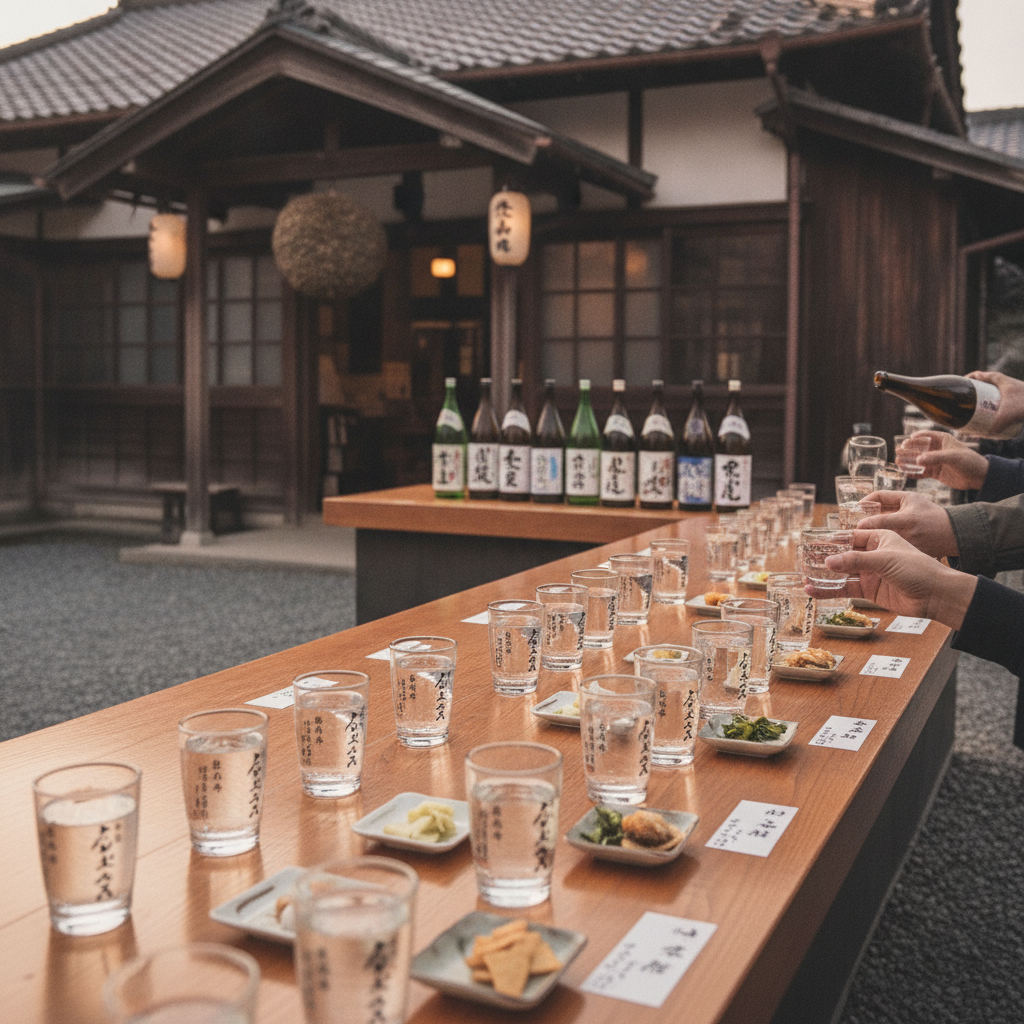
Following the visual and olfactory feast of the brewery, it's time to engage the palate. While driving prohibits direct indulgence for the driver, a designated passenger can begin their exploration, or the driver can appreciate the complex aromas and nuances in small, non-alcoholic samples (if offered). The brewery's shop, usually housed in a charmingly rustic building, offers an array of their finest creations. Here, the sheer diversity of sake becomes apparent – from crisp, dry junmai daiginjo with its delicate floral notes to richer, more robust honjozo. Each bottle, meticulously crafted, tells a story of the rice varietal, the yeast strain, the water, and the unique hand of the toji. This is where the term 'local sake' (jizake) truly comes alive; these are not mass-produced beverages, but expressions of a specific place, a specific season, and a specific philosophy. The feeling of holding a freshly bottled sake, still cool from the cellar, is one of profound connection to the land and its people.
1:00 PM - 2:30 PM: A Taste of Nara's Culinary Soul
Our stomachs rumble in harmony with the gentle purr of the 86. Lunch calls, and we seek out a local, unassuming eatery, the kind you'd never find without the freedom of your own vehicle. These are often small, family-run establishments, their exteriors modest, their interiors exuding a warm, welcoming charm. The food served here is not about haute cuisine; it's about honest, regional flavors, prepared with love and generations of tradition. Imagine a simple yet exquisitely balanced meal: perhaps a bowl of fragrant soba noodles, made from buckwheat flour harvested nearby, accompanied by tempura of seasonal vegetables, impossibly light and crisp. Or perhaps a set meal featuring local Nara specialties, like tender, simmered venison (a nod to Nara's deer population, though not necessarily from the park itself!) or vegetables prepared in a subtly sweet and savory broth. The rice, fluffy and perfectly cooked, is a stark reminder of the same grain that becomes sake. The flavors are clean, profound, and deeply satisfying, offering a true taste of Nara's bounty. For the passenger, a small glass of the local sake, served gently warmed, might accompany the meal, its nuanced flavors blossoming alongside the local fare. The driver, meanwhile, enjoys the aroma and the pure, refreshing taste of locally sourced water.
2:30 PM - 5:00 PM: Winding Roads, Hidden Vistas, and the Joy of Driving
With appetites sated, it's time to truly stretch the legs of our 86 and discover more of Nara's hidden beauty. This afternoon is dedicated to the sheer joy of driving, to navigating the intricate network of mountain roads that crisscross the prefecture. We choose a route less traveled, a series of winding passes that climb gently through forests of cedar and cypress. The road surface is typically impeccable, a testament to Japanese engineering, allowing the 86 to truly shine. Each corner is an invitation, a perfectly sculpted arc that the car takes with sublime balance and feedback. The engine, responsive and eager, revs willingly, and the feeling of precise control as you downshift, aim for the apex, and power out is exhilarating. This is what JDM driving is all about – a dance of weight transfer, grip, and engine note, all harmonizing against a backdrop of breathtaking scenery. Sunlight filters through the dense canopy, dappling the asphalt in shifting patterns of light and shadow. We might pause at an unexpected overlook, a small pull-off where the trees part to reveal a panoramic vista of emerald valleys stretching to distant, hazy mountains. The air here is cool, clean, and carries the scent of pine and damp earth. It’s a moment of profound tranquility, punctuated only by the gentle ticking of the cooling engine. Further along, a small, ancient shrine, almost swallowed by the forest, might appear. These are the spontaneous discoveries, the 'Secret Japan' moments that public transport can never offer.
5:00 PM - 6:00 PM: Retreat to a Traditional Haven
As the sun begins its graceful descent, painting the sky in hues of orange and soft pink, we make our way to our accommodation: a traditional Japanese ryokan or minshuku nestled deep within the countryside. These aren't hotels; they are sanctuaries of peace and cultural immersion. The architecture itself, often crafted from dark wood and paper screens, feels timeless, a direct link to a bygone era. The welcome is warm, genuine, a testament to Japanese hospitality. Slipping off your shoes at the entrance, you step onto cool tatami mats, the scent of straw and polished wood filling the air. Your room, minimalist yet utterly comfortable, offers a sense of profound calm. The sliding doors might open to a private garden or a view of rolling hills, a perfect counterpoint to the day's exhilarating drive. The quietude here is absolute, broken only by the chirping of cicadas or the distant croak of a frog – a stark contrast to the urban symphony of Osaka, a mere hours' drive away. This remote location, chosen for its tranquility and authenticity, is another gift of your automotive independence.
6:00 PM - 9:00 PM: The Art of Evening Sake Tasting and Kaiseki Dinner
The evening at the ryokan is where the day's journey truly culminates. After a refreshing soak in the communal hot spring bath (onsen), soothing tired muscles and cleansing the spirit, it's time for dinner. This is not merely a meal; it's a kaiseki experience, a multi-course culinary journey that is as much art as it is sustenance. Each dish, meticulously prepared and exquisitely presented, is a tiny masterpiece, reflecting the season and the local bounty. Fresh river fish, delicate tempura, perfectly sliced sashimi, and vibrant pickled vegetables appear in a graceful procession. And now, for the passenger, or for both of you to truly appreciate the depth of Nara's liquid gold without the concern of driving: the sake tasting. Your hosts will likely offer a selection of local sake, perhaps even some from the very breweries you visited. This is your chance to compare, contrast, and truly understand the subtle variations. Taste the crispness of a junmai ginjo, the fruitiness of a daiginjo, the earthiness of an unfiltered nigori. Notice how different sakes pair with different dishes, enhancing the flavors of the seasonal ingredients. The conversations flow as freely as the sake, illuminated by the soft glow of traditional lanterns. The absence of city noise, the feeling of being utterly removed from the hustle, and the profound satisfaction of truly experiencing local culture make this an unforgettable evening. You raise a small ceramic cup, toast to the day's adventure, and savor the rich, complex flavors of Nara's soul.
Day 2: Deeper into Nara's Liquid History & The Thrilling Return
7:00 AM - 9:00 AM: Sunrise Serenity and Traditional Breakfast
Awakening in a traditional Japanese room is a gentle affair. The first light of dawn filters through the shoji screens, casting soft patterns on the tatami floor. A quiet stroll in the ryokan's garden, perhaps by a koi pond, offers a moment of reflection and serenity. The air is fresh, perhaps still carrying the scent of morning dew on the surrounding forests. Breakfast, another carefully curated meal, typically consists of grilled fish, miso soup, steamed rice, various pickled vegetables, and a soft-boiled egg. It's a nourishing and traditional start to the day, light yet satisfying, preparing you for another day of exploration and driving. The tranquility of the morning reinforces the profound value of having escaped the urban sprawl, a privilege afforded by the freedom of your own vehicle.
9:00 AM - 12:00 PM: The Science and Soul of Sake: A Different Perspective
After checking out, we set off in the 86, the engine purring contentedly, ready for more adventure. Today, we visit another brewery, but one that offers a slightly different perspective. Perhaps it's a more modern facility, showcasing innovative techniques and environmentally conscious brewing practices, or one that specializes in a particularly rare rice varietal, cultivated only in specific Nara fields. Here, you might delve deeper into the scientific precision involved: the careful monitoring of temperature during fermentation, the importance of specific yeast strains in creating different flavor profiles, and the meticulous polishing ratios of the rice grains. You learn about the concept of shinpaku, the starchy white core of the rice grain, and how precise milling removes the outer layers to prevent off-flavors. The passion of the brewers, whether in an ancient wooden structure or a gleaming modern facility, remains constant. They speak of the rice as having a personality, of the water as a unique fingerprint, and of the fermentation process as a living, breathing entity that must be nurtured and guided. The art of kiki-zake (sake tasting) takes on a new dimension here, as you learn to identify specific aromas – apple, pear, banana, earthy mushroom – and textures on the palate. Even as the driver, smelling the nuanced aromas and observing the clarity of the sake from a safe distance deepens your appreciation for this complex beverage. This immersive experience deepens your understanding of why Nara's sake is so revered, its history woven into the very fabric of the land.
12:00 PM - 1:30 PM: Lunch at a Local Specialty Restaurant
For our final Nara lunch, we seek out a restaurant known for a particular local specialty. Perhaps it's a place famed for its kakinoha-zushi, small sushi pieces wrapped in persimmon leaves, a traditional Nara preserved food that speaks of the region's ancient culinary heritage. The subtle flavor imparted by the leaf, combined with cured fish and seasoned rice, is a delicate delight. Or maybe a restaurant celebrating yamato-gyu, the local brand of Wagyu beef, served as a simple steak or in a hot pot, showcasing its exquisite marbling and tenderness. These are the tastes that are intrinsically linked to Nara, flavors you won't easily find elsewhere, and a perfect way to savor the final culinary moments of our journey into the region. Again, the passenger might enjoy a carefully chosen local sake pairing, while the driver focuses on the fresh, pure flavors of the food and local tea, appreciating the overall experience.
1:30 PM - 4:00 PM: The Thrill of the Return – Mountain Passes and JDM Performance
The time has come to begin our journey back towards Osaka, but we're not taking the direct route. Our Toyota 86 yearns for one last dance, and we'll grant it on a different, perhaps even more exhilarating, mountain pass. This route is known for its tighter corners, more dramatic elevation changes, and breathtaking vistas that demand your full attention. The sun, now higher in the sky, bathes the winding road in a golden light, highlighting every curve and dip. This is where the 86 truly comes alive. The precise steering, offering direct feedback from the road, allows you to place the car exactly where you want it. The manual gearbox becomes an extension of your arm, each perfectly timed shift delivering power smoothly and efficiently. The balance of the chassis, the low center of gravity, and the rear-wheel-drive dynamics make every corner an engaging challenge, a conversation between you and the machine. You feel the g-forces, the subtle movements of the car, and the exhilarating surge of acceleration out of each turn. This isn't reckless speed; it's precision driving, a celebration of automotive engineering and skill. We stop at a final, spectacular overlook, perched high above a vast valley. Below, the patchwork of fields and villages stretches out, eventually giving way to the hazy outline of the Kansai plains and, in the far distance, the emerging skyline of Osaka. It’s a moment to truly appreciate the scale of your journey, the distance covered, and the incredible, diverse landscapes you've traversed – all thanks to the freedom of the open road and the spirit of your JDM companion.
4:00 PM - 5:00 PM: The Gradual Descent and Sense of Accomplishment
The exhilarating mountain passes eventually give way to smoother, broader roads as we begin our gradual descent back towards civilization. The transition is subtle at first, the occasional house appearing, then small clusters of shops, before the familiar signs of urban sprawl begin to emerge. The driving shifts from an active, engaging dance to a more relaxed cruise. The rhythmic hum of the engine becomes a comforting soundtrack, a testament to miles well-traveled. As you approach the outer edges of Osaka, the traffic thickens, the pace slows, but the sense of accomplishment remains. You haven't just driven to Nara; you've experienced it, intimately, passionately, and on your own terms. The contrast between the tranquil, sake-infused countryside and the bustling, vibrant city is stark, yet deeply satisfying. You've uncovered 'Secret Japan,' not by following a crowd, but by forging your own path.
Nara Sake, Local Sake, Brewery Tours, Sake Tasting - Expert Advice & Cultural Nuances

Driving in Japan is an adventure unlike any other, and to truly unlock its potential, especially when venturing into the hidden corners of Nara, a few insider tips and cultural insights will prove invaluable. Think of these as the subtle nuances, the unspoken rules that elevate your journey from a mere road trip to a profound cultural immersion.
The Unsung Heroes: Michi-no-Eki (Roadside Stations)
Forget the soulless rest stops you might be accustomed to. Japan's Michi-no-Eki are vibrant cultural hubs, vital arteries of local life. As a former train conductor who's spent countless hours driving Japan's highways and byways, I can tell you these are more than just places to refuel or use the restroom. Each Michi-no-Eki is a miniature marketplace, a proud showcase of its surrounding region. You’ll find an astonishing array of local produce – often fresher and cheaper than in city supermarkets – handcrafted souvenirs, regional delicacies, and unique snacks that are literally impossible to find anywhere else. Imagine discovering a small batch of sake-infused ice cream, or a bag of locally grown sweet potatoes, still warm from the oven. Many even boast small museums, observation decks, or even hot springs. Stop at every one that piques your interest. They are windows into the soul of rural Japan, offering genuine local interaction and a chance to truly taste the terroir of the land you're driving through. Look for the distinct green sign with a white road symbol – a beacon of local flavor and authentic experiences.
Unearthing Hidden Gems: The Art of Discovery
The beauty of driving your 86 or BRZ is the freedom to stray from the predetermined path. To find those truly hidden gems – the tiny, family-run ramen shop with only four seats, the ancient, moss-covered shrine tucked away behind a bamboo grove, or the serene, overlooked viewpoint – requires a discerning eye and a willingness to trust your instincts. Look for small, hand-painted signs (even if you can't read Japanese, a distinctive graphic can draw you in). Observe where local cars are parked in abundance, especially during lunch hours – that's a sure sign of a good, unpretentious eatery. Engage with people at the Michi-no-Eki; a simple nod and a smile can sometimes lead to a local recommending a spot that isn't in any guidebook. These are the moments that truly define 'Secret Japan' – not a pre-packaged experience, but a personal discovery, hard-won and deeply rewarding.
Driving Etiquette & Safety on Japan's Roads
While Japanese roads are generally well-maintained and signs are often in both Japanese and English, a few pointers will enhance your driving experience:
- Left-Hand Traffic: Japan drives on the left. If you're accustomed to driving on the right, give yourself extra time to adjust, especially at intersections and roundabouts.
- Speed Limits: Strict. Adherence is crucial. Most urban roads are 40 km/h, national roads 50-60 km/h, and expressways 80-100 km/h. Don't be tempted to push your 86 too hard on public roads; save the spirited driving for mountain passes with clear visibility and no traffic.
- Politeness Reigns: Japanese drivers are generally courteous and patient. Aggressive driving is rare and frowned upon. Always yield, signal clearly, and maintain a safe following distance.
- Narrow Roads: In rural areas, many roads, particularly those leading to hidden breweries or scenic spots, can be surprisingly narrow. Be prepared to slow down, and if necessary, pull over to let oncoming traffic pass. Your compact 86 is perfect for these situations.
- Headlights: Even on bright days, it's customary (and often required) to use headlights when entering tunnels, which are abundant in mountainous regions.
- Drinking and Driving: ABSOLUTELY FORBIDDEN. This cannot be stressed enough. Japan has zero tolerance. If you're planning on sake tasting, ensure you have a designated driver who abstains completely, or plan an overnight stay at a ryokan where you can indulge responsibly. This itinerary is built around the assumption of a responsible approach to sake appreciation.
By embracing these nuances, you won't just be driving through Japan; you'll be experiencing it with an insider's perspective, appreciating the subtle layers of its rich culture and the thrilling freedom that only a JDM car can provide.
Nara Sake, Local Sake, Brewery Tours, Sake Tasting - Detailed Logistics & Pre-Trip Tips
Mastering the roads of Japan in your JDM machine requires more than just driving skill; it demands a grasp of local logistics. As someone who's not only commanded trains but has also extensively explored Japan by car, often in performance vehicles, I can tell you that a little preparation goes a long way. Let's talk about the practicalities that will make your Nara sake adventure seamless and exhilarating in 2026.
Traffic & Tolls: Navigating Japan's Road Network (2026 Update)
Japan's expressway system is highly efficient, connecting major cities and regions with remarkable speed. However, this convenience comes at a cost – tolls can be high. From Osaka to Nara's more remote sake regions, you'll primarily use expressways, then transition to national and prefectural routes. Urban areas, especially around Osaka, can experience congestion during peak hours (7-9 AM and 5-7 PM), but outside these times, traffic generally flows well. GPS systems are excellent, often integrated into rental cars and frequently updated. They'll guide you flawlessly, even on the most obscure back roads, ensuring you hit every tucked-away brewery.
ETC Card: Your Expressway Fast Pass
An Electronic Toll Collection (ETC) card is not just a convenience; it's practically essential for smooth expressway travel. Imagine cruising past long lines at manual toll booths, the barrier lifting automatically as your car passes through. This is the magic of ETC. The card is linked to a reader in your rental car, deducting tolls automatically. It's not always standard with rentals, so be sure to request an ETC card at the time of booking. It will save you time, hassle, and the need to fumble for change at every tollgate, allowing you to maintain that perfect driving rhythm in your 86 or BRZ.
Gas Stations: The 'Mantan' Moment
Finding gas (gasorin) is rarely an issue, even in rural Nara. Most stations offer two main types of gasoline: Regular (レギュラー, pronounced 'regulaa') and High-Octane (ハイオク, pronounced 'hai-oku'). For your performance-oriented 86 or BRZ, high-octane is recommended for optimal performance, just as you'd use for any sports car. When you pull up, simply say 'Mantan de onegai shimasu' (まんたんでおねがいします), which means 'Please fill it up.' Many rural stations still offer full service, where an attendant will cheerfully pump your gas, clean your windows, and even direct you back onto the road. It’s a delightful, uniquely Japanese interaction. Don't be surprised if they ask if you want 'Regular' or 'High-Octane' – a simple 'Hai-oku' will suffice. Remember to check which side your fuel cap is on before pulling up to the pump, though most attendants are quick to guide you.
Parking Prowess
In cities like Osaka, coin-operated parking lots are ubiquitous. Look for signs with 'P' or 駐車場 (chūshajō). Many operate on a timed basis, with rates clearly displayed. In rural Nara, however, parking is often free at tourist attractions, breweries, and smaller shops. When parking, be mindful of space. Japanese parking spots can be narrower than what you might be used to, but your compact 86 or BRZ handles them with ease. Always park neatly and within the lines – a common courtesy that is highly valued.
The Unmatched Thrill of a JDM (MT) Drive
Driving a manual transmission JDM car like the 86 or BRZ in Japan is not just a mode of transport; it's a profound part of the adventure. It's the tactile connection to the machine, the precise engagement of the clutch, the satisfying click-clack of the shifter through the gates. On those winding Nara roads, it's about perfectly rev-matching your downshifts, feeling the engine brake, and powering out of corners with exhilarating precision. There's an unmatched visceral satisfaction in mastering the manual on these expertly engineered roads, truly feeling every curve and gradient. It transforms the act of driving from a chore into a joyous, engaging dance. This is why you choose a JDM; not just for the destination, but for the journey itself, for the intimate conversation between driver and machine, for the pure, unadulterated thrill of the drive.
Nara Sake, Local Sake, Brewery Tours, Sake Tasting - Comprehensive FAQ
Embarking on a JDM road trip in Japan often brings a few logistical questions to mind. Here are some of the most common queries, comprehensively answered, to ensure your Nara sake and driving adventure is stress-free and spectacular:
Do I need a special license to drive in Japan?
Yes, for an unforgettable drive in Japan, you'll need three key documents to present to your rental company and potentially to authorities if stopped. First, your valid international driving permit issued under the 1949 Geneva Convention. Second, your domestic driver's license from your home country. And third, your passport. It's crucial to check if your country is a signatory to the 1949 Geneva Convention, as permits from other conventions are not valid in Japan. Always carry all three documents with you while driving. Without them, you cannot legally operate a vehicle in Japan.
What about insurance?
Comprehensive insurance is paramount when renting a car in Japan. Reputable rental companies will offer various insurance packages, and it's highly recommended to opt for the fullest coverage possible, including collision damage waiver (CDW) and personal accident insurance (PAI). While Japanese drivers are generally safe and roads are well-maintained, unforeseen circumstances can occur. Understanding your coverage limits and deductibles (excess fees) before you hit the road will provide invaluable peace of mind, allowing you to fully concentrate on the exhilarating drive in your 86 or BRZ.
I'm nervous about driving a manual transmission (MT) car. Should I still get a JDM?
It's completely normal to have some apprehension if you're not accustomed to driving an MT, especially on unfamiliar roads. However, the thrill of driving a JDM like the 86 or BRZ, which are renowned for their forgiving and engaging manual gearboxes, is an experience not to be missed. If you have some basic MT experience, even if it's rusty, these cars are incredibly rewarding to drive. Start slowly, practice in a quiet area if possible, and let the car's precise engineering guide you. The satisfaction of mastering the manual on Japan's scenic routes, feeling that deep connection to the machine, far outweighs any initial anxiety. Many find it reignites their passion for driving. If you're truly inexperienced, consider booking an automatic JDM, but if you have even a little confidence, seize the opportunity for the MT experience – it's part of the legend!
What are winter road conditions like in Nara, especially in the mountains?
While the Kansai region, including much of Nara, generally experiences relatively mild winters compared to northern Japan, mountain passes can indeed see snow and icy conditions, particularly from late December to early March. If you plan a winter trip, it's essential to check weather forecasts for your specific route just before and during your journey. In snowy conditions, specialized winter tires (studless tires) or even snow chains are often mandatory on certain roads. Most rental companies will equip cars with winter tires if you inform them of your winter travel plans for snowy areas. However, for this Nara sake itinerary, which primarily focuses on the lower mountain ranges and valleys, heavy snow is less common, but vigilance is always advised. Prioritize safety and adjust your driving style to the conditions.
Nara Sake, Local Sake, Brewery Tours, Sake Tasting - The Final Call: CTA
You've journeyed through the philosophical heart of Japanese driving, delving deep into a two-day itinerary that promised more than mere sightseeing. You’ve imagined the intoxicating aroma of fermenting rice, felt the sublime precision of a Toyota 86 carving through emerald mountains, and savored the quiet reverence of Nara's ancient sake breweries. This isn't just a trip; it's a sensory symphony, a cultural immersion, and an unforgettable communion with Japan's hidden landscapes and liquid artistry. You've uncovered the 'Secret Japan' that lies beyond the reach of conventional travel, a Japan that whispers its tales not from train windows, but from winding roads and the thrum of a performance engine.
This kind of journey, one etched into your soul with every rev of the engine and every sip of liquid history, demands the right machine. It calls for a JDM legend, a car that speaks the language of the road as fluently as you'll soon speak the language of sake. A precision-engineered 86 or BRZ isn't just a vehicle; it's your key to unlocking those hidden pathways, to experiencing the very essence of the Japanese drive, and to making memories that will resonate long after you've returned home.
That's where a specialist comes in – a place where the love for Japanese automobiles runs as deep as the local sake breweries' history. For a truly authentic JDM experience, for the chance to command a precision-engineered 86 or BRZ and unlock the secret pathways of Nara, look no further than Omoshiro Rent-a-Car Osaka Chuo. We understand the passion, we live the drive, and we're ready to hand you the keys to your next great Japanese adventure. Your legend starts here. Book your journey, ignite your engine, and discover the Japan you never knew existed.
