
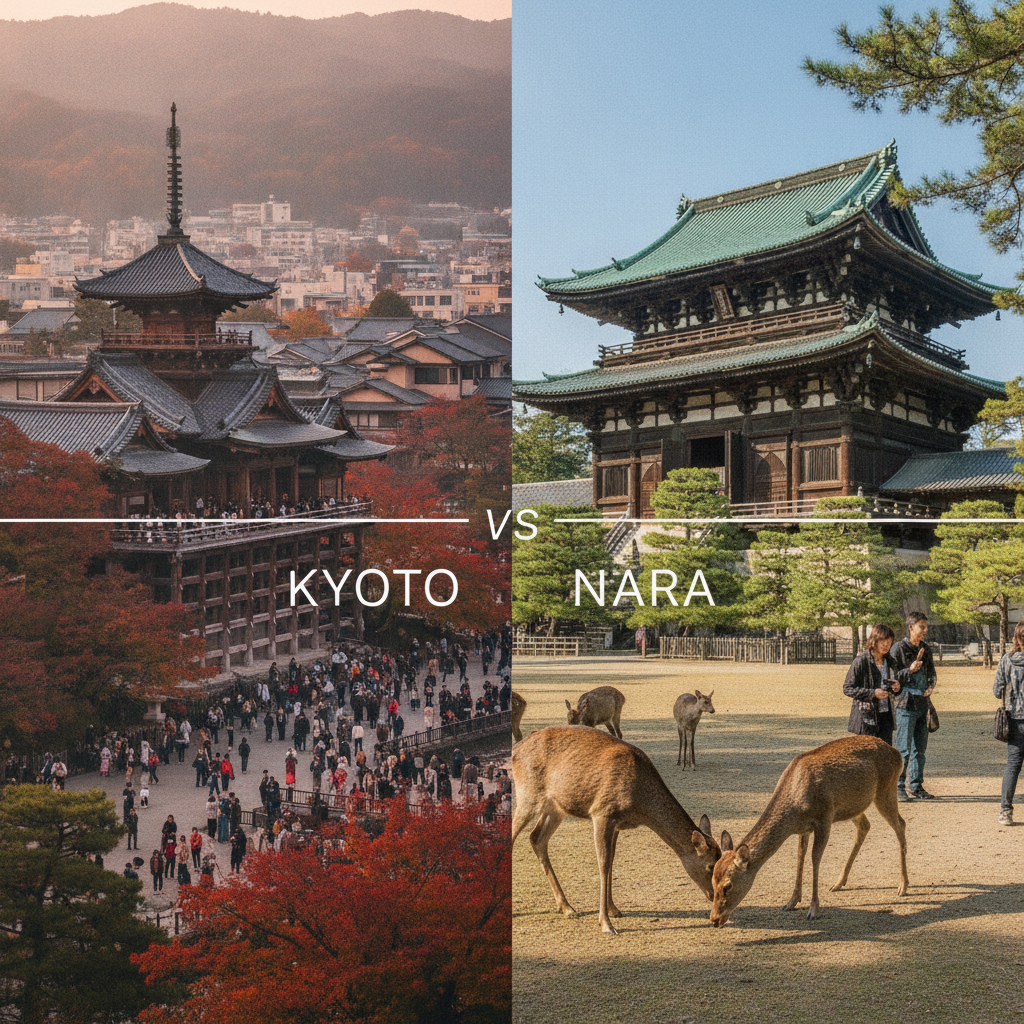
Nara and Kyoto, Kansai Loop, Comparison, Travel Plan - The Philosophy of Driving in Japan
For years, from the polished steel carriage of a Kintetsu train, I saw Japan glide by as a series of perfectly framed postcards. Efficient, reliable, and undeniably beautiful, the railway system is a testament to Japanese precision. But let me tell you, as a former conductor, the tracks, while linking great cities, also serve as an invisible tether, binding you to the well-trodden paths. You see the famous sights, yes, but you don't feel the pulse of the land. You don't breathe in the raw, unfiltered essence of 'Secret Japan.'
To truly unlock Kansai, to peel back its layers of ancient history, vibrant culture, and breathtaking natural beauty, you must embrace the open road. The bullet train whisks you from one major station to the next, a mere blink through the countryside. But a car – a nimble, responsive JDM machine like the Toyota 86 or Subaru BRZ – offers a profoundly different pilgrimage. It transforms you from a passive observer into an active participant, a true explorer.
Consider the allure: the rhythmic thrum of the flat-four engine, a melodic counterpoint to the chirping cicadas. The precise feedback from the steering wheel as you carve through a mountain pass, revealing vistas that no guidebook dares to print. The freedom to chase a fleeting sunset over the Pacific or stumble upon a hidden Shinto shrine nestled deep within a bamboo grove, its moss-covered stones whispering tales of centuries past. These are the moments trains simply cannot deliver. They are the essence of 'Secret Japan' – a Japan found not on a timetable, but on an adventurer's map.
Starting from Osaka, a vibrant metropolis that serves as the perfect launchpad, a car grants you unparalleled access. You're not confined to the tourist hubs; you're empowered to stray. To compare Nara's ancient imperial grandeur with Kyoto's refined aesthetic isn't just about visiting temples; it's about experiencing the nuanced transition between these cultural titans on your own terms. It's about taking the scenic routes, discovering the local culinary secrets tucked away in unassuming towns, and connecting with the landscape on an intimate, visceral level.
This isn't just about convenience; it's about communion. With a JDM legend like the 86 or BRZ, every turn becomes an invitation, every straight a symphony. You're not just driving; you're dancing with the road, your senses alive to every shift in scenery, every change in elevation, every waft of mountain air. It's an automotive poetry, a freedom that transcends mere transportation, offering a deep, resonant connection to the heart of Japan. This is the philosophy that guides our journey, an ode to the unmatched spirit of exploration that only a car can provide.
Nara and Kyoto, Kansai Loop, Comparison, Travel Plan - The 2-Day Itinerary: Deep Dive

Day 1: Unearthing Ancient Spirits and Winding Paths – Osaka to Rural Nara
7:00 AM - 8:00 AM: The Osaka Awakening & The Call of the Open Road
The dawn breaks over Osaka, painting the urban sprawl in hues of rose and gold. There's an electric hum in the air, a precursor to the day's adventure. You've picked up your weapon of choice – the sleek, responsive 86 or BRZ, its flat-four engine a low, eager growl. The seating position is perfect, the manual gearbox a joy to engage. With a deep breath, you guide the car out of the city's waking embrace, the concrete canyons giving way to the promise of open tarmac. The first few kilometers are about familiarization, feeling the perfectly weighted steering, the crisp throttle response. Your senses are already heightened, anticipating the thrill to come.
8:00 AM - 9:00 AM: Expressway Symphony – Osaka to Nara Prefecture
Merging onto the Kinki Expressway, the 86/BRZ stretches its legs. The roar of the engine as you confidently accelerate, the smooth, effortless shifts of the manual transmission, it's a symphony of mechanical precision. Japan's expressways are a marvel of engineering, and even here, there's a certain joy in the efficiency and smoothness. The urban landscape gradually morphs into rolling hills, blanketed in a thousand shades of green. The air, crisp and fresh, filters through the windows, carrying the scent of distant forests. This isn't just travel; it's a pre-meditation, a cleansing of the urban palate before diving into the ancient heart of Japan.
9:00 AM - 11:30 AM: Nara's Majestic Deer & Grandeur of Todai-ji
Exiting the expressway, the roads become a little narrower, more winding, a gentle hint of the fun to come. Soon, you arrive in Nara, the ancient capital. But we're not just here for the ubiquitous deer, charming as they are. Parking the 86/BRZ with an almost playful precision, you step out and are immediately greeted by these graceful, bowing creatures. They are a living testament to Nara's timeless spirit. However, the true marvel awaits at Todai-ji Temple. As you approach the Great Buddha Hall, the sheer scale of this wooden edifice, the largest of its kind in the world, is humbling. Built in the 8th century, it houses a colossal bronze Buddha statue, its serene gaze overlooking generations of visitors. Standing before it, you can almost hear the echoes of ancient prayers, feel the weight of a thousand years of history. The air within the hall is cool, thick with reverence, a stark contrast to the lively bustle outside. The wooden pillars, the intricate carvings, the sheer architectural audacity – it’s a profound experience.
11:30 AM - 1:00 PM: Lunch in Nara & The Yamanobe-no-Michi Approach
After Todai-ji, it's time for a taste of Nara. Rather than tourist traps, seek out a local eatery just off the main drag. Imagine a small, unassuming shop specializing in kakinoha-zushi, sushi wrapped in persimmon leaves. The delicate flavor of the cured fish, subtly infused with the leaf's aroma, is a revelation. Or perhaps a bowl of piping hot miwa somen, thin wheat noodles from the nearby Sakurai region, a light yet satisfying meal perfect for fueling your drive. With your appetite sated, you jump back into the 86/BRZ. Now, for the real driving. Instead of heading straight out, we’ll take a detour onto the legendary Yamanobe-no-Michi, Japan’s oldest road. While much of it is a walking trail, certain sections are drivable, offering glimpses of rustic beauty and a precursor to the winding roads ahead.
1:00 PM - 3:30 PM: Asuka Village – Cradle of Japanese Civilization & Scenic Backroads
Leaving the more crowded parts of Nara, you point the 86/BRZ south towards Asuka. This is where 'Secret Japan' truly begins to unfold. The road becomes a ribbon, winding through verdant valleys and past ancient burial mounds (kofun). The 86/BRZ feels alive here, each corner a dance, the engine singing through the gears. Asuka was the very first capital of Japan, preceding Nara and Kyoto, and it exudes a timeless tranquility. Here, you'll find enigmatic stone carvings, like the Turtle Stone and Masuda-no-Iwafune, whose origins remain shrouded in mystery. You're not fighting crowds; you're exploring history at your own pace. The scenery is pastoral: rice paddies shimmering in the sunlight, traditional farmhouses with dark tiled roofs, and small, forgotten temples clinging to hillsides. The geology of the region, characterized by gentle undulations and ancient volcanic activity, creates a wonderfully varied topography for driving. This is where the car truly shines, taking you deep into the historical heartland, far from any train station.
3:30 PM - 5:30 PM: Yoshino’s Foothills & Uda City’s Mystical Drives
From Asuka, the real mountain driving begins as you delve deeper into the Yoshino region, famed for its cherry blossoms, but equally captivating in any season for its dramatic topography. The roads become tighter, more challenging, ascending and descending through dense cedar and cypress forests. The 86/BRZ is in its element, its agile chassis and communicative steering making every hairpin turn an exhilarating experience. The scent of pine and damp earth fills the cabin. You might find yourself on Route 169 or smaller prefectural roads, carving through tunnels of green, the engine note echoing off the rock faces. This is not about speed; it's about the pure, unadulterated joy of driving. Stop at a scenic overlook, perhaps near Uda City, and gaze upon the misty, rolling hills, a tapestry of greens and grays stretching to the horizon. The silence, broken only by the rustling leaves and the distant hum of your cooling engine, is profound. You are deep in the heart of rural Kansai, where time seems to slow, and ancient spirits linger.
5:30 PM - 7:00 PM: Arrival at the Ryokan & Culinary Delights
As dusk begins to settle, casting long shadows across the valleys, you arrive at your traditional ryokan, perhaps in the Sakurai area or a secluded spot near Uda. The warmth of the inn, the gentle greetings of the staff, and the aroma of traditional Japanese cuisine welcome you. After parking the 86/BRZ, a sense of accomplishment washes over you. You've truly earned this respite. Change into a yukata, and prepare for a kaiseki dinner – a multi-course culinary journey. Each dish, a work of art, uses fresh, local ingredients: delicate river fish, crisp mountain vegetables, perhaps even locally-sourced Yamato beef. The sake flows, warming you from the inside. The flavors are subtle yet complex, a reflection of the region's bounty. You dine overlooking a meticulously maintained Japanese garden, the sounds of nature drifting in, a world away from the urban bustle. This isn't just a meal; it's an immersion into Japanese hospitality and culture, a perfect end to a day of exploration.
7:00 PM onwards: Onsen & Stargazing
After dinner, immerse yourself in the ryokan's onsen (hot spring bath). The steaming, mineral-rich water soothes tired muscles, melting away the miles. Under a sky ablaze with stars, far from city lights, the experience is truly magical. You reflect on the day – the ancient power of Todai-ji, the historical whispers of Asuka, the exhilarating dance with the mountain roads in the 86/BRZ. This is the Japan few tourists ever see, a Japan discovered one winding road at a time.
Day 2: From Tea Plantations to Imperial Grandeur – Rural Nara to Outer Kyoto & Back to Osaka
7:00 AM - 8:00 AM: Sunrise & Traditional Japanese Breakfast
Wake to the gentle rays of the morning sun filtering through your shoji screen. The air is cool and crisp. A traditional Japanese breakfast awaits: grilled fish, miso soup, fluffy rice, and various pickled vegetables. It's a nourishing and healthy start, perfectly preparing you for another day of driving adventure. Savor the delicate flavors, the peaceful atmosphere of the ryokan, knowing that soon, the 86/BRZ awaits to carry you through more of Kansai's hidden gems.
8:00 AM - 10:00 AM: Scenic Drive Towards Uji – Tea Country Twists
With renewed energy, you fire up the 86/BRZ. The engine settles into a familiar idle, a comforting sound. Leaving the ryokan, you head north, aiming for the heart of Japan's tea country, Uji. The route itself is a delight, taking you through prefectural roads (perhaps Route 369 or others that snake through Minamiyamashiro village), renowned for their scenic beauty and engaging curves. These roads are less traveled, allowing you to fully appreciate the communicative chassis of the 86/BRZ. You'll pass through small, charming villages, see farmers tending their fields, and witness the serene beauty of the Japanese countryside. The landscape gradually transitions, with rolling hills giving way to meticulously manicured tea plantations, their vibrant green leaves shimmering in the morning sun. The air takes on a subtle, earthy fragrance of tea, a unique sensory experience. The geology here involves ancient river valleys and fertile plains, perfect for tea cultivation, and these features create a natural flow to the roads, a symphony of sweeping bends and gentle gradients.
10:00 AM - 12:00 PM: Uji – A Taste of Green Tea Culture & Byodo-in
Pulling into Uji, you park the 86/BRZ, ready to immerse yourself in a different kind of ancient beauty. Uji is synonymous with green tea, and you must indulge. Visit a traditional tea house, savoring a bowl of meticulously prepared matcha, its vibrant green color and rich, umami flavor a true delight. Explore the local shops offering every conceivable green tea product, from sweets to soba. But Uji is not just about tea; it's home to the breathtaking Byodo-in Temple, a UNESCO World Heritage site featured on the 10-yen coin. Its stunning Phoenix Hall, seemingly floating on a tranquil pond, is an architectural masterpiece from the Heian period. The colors – the deep vermillion of the building, the emerald green of the water, the azure sky – are almost surreal. Walking through its serene grounds, you feel a profound sense of peace, a perfect counterpoint to the exhilarating drive.
12:00 PM - 1:30 PM: Lunch in Uji & Drive to Outer Kyoto's Hills
For lunch, consider a specialty unique to Uji: chazuke (tea over rice) or even green tea flavored soba, offering a truly local culinary experience. With your appetite satisfied, you once again embrace the driver's seat of the 86/BRZ. Now, you’ll skirt around the bustling heart of Kyoto, heading for its more tranquil, car-accessible periphery. The journey itself is designed to be part of the adventure, showcasing the versatility of your JDM machine. We'll avoid the city center's heavy traffic and narrow streets, focusing on the breathtaking drives that lead to Kyoto's outer sanctuaries.
1:30 PM - 4:00 PM: Mt. Hiei Drive – Panoramic Views & Mystical Temples
Your destination: Mount Hiei. This isn't just a mountain; it's a sacred realm. The drive up the Hieizan Driveway (a toll road, but worth every yen) is a motor enthusiast's dream. The 86/BRZ effortlessly climbs the winding asphalt, each curve a testament to its balanced chassis. The engine note rises and falls with each gear change, a mechanical serenade. As you ascend, the views become increasingly spectacular, offering panoramic vistas of Kyoto, Lake Biwa (Japan's largest freshwater lake), and the surrounding mountain ranges. The air grows cooler, crisper. At the summit lies Enryaku-ji Temple, the head temple of the Tendai sect of Buddhism and another UNESCO site. It's a sprawling complex of ancient halls nestled amidst towering cedars, shrouded in an almost mystical atmosphere. Walking its grounds, you feel the weight of centuries of spiritual devotion. The mist often rolls in, adding to the ethereal quality, making it feel like a journey into a different time. This drive and exploration offer an unparalleled perspective of Kyoto, far removed from the throngs of tourists below.
4:00 PM - 6:00 PM: Scenic Descent & Return Towards Osaka
The descent from Mt. Hiei in the 86/BRZ is equally thrilling, requiring precise braking and smooth cornering, a true test of driver and machine. As you carve your way down, the city of Kyoto slowly reveals itself once more. Instead of lingering, we take a different route back, perhaps via the Meishin Expressway, enjoying the high-speed stretches. This leg of the journey offers a chance to reflect on the contrast between Nara's raw, ancient power and Kyoto's refined elegance, all experienced through the lens of the open road. The 86/BRZ devours the kilometers, feeling planted and secure, a testament to its engineering.
6:00 PM - 7:00 PM: Sunset Drive & Arrival in Osaka
As you approach Osaka, the setting sun casts a warm, golden glow across the cityscape. The sky transforms into a canvas of fiery oranges, deep purples, and soft pinks. The urban sprawl begins to emerge, lights twinkling in the distance, a familiar beacon. The gentle hum of the engine, which has been your constant companion, now signifies the nearing end of an incredible journey. Pulling back into Osaka, the vibrant energy of the city feels different now, seen through the eyes of an adventurer who has truly experienced the heart of Kansai. You've uncovered 'Secret Japan,' not by sticking to the rails, but by embracing the freedom of the road, guided by the spirit of the 86/BRZ.
Nara and Kyoto, Kansai Loop, Comparison, Travel Plan - Expert Advice & Cultural Nuances
Navigating Japan by car isn't just about following GPS; it's about embracing a unique set of cultural experiences and nuances that truly enrich the journey. As someone who's spent countless hours on these roads, both as a conductor gazing out and as a driver in the thick of it, I can tell you the real magic often lies in the details.
First, let's talk about the incredible institution that is the "Michi no Eki" (Roadside Station). These aren't your average rest stops. Michi no Eki are community hubs, each one a miniature showcase of its local region. Pulling up in your 86/BRZ, you'll find impeccably clean restrooms, but also a treasure trove of local produce: freshly picked fruits and vegetables, often sold directly by the farmers who grew them. Imagine biting into a perfectly ripe peach from Wakayama or discovering a unique local sake from a small Nara brewery. You'll find artisanal crafts, regional snacks – perhaps a packet of crispy "Jagariko" potato sticks with a unique local flavor – and often, a small restaurant serving delicious, authentic regional cuisine. They are perfect for stretching your legs, sampling local delicacies, and getting a genuine feel for the area's character. Don't just refuel your car; refuel your soul with local charm.
Beyond the Michi no Eki, the true gems are the hidden local establishments. Forget the chain restaurants; seek out the small "shokudo" (eateries) tucked away in side streets or along rural routes. Look for places with a faded noren (fabric curtain) at the entrance and a few local cars parked outside. These are where you'll find homemade soba, hearty udon, or "teishoku" (set meals) prepared with generations of love. Often, there's no English menu, but a friendly smile and pointing to a picture will usually get you what you need. These places offer a taste of everyday Japan that's impossible to find in tourist zones.
Now, for driving etiquette. Japanese roads are incredibly well-maintained, but they demand respect. Speed limits are strictly enforced – often lower than what you might be used to (typically 40-60 km/h on regular roads, 80-100 km/h on expressways). Be particularly mindful of passing lanes on expressways; they are for passing, not cruising. Once you've overtaken, return to the left lane. Japanese drivers are generally courteous and patient. Aggressive driving is rare and frowned upon. You'll find that road signs are increasingly bilingual, with English translations, especially on major routes and around tourist areas. However, learning a few key Japanese phrases for directions (e.g., "Migi" for right, "Hidari" for left, "Massugu" for straight) can be incredibly helpful and appreciated by locals.
Parking, especially in urban centers, requires a keen eye and a bit of patience. While larger attractions have dedicated lots, smaller shops or temples might only have coin parking (コインパーキング). These often operate on an automated system where you pay at a machine before exiting. In rural areas, parking is generally easier to find and often free. The smaller footprint of an 86/BRZ makes navigating and parking in tight spots considerably less stressful than a larger vehicle.
Driving in Japan offers a fascinating contrast. In the cities, it's about precision, patience, and navigating a dense, intricate network of roads. But once you break free into the countryside, it transforms. The roads become your playground, winding through ancient forests, alongside pristine rivers, and over majestic mountain passes. The serenity of a rural drive, punctuated by the responsive growl of your JDM machine, is an experience that lingers long after you've parked. This blend of structured order and untamed beauty is what makes driving in Japan an unparalleled adventure.
Nara and Kyoto, Kansai Loop, Comparison, Travel Plan - Detailed Logistics & Pre-Trip Tips
Embarking on a Japanese road trip in 2026 demands a firm grasp of the logistical landscape. While the roads are meticulously maintained and signposted, understanding the unique operational aspects will elevate your journey from a simple drive to a seamless, exhilarating adventure in your 86 or BRZ.
Let's talk about traffic. In major urban centers like Osaka or Kyoto, especially during peak hours (roughly 7-9 AM and 5-7 PM), traffic can be dense. Patience is key. However, the moment you transition to the expressways or, better yet, the rural routes that lace through Kansai's heartland, the congestion dissipates. The joy of driving your JDM car truly comes alive on these less-traveled paths, where the responsive steering and finely tuned suspension of the 86/BRZ can be fully appreciated. Anticipate smooth, efficient travel outside the major metropolitan arteries, allowing you to absorb the landscape rather than stress over traffic.
An absolute essential for any significant driving in Japan is an ETC (Electronic Toll Collection) card. This small device, usually inserted into a reader on your dashboard, allows for automatic payment at expressway toll gates. Instead of fumbling for change or tickets, you simply drive through the dedicated ETC lane, and the barrier lifts seamlessly. Not only does this save time, but it also often qualifies you for discounts on tolls, especially during off-peak hours or on specific routes. Renting an ETC card with your vehicle is highly recommended; it streamlines your journey and keeps the momentum of your thrilling drive uninterrupted. Imagine the satisfaction of cruising through a toll gate in your 86/BRZ while others queue, a subtle nod to the efficiency of your Japanese adventure.
Fueling up is another distinct Japanese experience. While self-service stations are becoming more common, you'll still encounter full-service stations, especially in rural areas. The staff will greet you with enthusiastic calls of "Irasshaimase!" (Welcome!). When asked how much fuel you need, the magic word is "Mantan" (満タン), meaning "full tank." The attendants are incredibly efficient, often cleaning your windows and emptying your ashtray (even if you don't smoke!). For your 86/BRZ, you'll typically be looking for "Regular" (レギュラー) or "High Octane" (ハイオク). Most JDM performance cars thrive on high octane, so it's a good idea to confirm with your rental provider. Payment is usually by cash or credit card. Embrace the interaction; it's a small but memorable part of the cultural tapestry.
Parking in Japan, particularly in cities, can be a tight affair. Multi-story "coin parking" garages are ubiquitous, but spaces can be compact. The nimble size of the 86/BRZ is a distinct advantage here, allowing you to slot into spots that larger vehicles might struggle with. Always be aware of the exact parking fees and duration limits. In rural areas, parking is generally more abundant and often free, especially at attractions or Michi no Eki. Mastering the art of parking in Japan – a blend of precision and patience – becomes another skill acquired on your journey.
And finally, the pure, unadulterated exhilaration of driving a JDM car with a manual transmission. The Toyota 86 or Subaru BRZ is not just a car; it's an extension of your will. The direct connection from the shifter to the gearbox, the subtle vibration of the engine through the pedals, the perfectly calibrated clutch – it's a sensory feast. Each downshift into a corner, each smooth upshift on an open road, is an act of pure engagement. It's about feeling the road through your fingertips, listening to the flat-four engine sing as you rev-match for a perfect gear change. This isn't just a way to get from A to B; it's an immersive dance, a mechanical ballet that deepens your connection to the winding roads and breathtaking landscapes of Kansai. For the true car enthusiast, the manual JDM experience is the very soul of this adventure, a constant reminder that you are not just a tourist, but a driver in pursuit of true automotive nirvana.
Nara and Kyoto, Kansai Loop, Comparison, Travel Plan - Comprehensive FAQ
Embarking on a self-drive adventure in Japan naturally brings forth a host of questions. Here, I'll address the most common concerns to ensure your journey is as smooth and worry-free as the perfectly paved Japanese roads.
Do I need an International Driving Permit (IDP) to drive in Japan?
Yes, absolutely. To drive in Japan, you will need an International Driving Permit (IDP) issued under the 1949 Geneva Convention. This must be presented along with your valid domestic driver's license and your passport. Make sure your IDP is issued by an authorized organization in your home country and is valid for the duration of your stay. For specific details on eligibility and requirements for your country, please consult the official guidelines and ensure your IDP is correctly dated and presented with all required accompanying documents. Without these three documents – IDP, domestic license, and passport – you will not be permitted to drive.
What about car insurance?
Comprehensive insurance is paramount. When renting your JDM 86/BRZ, always opt for the most extensive coverage available. This typically includes basic liability, property damage, and personal injury protection. Many rental companies also offer additional coverage options, such as Non-Operation Charges (NOC) waiver, which covers lost income for the rental company if the vehicle is damaged. While accidents are rare in Japan due to courteous driving, having robust insurance provides invaluable peace of mind, allowing you to focus on the joy of the drive.
I'm a bit nervous about driving a manual transmission (MT) car. Any tips?
The thrill of an MT JDM car like the 86/BRZ is truly unmatched, offering a profound connection to the road. If you're comfortable with a manual, Japan's smooth roads are a fantastic playground. If you're a bit rusty or less experienced, consider practicing in a quiet area before hitting the main routes. The clutch on most Japanese cars is forgiving, and the gear throws are precise. Focus on smooth shifts and enjoy the engagement. Remember, it's not about speed; it's about control and the visceral pleasure of driving. Take your time, get a feel for the car, and you'll be rev-matching like a pro in no time.
What are the road conditions like in winter, especially for mountain passes?
Winter driving in Japan varies significantly by region. While Kansai's lowlands generally experience mild winters with infrequent snow, mountain passes, especially those at higher elevations or further north, can see heavy snowfall and icy conditions. During winter months (typically December to March), snow tires or tire chains are mandatory in designated snow zones. Always check local weather and road conditions before embarking on a mountain journey. Your rental provider can equip your 86/BRZ with appropriate tires if you plan a winter trip to snowy regions. However, for a typical Kansai loop focused on Nara and Kyoto, winter driving is usually manageable, but caution is always advised.
Can I use my smartphone for navigation?
Yes, modern smartphones with apps like Google Maps work exceptionally well in Japan, offering real-time traffic updates and often bilingual directions. Consider purchasing a local SIM card or renting a portable Wi-Fi device to ensure consistent connectivity, especially in more rural areas where public Wi-Fi might be sparse. The 86/BRZ often comes with integrated navigation, but having a smartphone as a backup or for personal points of interest is always a good idea.
Nara and Kyoto, Kansai Loop, Comparison, Travel Plan - The Final Call: CTA
You’ve seen the ancient spirits stir in Nara, felt the reverence of Kyoto’s outer sanctuaries, and tasted the crisp air of Kansai’s winding mountain roads. You’ve experienced the symphony of the flat-four engine, the precise dance of a manual gearbox, and the unparalleled freedom that only a JDM legend like the 86 or BRZ can offer. This isn't just a trip; it's a pilgrimage for the soul, an automotive awakening that transcends the ordinary.
The tracks of the Kintetsu line once showed me Japan through a window, but the open road has revealed its very heart. This is your chance to escape the tourist clichés, to chase sunsets over Lake Biwa, to discover hidden ramen shops in forgotten towns, and to truly drive the dream.
Are you ready to carve your own path through Japan’s ancient soul? To feel the perfect balance of an 86 or BRZ as it glides through a mountain pass? To write your own chapter in the story of 'Secret Japan'?
Then the only question left is, when do you start? Your adventure begins not on a train platform, but at a rental counter in Osaka. As a former Kintetsu conductor who now runs a JDM specialty rental shop, I understand the call of the road like no other. We offer a meticulously maintained fleet of manual transmission, JDM, and custom cars, including the very 86 and BRZ models that are perfect for this exact adventure.
Don't just visit Japan. Drive it. Experience it. Live it. Make your unforgettable Kansai road trip a reality. Secure your ultimate driving machine today and unlock the true spirit of Japan.
Your journey of discovery, passion, and unparalleled driving thrills awaits. Book your JDM adventure at Omoshiro Rent-a-Car Osaka Chuo.
