
Greetings, fellow adventurers and purveyors of the open road! As someone who spent years navigating the intricate railway lines of Kintetsu, observing Japan’s stunning landscapes from the confined window of a train, I can tell you with absolute certainty: there’s a Japan that trains simply cannot touch. A Japan that whispers its ancient secrets only to those who dare to venture off the beaten path, steering their own destiny. This is the philosophy that drives me, the very core of my being that transitioned from the controlled rhythm of a train conductor to the exhilarating freedom of a JDM rental car entrepreneur. And today, I invite you to embrace that philosophy, to discover the true heart of Japan’s ancient past not as a passive observer, but as an active participant behind the wheel of a responsive machine like the Toyota 86 or Subaru BRZ.
Why a car, you ask, from a former train man? Because while Japan’s public transport is undeniably efficient, it is also inherently limiting. It guides you along predetermined routes, depositing you at bustling stations, forcing you into the well-trodden corridors of popular tourist spots. But the real magic of Kansai, the true ‘Secret Japan,’ lies in the spaces between. It lurks down winding country roads, nestled in forgotten hamlets, atop verdant hills where ancient spirits still roam. These are places where train lines cease, and bus routes become infrequent, leaving the intrepid traveler stranded. But with the keys to an 86 or BRZ in your hand, Osaka transforms from a mere city into the ultimate launchpad for an unforgettable adventure. Imagine peeling away from the urban sprawl, the purr of the engine a prelude to the symphony of the open road, as you carve your own path through landscapes steeped in millennia of history. You’re not just traveling; you’re engaging with the very fabric of the nation, feeling the subtle shifts in the asphalt, the crisp mountain air on your face, and the palpable sense of anticipation as each turn reveals a new vista, a new secret waiting to be discovered. This is not just about convenience; it's about connection, about immersing yourself in the journey as much as the destination, about understanding Japan on a visceral, deeply personal level that only the freedom of a private vehicle can afford.
Nara's Ancient Heartbeat: A JDM Road Trip Through Asuka and Heijo-kyo's Timeless History - The 2-Day Itinerary: Deep Dive
Prepare yourselves, for this is not just a drive; it is a pilgrimage. A journey back in time, tracing the very roots of Japanese civilization, all from the exhilarating cockpit of a true JDM legend: your trusty Toyota 86 or Subaru BRZ. We’ll peel back the layers of modernity, bypassing the typical tourist traps, to uncover the profound ancient romance of Nara, focusing intensely on the cradle of Japan – Asuka-kyo – and its glorious successor, Heijo-kyo. This isn't a race; it's an immersion, a deep dive into history where every turn of the wheel, every shift of the gear, brings you closer to the souls of emperors and the dawn of a nation. Buckle up, and let’s embark on a two-day odyssey that promises to etch itself into your memory forever.
Day 1: Osaka to the Mystical Cradle of Asuka-kyo
08:00 AM - 09:00 AM: The Grand Departure from Osaka
The morning air in Osaka is crisp, alive with the promise of adventure. You’ve just completed the pre-trip checks, the gleaming paintwork of your 86 or BRZ reflecting the rising sun. Slip into the driver’s seat, the snug embrace of the bolstered seat a perfect fit. Turn the key – or press the start button – and listen. That distinct thrum, the eager rumble of the horizontally opposed engine, is the overture to our journey. It’s a sound that promises precision, agility, and an unparalleled connection to the road. Engage first gear, feel the satisfying mechanical click, and smoothly release the clutch. The city lights begin to fade in your rearview mirror as we navigate the initial urban sprawl, heading east towards the ancient heartland.
09:00 AM - 10:30 AM: Carving Through the Kashiwara Plains towards Asuka
Our initial route takes us onto the Hanwa Expressway, a necessary artery to escape the city, but soon we’ll diverge onto smaller, more engaging roads. The highway gives way to Prefecture Route 35 and then 369, transforming from a multi-lane concrete ribbon into a more intimate, two-lane affair. This is where the 86/BRZ truly begins to sing. The steering, sharp and direct, communicates every nuance of the tarmac. As we drive, the urban landscape melts away, replaced by the sprawling Kashiwara Plains. Here, endless rice paddies stretch out like emerald carpets, interspersed with traditional farmhouses and clusters of ancient burial mounds – the first silent sentinels of the past we encounter. The drive becomes a meditation, the rhythmic hum of the engine a counterpoint to the gentle sway of the fields. You’ll feel the car’s eagerness on the sweeping curves, the engine revving cleanly as you accelerate out of each bend, the landscape opening up before you like a living scroll.
10:30 AM - 12:30 PM: Ishibutai Kofun – A Giant’s Stone Stage
Our first destination in Asuka is the colossal Ishibutai Kofun. As you approach, the sight of these gargantuan stones, exposed to the elements for over a millennium, is truly awe-inspiring. Park the 86/BRZ in the designated area, the car’s low stance a stark contrast to the ancient monument. This megalithic structure, believed to be the tomb of Soga no Umako, a powerful statesman of the Asuka period, isn’t merely a pile of rocks; it’s a testament to incredible engineering and political might from the 7th century. Walk around its perimeter, run your hand over the moss-covered granite, and try to imagine the sheer human effort required to quarry, transport, and assemble these stones without modern machinery. The surrounding parkland is meticulously maintained, offering serene paths amidst ancient trees. The air here feels different, cooler, heavier with the weight of history. The winding country lanes leading up to it, flanked by bamboo groves and small village homes, offer delightful snaking turns, allowing you to truly feel the balance and agility of your chosen JDM machine.
12:30 PM - 01:30 PM: Lunch in Asuka – Taste of Ancient Simplicity
For lunch, we’ll seek out a local eatery in the heart of Asuka village. Forget the flashy tourist restaurants; we’re looking for authenticity. Drive your 86/BRZ down narrow, winding lanes, the responsive clutch making easy work of slow maneuvering, until you find a small, family-run restaurant – perhaps one specializing in asuka-nabe (a creamy hotpot unique to the region) or simple, hand-rolled soba. The ingredients are likely sourced from the very fields you’ve just driven past. The taste is pure, unpretentious, a culinary echo of the ancient simplicity that defines Asuka. Imagine the crunch of fresh vegetables, the warmth of the broth, the quiet chatter of local patrons – an experience far removed from the city’s clamor.
01:30 PM - 03:30 PM: Tombs of Emperors and Empress – Takamatsuzuka and Kitora Kofun
With bellies full, it's time to delve deeper into Asuka's hidden treasures. A short, enjoyable drive through picturesque countryside, where the 86/BRZ gracefully navigates gentle undulations in the road, brings us to the Takamatsuzuka Kofun and Kitora Kofun. These are not grand, exposed monuments like Ishibutai, but rather earthen mounds guarding precious murals within – delicate paintings that provide an unprecedented glimpse into the life, fashion, and cosmology of Japan’s earliest imperial court in the late 7th and early 8th centuries. While direct entry to the actual burial chambers is restricted to preserve the murals, the excellent visitor centers – the Takamatsuzuka Mural Hall and the Kitora Kofun Mural Experience Building – offer incredibly detailed replicas and explanations. Standing before these digital recreations, you’ll feel a profound connection to the empresses and princes who once walked these lands, their stories brought to life by vibrant depictions of celestial beings and courtly life. The approach roads here are charmingly rustic, narrow paths winding through small settlements, demanding precise steering inputs and careful throttle modulation from your JDM steed, making the journey an engaging part of the discovery.
03:30 PM - 05:00 PM: Asuka-dera Temple – Japan's First Buddhist Temple & Asuka Historical Park
Next, we head to Asuka-dera Temple, a site of immense historical and spiritual significance. The drive is short, just a few exhilarating minutes where the engine note of the 86/BRZ echoes softly off the surrounding hills. Founded in 588 AD, it holds the distinction of being Japan's very first fully-fledged Buddhist temple. While the original grand structures have long since vanished, replaced by a more modest complex, the central statue of Sakyamuni Buddha, dating back to 609 AD, remains an astonishing survivor. Sitting silently in the main hall, it is one of the oldest Buddha statues in Japan, its weathered face radiating an ancient serenity. Touch the cool wood of the temple, breathe in the scent of aged incense, and feel the weight of centuries of devotion. Afterwards, take a leisurely drive through the Asuka Historical Park. This sprawling area encompasses numerous smaller kofun, the tranquil Man'yo-no-Mori Forest, and observation points offering panoramic views of the Asuka landscape – a tapestry of rice paddies, gentle hills, and scattered remnants of an imperial past. The roads here are perfect for a relaxed cruise, windows down, letting the fresh air invigorate your senses as you soak in the atmosphere. The precise shifter of the 86/BRZ makes it a joy to engage with the drive, even at leisurely speeds.
05:00 PM - 06:30 PM: Scenic Drive to Nara City & Check-in
As the afternoon wanes, we begin our drive towards the larger Nara City area for our overnight stay. This journey is particularly scenic. Asuka’s gentle, rolling hills give way to more pronounced topography. We’ll navigate through Prefecture Route 15 and then 369, which offer a delightful series of curves and elevation changes. This is where the communicative chassis of the 86/BRZ truly shines. You’ll feel the grip of the tires, the minimal body roll, and the controlled power delivery as you smoothly transition through the bends. The setting sun paints the sky in hues of orange and purple, casting long shadows across the landscape. The engine’s growl becomes a comforting companion as the light fades, and the excitement of a new region builds. Check into your accommodation, perhaps a traditional ryokan or a comfortable hotel that offers a blend of modern comfort and Japanese charm.
07:30 PM Onwards: Dinner & Relaxation in Nara
After a day steeped in ancient history and engaging driving, it’s time to savor Nara’s culinary delights. Venture out into the city center or Naramachi district. Seek out a local restaurant specializing in Nara’s unique cuisine – perhaps some delicate kakinoha-zushi (sushi wrapped in persimmon leaves) or a hearty local vegetable dish. The atmosphere in Nara at night is generally quieter than Osaka, offering a perfect opportunity to reflect on the day’s discoveries. Enjoy a leisurely meal, perhaps a local sake, and let the historical ambiance of Nara wash over you. The crisp night air, the subtle scents from nearby eateries, and the distant sounds of the city will be a gentle lullaby, preparing you for another day of exploration.
Day 2: The Grandeur of Heijo-kyo and the Charms of Nara
08:30 AM - 09:30 AM: Breakfast & Drive to Heijo Palace Site
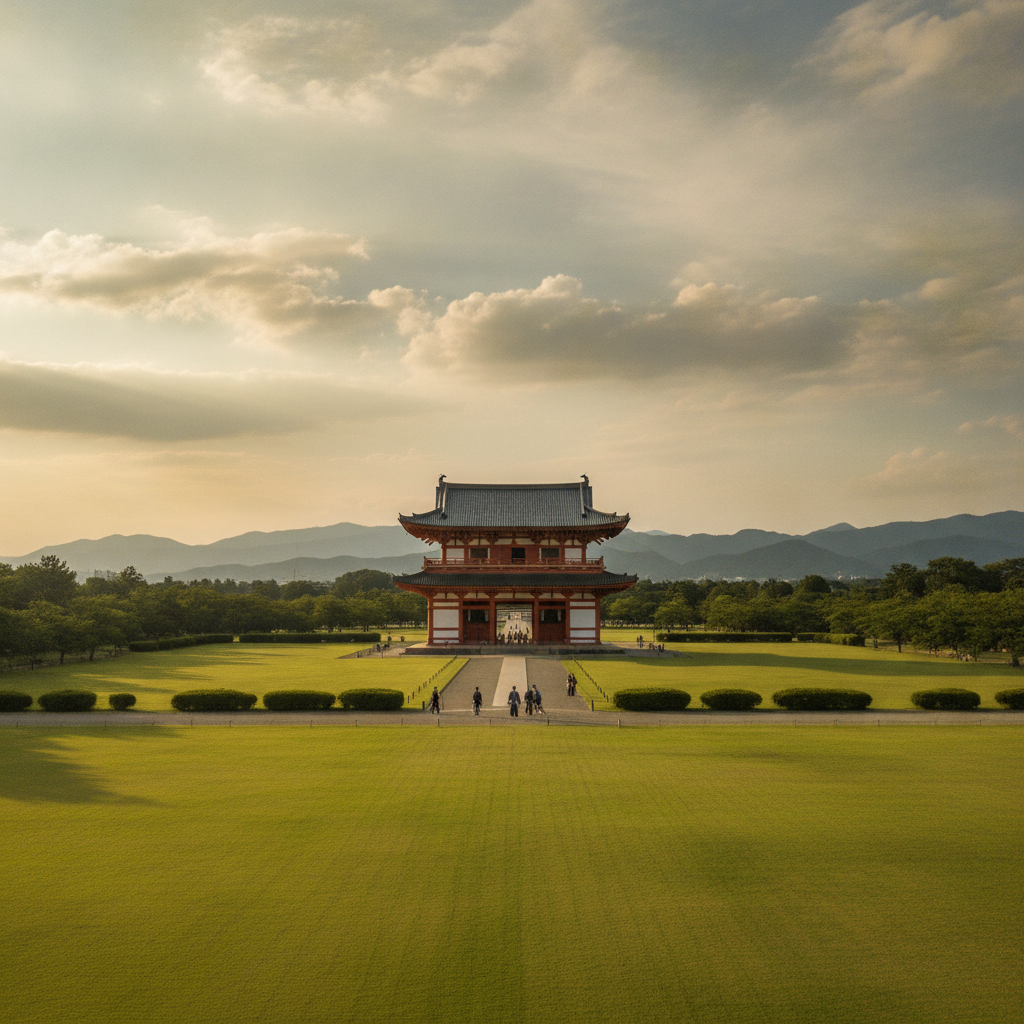
Awake refreshed, the scent of a traditional Japanese breakfast – perhaps miso soup, grilled fish, and rice – filling the air. After a nourishing meal, it's time to fire up the 86/BRZ once more. The drive to the Heijo Palace Site, the magnificent heart of ancient Heijo-kyo, is short and direct from central Nara. Even this brief urban drive is a pleasure in the 86/BRZ, its compact size and nimble handling making city navigation effortless. The early morning light bathes the reconstructed Suzaku Gate in a golden glow, setting the stage for a day of imperial grandeur.
09:30 AM - 12:00 PM: Heijo Palace Site – Walking Through Imperial Splendor
Park your car and step into history. The Heijo Palace Site, a UNESCO World Heritage site, was the imperial capital of Japan from 710 to 784 AD. This vast, open expanse – once covering an area of 120 hectares – offers a staggering sense of scale, a testament to the ambition of Japan's nascent imperial state. Walk through the imposing Suzaku Gate, its vermilion pillars standing sentinel. Beyond it lies the reconstructed Daigokuden (Imperial Audience Hall), a breathtaking structure with a magnificent and intricate interior that houses a replica of the emperor's throne. Standing here, amidst the wide-open spaces, you can almost hear the rustle of silk robes, the murmur of ancient court officials, and the distant sounds of a bustling capital. The sheer emptiness of much of the site, interspersed with meticulously researched reconstructions, allows your imagination to run wild. It’s a place of quiet reflection, allowing you to absorb the magnitude of a city that once governed an entire nation. The gentle breeze rustling through the tall grasses adds to the atmospheric sense of a bygone era. The journey here in the 86/BRZ, feeling the asphalt beneath you, serves as a poignant contrast to the ancient earth you now walk upon – a bridge between modern engineering and timeless history.
12:00 PM - 01:00 PM: Nara National Museum & Todai-ji (Exterior)
From the Palace Site, a short drive – a mere 10-15 minutes – brings us to the vicinity of Nara Park. While Todai-ji is a must-see, we’ll approach it differently. Our focus is less on the deer and more on the profound historical context. First, a visit to the Nara National Museum (Eastern and Western Wings) is highly recommended. It houses an exceptional collection of Buddhist art, sculptures, and artifacts, many originating from Todai-ji and other Nara temples. This provides invaluable context before approaching the temple itself. Then, we’ll take a stroll towards Todai-ji, specifically focusing on the sheer architectural marvel of the Daibutsu-den (Great Buddha Hall) from the outside, appreciating its monumental scale without getting lost in the throngs around the Daibutsu itself. The approach through the Nandaimon Gate, flanked by the fearsome Nio guardian statues, is impressive enough. The beauty of having your own vehicle means you control the pace, allowing you to absorb the grandeur without feeling rushed or overwhelmed by crowds.
01:00 PM - 02:00 PM: Lunch in Naramachi – Traditional Flavors
For lunch, we’ll escape the immediate tourist buzz of Nara Park and head into the charming Naramachi district. This wonderfully preserved area, a short, delightful drive from Todai-ji, is a labyrinth of narrow streets, traditional machiya (townhouses), and quaint shops. Park the 86/BRZ in a discreet coin parking lot and explore on foot. Here, you can find small, authentic restaurants serving local favorites like “chagayu” (tea porridge), “mochi” (rice cakes, often freshly pounded at establishments like Nakatanidou, a spectacle in itself), or simply a delicious bowl of udon or soba in a renovated machiya. The atmosphere is quiet and intimate, a stark contrast to the grandeur of Heijo-kyo but equally steeped in history – the history of everyday life in an ancient capital. The aromas of simmering broths and freshly baked goods waft through the air, tantalizing your senses.
02:00 PM - 04:00 PM: Naramachi Exploration & Kasuga Taisha Shrine (Hidden Paths)
Spend some more time wandering Naramachi’s intricate alleys. Discover hidden temples, artisanal craft shops, and charming cafes. The joy of driving your 86/BRZ is the freedom to explore these less-traveled areas with ease. Afterwards, we’ll head to the magnificent Kasuga Taisha Shrine. Instead of just the main approach, we’ll explore its more serene, less-visited pathways. Drive a little further up, parking near the back, and walk along the quieter paths adorned with thousands of stone lanterns, many moss-covered and ancient, leading to the inner sanctums. The atmosphere here is mystical, almost otherworldly, especially when the lanterns are lit at dusk. The vibrant vermilion and white of the shrine buildings, set against the backdrop of an ancient forest, create a stunning visual spectacle. The air here is often filled with the scent of cedar and the gentle rustle of leaves, a peaceful counterpoint to the city’s sounds. The winding roads around Kasuga Taisha, with their dense tree cover and soft curves, provide another opportunity to appreciate the responsive steering and planted feel of your JDM sports car.
04:00 PM - 06:00 PM: The Homeward Journey – A Driver's Delight Back to Osaka
As the afternoon light begins to soften, it’s time to embark on our return journey to Osaka. But this is not merely a drive back; it’s a final symphony for the senses. We’ll take a route that prioritizes driving enjoyment, perhaps tracing sections of the Yamato Road or navigating the scenic backroads that connect Nara to Osaka, avoiding the most direct, often congested highways. The roads we choose will offer a final flourish of sweeping turns, gentle gradients, and moments where the horizon expands before you. The 86/BRZ will feel like an extension of yourself, its precise throttle response and communicative chassis making every corner a joy. As you downshift, the crisp engine note fills the cabin; as you accelerate, you feel the gentle push of the G-forces. The landscape will shift from ancient forests and rolling hills to the gradual re-emergence of urban sprawl, creating a poignant transition from timeless history to vibrant modernity. The setting sun will paint the sky in dramatic hues over the distant city, a fitting backdrop to the culmination of an extraordinary journey. Your mind will be full of the ancient tales you’ve uncovered, the breathtaking sights you’ve witnessed, and the exhilarating experience of truly driving Japan.
06:00 PM Onwards: Return to Osaka
Upon reaching Osaka, you'll feel a sense of accomplishment. The car, your steadfast companion, will have brought you through millennia of history, through scenic vistas and exhilarating roads. It’s not just a journey you’ve completed, but an experience you’ve crafted with your own hands, with the precision of a JDM legend. The rumble of the engine quiets as you pull into the return point, but the echoes of your adventure, and the memories forged, will resonate long after.
Nara's Ancient Heartbeat: A JDM Road Trip Through Asuka and Heijo-kyo's Timeless History - Expert Advice & Cultural Nuances

Embarking on a road trip in Japan, especially one so deeply immersed in history and driving pleasure, requires a nuanced understanding of local customs and hidden gems. As someone who has traversed these very roads countless times, both by rail and by wheel, let me impart some insider wisdom that will elevate your adventure from a mere drive to an authentic Japanese experience.
First, let’s talk about the “Michi-no-Eki,” or roadside stations. These are not merely rest stops; they are vibrant cultural hubs. Far beyond a simple petrol station and convenience store, each Michi-no-Eki is a unique microcosm of its local region. Here, you’ll find freshly harvested produce from nearby farms, artisanal crafts unique to the area, and local delicacies that you simply won’t encounter in big city supermarkets. Many even boast hot springs (onsen), observation decks, or small museums. They are excellent places to stretch your legs, grab a surprisingly delicious and often gourmet meal, and interact with local residents. Don’t rush past them; make a point to stop at a few. It’s a fantastic way to discover the “real” Japan, supporting local economies and unearthing treasures that no guide book could ever point you towards.
When it comes to food, my advice is to venture beyond the tourist-heavy areas. The “hidden gem” often reveals itself in the most unassuming places. Look for establishments with simple, sometimes even worn, facades. Observe where local families are dining or where a line of delivery scooters is gathered outside. These are often the places serving authentic, soul-satisfying cuisine at reasonable prices. Don’t be afraid to try something new, even if you don’t recognize the dish. A quick “osusume wa nan desu ka?” (What do you recommend?) with a friendly smile can open doors to culinary delights. In Nara, that might mean discovering a small udon shop in Naramachi with recipes passed down for generations, or a tea house in Asuka serving ancient regional sweets.
Driving in Japan, while generally very safe and courteous, has its own unspoken rules. Politeness on the road is paramount. If someone lets you merge, a quick flash of your hazard lights (often called “kansha-bura” or “thank you blinker”) is a common gesture of gratitude. Speed limits are strictly enforced, often by subtle cameras – so resist the urge to push the 86/BRZ to its absolute limits on public roads. However, the joy of a JDM sports car isn’t about raw speed; it’s about the tactile feedback, the precision of the steering, the balance in the corners. These roads, particularly in the hilly areas surrounding Asuka, are a joy to navigate within legal limits, allowing you to fully appreciate the car’s dynamic capabilities. Be mindful of pedestrians, especially in rural areas, and always yield right-of-way when indicated. Navigating smaller towns often involves narrow streets, so excellent situational awareness and the precise controls of your 86/BRZ will be invaluable.
Finally, embrace the unexpected. Japan is a country of delightful surprises. Sometimes the best discoveries are made when you take a spontaneous turn down a road less traveled, or when you strike up a conversation (even with gestures and a few basic Japanese phrases) with a local. Your JDM car is not just transport; it's a vehicle for serendipity, enabling you to chase every intriguing sign and explore every promising vista.
Nara's Ancient Heartbeat: A JDM Road Trip Through Asuka and Heijo-kyo's Timeless History - Detailed Logistics & Pre-Trip Tips
To truly unlock the magic of a Japanese road trip, especially one designed for the discerning JDM enthusiast, meticulous planning regarding logistics is key. While the thrill of the open road is undeniable, understanding the practicalities ensures a smooth and enjoyable journey. As of 2026, Japan’s traffic infrastructure remains highly efficient, but there are nuances to consider, particularly for foreign drivers.
Firstly, regarding traffic itself: expect congestion in major urban centers like Osaka, especially during peak commute hours (typically 7-9 AM and 5-7 PM on weekdays). However, once you escape the immediate metropolitan area and head into the Nara countryside, traffic quickly dissipates, giving way to beautifully maintained, often uncrowded roads. Weekends can see more leisure traffic, particularly around popular tourist sites, but the routes we've outlined for Asuka and Heijo-kyo are generally less affected than, say, coastal drives or major mountain passes. Always check real-time traffic updates via your car's navigation or smartphone apps before setting off, especially for the initial and final legs of your journey.
The ETC (Electronic Toll Collection) card is an absolute necessity for seamless travel on Japan's expressway network. Without it, you’ll be fumbling for cash or credit cards at every toll booth, holding up traffic and breaking the flow of your drive. Rental companies almost universally offer ETC cards (often for a small daily fee), which are linked to your rental agreement. The system is incredibly convenient: simply drive through the green ETC lane, and the toll is automatically recorded. Not only does it save time, but ETC users often benefit from discounted toll rates, particularly on weekends or late at night. Make sure to request an ETC card when booking your 86/BRZ.
Refueling your JDM machine is another aspect where local knowledge comes in handy. Japan has two primary types of gas stations: “full service” (Furu Sābisu) and “self-service” (Serufu Sābisu). For foreign visitors, especially those less familiar with Japanese, full-service stations can be a lifesaver. Pull up to the pump, and an attendant will greet you. A simple “Mantan, Regyura, onegai shimasu” (Full tank, Regular, please) or “Mantan, Hai-oku, onegai shimasu” (Full tank, High Octane, please – crucial for your 86/BRZ’s performance) will convey your needs. They’ll pump the gas, clean your windows, and often even empty your trash. It’s a delightful, efficient service. Self-service stations require a bit more navigation with touch screens, often available in English, but the process of selecting fuel type and quantity is straightforward once you’re familiar. Payment is usually by cash or credit card at both types. Remember, “regular” is green, “high octane” is yellow, and “diesel” is red (though you won't need that for your 86/BRZ!).
Parking in Japan, particularly in urban areas and around popular historical sites, requires a strategy. “Coin parking” lots are ubiquitous. These are typically pay-by-the-hour lots where you either take a ticket upon entry and pay at a machine upon exit, or a mechanism lowers to secure your car, and you pay at a central machine before you leave. Always check the signs carefully for rates and maximum parking durations. In more rural areas like Asuka, you’ll often find free parking lots near major attractions. When parking on the street, always look for designated spaces; illegal parking is strictly enforced and can result in fines or even towing. The compact size and maneuverability of the 86/BRZ make navigating tight parking spaces and narrow alleys significantly easier than with larger vehicles.
And now, for the heart of the matter: driving a JDM (Manual Transmission) car like the 86 or BRZ. This is where the true exhilaration lies. It's not just about getting from point A to point B; it's about the connection. The precise engagement of the clutch, the satisfying ‘thunk’ of the gear lever slotting into place, the immediate surge of power as you perfectly match revs for a downshift before a sweeping corner. This isn’t a machine that isolates you from the road; it integrates you. You feel every subtle undulation, every whisper of grip from the tires. On the winding roads leading through Asuka’s ancient hills or the scenic routes back to Osaka, the 86/BRZ transforms the drive into a dance. The delicate balance, the keen turn-in, the confidence-inspiring braking – every element works in harmony to provide an unparalleled, immersive driving experience. For the true car enthusiast, it's a sensory feast, elevating the journey from mere transportation to an active, engaging, and profoundly rewarding part of your Japanese adventure.
Nara's Ancient Heartbeat: A JDM Road Trip Through Asuka and Heijo-kyo's Timeless History - Comprehensive FAQ
Embarking on a self-drive adventure in Japan, especially for the first time, naturally brings forth a host of questions. As your guide and former conductor, allow me to address the most common concerns, ensuring you’re fully prepared for your JDM historical escapade.
Q: What are the requirements for driving a car in Japan as a foreigner?
A: To legally drive in Japan, you need an International Driving Permit (IDP) issued under the 1949 Geneva Convention. This must be presented along with your valid original driver's license from your home country and your passport. Please ensure your IDP is valid and not expired, as only specific formats are accepted in Japan. You typically obtain this from your national motoring association before arriving in Japan. It is absolutely crucial to have all three documents with you at all times when driving.
Q: What about car insurance?
A: Japanese law mandates that all vehicles have basic liability insurance. When you rent a car, this is automatically included. However, I highly recommend opting for comprehensive insurance offered by the rental company. This typically covers damage to the rental vehicle itself, often with a deductible (exclusion clause) that can be waived by paying a small additional fee (Collision Damage Waiver - CDW). While accidents are rare due to courteous driving, having comprehensive coverage provides invaluable peace of mind, allowing you to focus on the enjoyment of your drive without worry.
Q: I’m used to automatic cars. How difficult is it to drive an MT (manual transmission) JDM car like an 86 or BRZ in Japan?
A: If you already know how to drive a manual transmission, you'll adapt quickly. The 86 and BRZ are renowned for their forgiving clutches and precise shifters, making them a joy to operate. Japanese roads are generally well-maintained, and traffic flow outside major cities is smooth, giving you ample opportunity to practice and get comfortable. If you’re feeling rusty, take a few minutes in a quiet parking lot before heading out onto busier roads. The rewarding engagement of an MT car on Japan’s winding roads is well worth any initial trepidation. If you've never driven manual, it might be challenging for your first experience to be in a foreign country, but with patience and practice, it's an incredibly rewarding skill to master for a true JDM experience.
Q: What are the winter road conditions like, especially in Nara?
A: The Nara region, including Asuka and Heijo-kyo, generally experiences mild winters compared to northern Japan. While temperatures drop, significant snowfall is relatively rare and usually melts quickly. Therefore, for most of the winter months, special winter tires or chains are not typically necessary for this specific itinerary. However, if you plan to venture into higher mountain passes or if there’s an unseasonal heavy snowfall forecast, always check local weather and road conditions. Rental cars typically come equipped with all-season tires, but if you anticipate heavy snow or ice, you may need to request winter tires (studless tires) in advance, which usually incur an extra charge. Always prioritize safety and check forecasts before embarking on your journey.
Q: What about navigation? Will my phone GPS work?
A: Most modern rental cars come equipped with excellent in-car GPS systems, often with multi-language support. These systems are highly accurate and invaluable for navigating Japan’s sometimes complex road network. Additionally, popular smartphone navigation apps like Google Maps work exceptionally well in Japan, with reliable real-time traffic updates. Ensure you have a portable Wi-Fi device or a local SIM card with sufficient data for continuous connectivity. While many road signs are bilingual (Japanese and English), having a reliable GPS is essential for a stress-free journey.
Nara's Ancient Heartbeat: A JDM Road Trip Through Asuka and Heijo-kyo's Timeless History - The Final Call: CTA
You’ve journeyed with me through ancient imperial capitals, felt the weight of millennia in colossal stone tombs, and navigated the very roads where Japanese civilization first took root. This isn't just a trip; it's an odyssey, a profound connection to Japan’s soul, experienced not through a bus window or a train carriage, but through the direct, unfiltered engagement of a JDM sports car. You’ve imagined the crisp engine note of the 86 or BRZ echoing through serene valleys, the precise steering guiding you through picturesque country lanes, and the exhilarating satisfaction of a perfectly executed gear change. The whispers of emperors, the serene beauty of ancient temples, and the thrill of discovery are all waiting for you.
Your adventure into Japan's ancient heart awaits, and it begins with the perfect machine. If you're ready to embrace the true spirit of Japanese exploration, to feel the road beneath you and the history around you, then there's only one place to start. For the genuine JDM experience, for the freedom of an 86 or BRZ, and for a rental experience curated by someone who truly understands the roads of Japan – an ex-Kintetsu conductor, no less – look no further. Omoshiro Rent-a-car Osaka Chuo is your gateway to an unforgettable Japanese road trip. We don't just rent cars; we empower adventures. Book your meticulously prepared 86 or BRZ today, and let's make some history of our own.
