
The Ultimate Nara Kakinoha Sushi Honten Recommended Drive Course: A JDM Pilgrimage Through Ancient Japan
For over a decade, my life was dictated by the rhythmic clicking of rails and the precise, unyielding schedule of the Kintetsu Railway. As a conductor, I saw the beauty of Nara through a rectangular window, a fleeting landscape of emerald forests and ancient temples framed by the steel architecture of public transport. It was a beautiful view, certainly, but it was a view on a leash. The train takes you where the tracks go; it never takes you where the soul wants to wander. This is why I traded the conductor's cap for the driver's seat. Today, as a professional travel writer and a specialist in Japanese Domestic Market (JDM) performance cars, I am here to tell you that to truly experience the Nara Kakinoha Sushi Honten recommended drive course, you must leave the station behind. You need four wheels, a naturally aspirated boxer engine, and the freedom to chase the scent of mountain cedar and fermented vinegared rice into the misty heart of Japan.
1. The Philosophy of Driving in Japan: Why the Road Trumps the Rail
In Japan, the Shinkansen is a marvel of engineering, but it is a sterile experience. To visit the "Main Stores" (Honten) of Nara’s famous Kakinoha Sushi—sushi wrapped in persimmon leaves—you have to delve into the Kii Peninsula, a region of rugged peaks and deep spiritual history. Public transport here is sparse, and the best culinary treasures are hidden in mountain folds where the buses only run twice a day. The philosophy of "Secret Japan" is rooted in the concept of Michi (the road or the path). It’s about the transitions between destinations.
Starting your journey from Osaka, the transition from the concrete jungle of Namba and Umeda to the winding mountain passes of Nara is a sensory overload. In a car like the Toyota 86 or Subaru BRZ, this isn't just a commute; it’s an engagement with the topography. The low center of gravity and the mechanical feedback of a manual transmission allow you to feel the very texture of the asphalt that has been laid over ancient pilgrimage routes. As a former conductor, I appreciate the efficiency of trains, but as a driver, I live for the moments where the road dictates the pace. When you drive, you aren't just a passenger in Japan's history; you are an active participant in its landscape. This drive is about more than just food; it is about the synthesis of JDM engineering and thousand-year-old culinary traditions.

2. The 2-Day Itinerary: Deep Dive into the Nara Kakinoha Sushi Honten Recommended Drive Course
Day 1: The Ascent into the Yamato Heartland
08:00 AM – Departure from Central Osaka
The journey begins as you pull out of the neon-soaked streets of Osaka. The morning sun glints off the hood of your Toyota 86. As you hit the Hanshin Expressway toward the Nishi-Meihan, the engine hums with anticipation. The goal today is not just to eat, but to trace the origins of the Kakinoha Sushi culture. We are heading toward the Yoshino region, the spiritual birthplace of this unique delicacy.
09:30 AM – The Gateway: Route 169
As you exit the expressway and merge onto Route 169, the scenery shifts dramatically. The wide lanes narrow, and the architecture changes from modern steel to weathered wood and gray tile. Route 169 is a driver's dream, following the curves of the Yoshino River. Here, the 86 comes into its own. The steering is heavy and precise, communicating the nuances of every bend. The river to your left is a shimmering ribbon of turquoise, framed by the dense, dark green of the Yoshino cedars.
11:00 AM – The First Pilgrimage: Kakinoha Sushi Honten in Yoshino
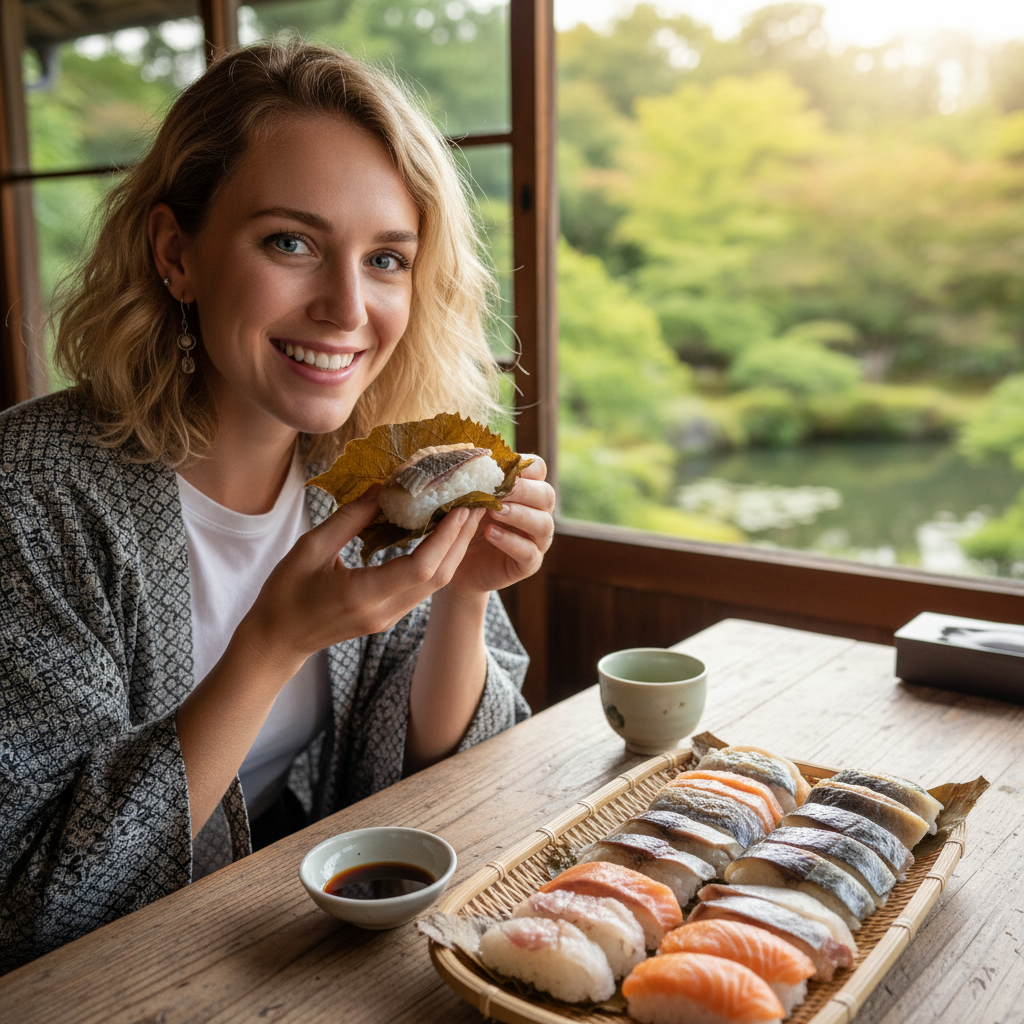
Our first major stop is a legendary "Honten" (Main Store) tucked away in the foothills. Kakinoha Sushi was born from necessity. In the Edo period, transport from the coast of Kumano to the inland mountains of Nara took days. To preserve the fish, it was salted and wrapped in persimmon leaves (kakinoha), which possess natural antibacterial properties. When you step into the Honten, the air is thick with the scent of vinegar and aged wood. You order a set of mackerel (saba) and salmon (sake). The texture is different here—tighter, more infused with the subtle tannins of the leaf. Each piece is a compact brick of history. You eat slowly, watching the mountain mist roll over the distant ridges.
01:30 PM – The Technical Climb: Mount Yoshino and the Middle Loop
After lunch, we take the 86 higher. The road toward Kami-Yoshino is a sequence of hairpins that test your footwork on the pedals. Heel-and-toe shifting becomes second nature as you navigate the steep inclines. The sounds of the forest—the rustle of bamboo and the distant call of a mountain hawk—are punctuated by the crisp downshifts of the boxer engine. We aren't just looking for food; we are looking for the "Secret Japan" that exists above the clouds. We stop at a roadside lookout where the view spans the entire valley. The geologically ancient Kii mountains stretch out like a frozen green ocean.
04:00 PM – Riverside Relaxation and Cultural Immersion
We descend toward the village of Kawakami. The road follows the emerald pools of the river. This is the area where the persimmon trees are most abundant. In autumn, the hills are dotted with bright orange fruit. We visit a small, family-run workshop where they still hand-press the sushi into wooden molds. There is no automated machinery here; it is the strength of the artisan’s hands that compacts the rice. The flavor profile changes slightly with every kilometer you drive deeper into the mountains—more salt, more vinegar, more soul.
07:00 PM – Overnight in a Traditional Ryokan
We check into a local ryokan (traditional inn) that sits on a cliff overlooking the river. After a day of spirited driving, the hot springs (onsen) are a welcome relief. The dinner isn't just sushi; it's a multi-course kaiseki meal featuring local mountain vegetables, river trout, and, of course, a special selection of aged Kakinoha Sushi that has been pressed for over 24 hours to intensify the flavor. As the engine of the 86 cools in the courtyard, you fall asleep to the sound of the river.
Day 2: The High Passes and the Deep Forest
08:30 AM – Morning Engine Start and Route 309
Day two begins with the cold start of the 86. The exhaust note echoes off the stone walls of the village. Today, we tackle Route 309, often referred to as one of the most beautiful yet challenging driving roads in Kansai. Our destination is the deeper recesses of Nara, targeting another Honten that specializes in a variant of Kakinoha Sushi using "trout" caught in the local streams.
10:00 AM – The Toge Experience: The Mitarai Valley
The road becomes exceptionally narrow, a "cool" JDM challenge. Here, the compact dimensions of the 86 are an advantage. You pass through hand-chiseled rock tunnels and over narrow bridges where the water below is so clear it looks like liquid glass. This is the Mitarai Valley. We stop the car and hike for 20 minutes to see the waterfalls. The negative ions in the air are a sharp contrast to the city smog of Osaka. The geological features here—massive granite boulders smoothed by millennia of water—remind you of the raw power of the Japanese wilderness.
12:30 PM – The Hidden Honten: Tenkawa Village
We reach Tenkawa, a village known for its "spiritually charged" atmosphere and its connection to Shugendo (mountain asceticism). The Kakinoha Sushi here is lighter, with rice that has a subtle sweetness. We sit on a wooden porch, the 86 parked within sight, and savor the trout sushi. The orange-hued fish is delicate, melting away to leave the herbal fragrance of the persimmon leaf on the palate. This is the peak of the Nara Kakinoha Sushi Honten recommended drive course—a moment of perfect culinary and mechanical harmony.
03:00 PM – The High Plateau: Odaigahara Driveway
If the weather permits, we take the Odaigahara Driveway. This is a dead-end mountain road that climbs to nearly 1,600 meters. It is a high-speed winding road with panoramic views of the Pacific Ocean on a clear day. The air is thin and cold, and the 86 breathes deeply, its power delivery remaining linear and predictable. This is where you truly understand why JDM cars are built the way they are—they are designed for these very mountains.
06:00 PM – The Return Loop: Gojo and the Sunset
As we head back toward Osaka, we pass through the city of Gojo. Gojo is home to some of the oldest Kakinoha Sushi establishments in the world. We pick up a final box of sushi—this time a "mix" set—to take back. The sun sets behind the Katsuragi mountains, painting the sky in shades of violet and gold. The drive back on the expressway is a time for reflection. You’ve covered over 300 kilometers of some of the most challenging and beautiful terrain in Japan, and you’ve eaten sushi that tastes like the mountains themselves.
3. Expert Advice & Cultural Nuances for the Nara Drive
Driving in Nara’s deep south is an exercise in etiquette and awareness. While the 86 is a performance car, the mountain roads are shared with local elderly residents and the occasional wild deer or boar. The Japanese concept of Omoiyari (consideration for others) is vital. If a local truck is behind you, they likely know the roads better; pull over into a "退避所" (taihi-jo, or turnout) and let them pass. They will often give you a brief hazard-light flash as a thank you—a secret language of the Japanese road.
One of the greatest joys of a Nara drive is the "Michi-no-Eki" (Roadside Stations). These are not mere gas stations. They are hubs of local culture. At the Michi-no-Eki in Yoshino or Kamikitayama, you can find hyper-local versions of Kakinoha Sushi, sometimes wrapped in "Yamazakura" (mountain cherry) leaves during the spring, or varieties that use wild mountain herbs mixed into the rice. These stations also sell the freshest local produce—persimmons, yuzu, and the famous Nara pickles (Narazuke). Always carry cash (Yen), as many of these mountain gems do not accept international credit cards.
Also, pay attention to the "Melody Roads." In certain parts of Nara, the grooves in the asphalt are spaced so that when you drive over them at a specific speed, the vibration plays a folk song through the car’s tires. It’s a whimsical touch that reminds you that in Japan, even the infrastructure has a soul.
4. Detailed Logistics & Pre-Trip Tips for 2026
As we navigate the travel landscape of 2026, several things have changed, but the thrill of the JDM drive remains constant. First, ensure your car is equipped with an ETC (Electronic Toll Collection) 2.0 card. Many expressway exits in Nara are now "ETC Only," and having a card allows you to breeze through tolls without stopping, keeping your driving rhythm intact. Most of our vehicles at the rental shop come pre-installed with these units.
When it comes to fueling your Toyota 86, you’ll be looking for "High-Octane" (called Haoku in Japanese). When you pull into a gas station, the staff will often approach you (unless it’s a "Self" station). A simple "Haoku, mantan, kurejitto de" (High-octane, full tank, by credit card) will get you sorted. The staff might offer to wipe your windows or take your trash—this is the legendary Japanese hospitality (Omotenashi) that extends even to the petrol pump.
Parking in Nara’s mountain villages can be tight. The 86 is perfect here because of its compact footprint, but always look for designated parking areas. Never park on the side of a narrow mountain road; it blocks timber trucks and emergency vehicles. Most Honten shops have a few dedicated spots marked with their logo. As for the car itself, driving a manual (MT) JDM car in the mountains provides a level of engagement that no automatic can match. The connection between the engine's revs, the gear selection, and the car's weight transfer is a form of mechanical meditation.
5. Comprehensive FAQ: Driving in Japan
Q: What license do I need to drive in Japan?
A: This is the most critical point. To drive in Japan, you must possess a valid International Driving Permit (IDP) issued under the 1949 Geneva Convention. You must also carry your original home-country driver's license and your passport. Note that IDPs issued under the 1968 Vienna Convention or other formats are not valid in Japan. Some countries (like Switzerland, Germany, France, etc.) require a certified Japanese translation of their domestic license instead of an IDP. Please check the official requirements for your specific country before arrival.
Q: Is it difficult to drive a manual (MT) car on the left side of the road?
A: If you are from a right-hand-drive country (like the UK or Australia), it’s easy. If you are from the US or Europe, it takes about 20 minutes to adjust. The gear shifter will be on your left, but the pedal layout (Clutch-Brake-Gas) is identical worldwide. The 86 has a very forgiving clutch and precise gate, making it an excellent car for those who are experienced with MT but new to Japanese roads.
Q: What are the winter road conditions in Nara?
A: From late December to early March, the high mountain passes (like Route 309 and Odaigahara) can be covered in snow or ice. During this time, we equip our fleet with studless winter tires. However, for the best "sporty" driving experience, the months of April to November are ideal, with October and November offering the stunning "Koyo" (autumn colors).
Q: Is insurance included?
A: When renting a high-performance JDM car, always ensure you have full coverage, including a Collision Damage Waiver (CDW) and Non-Operation Charge (NOC) protection. These roads are narrow, and it’s better to drive with peace of mind.
6. Your Journey Starts Here
The Nara Kakinoha Sushi Honten recommended drive course is more than a checklist of locations; it is a sensory journey that connects you to the heart of Japan. It is the smell of vinegar-soaked rice, the sight of mist-covered peaks, and the tactile joy of rowing through the gears of a Toyota 86 on a mountain pass. As a former conductor, I spent years watching these mountains from a distance. Now, I invite you to touch them, to hear them, and to drive them.
Don't settle for a standard rental car or a crowded tourist bus. Experience the engineering excellence of a JDM legend while exploring the ancient culinary heritage of Nara. At Omoshiro Rental Car Osaka Chuo, we specialize in providing enthusiasts with the tools to create these unforgettable memories. We don't just rent cars; we provide the keys to a Japan you won't find in any guidebook. Our fleet of manual Toyota 86s and BRZs is meticulously maintained and ready for the mountains. Book your JDM adventure with Omoshiro Rental Car Osaka Chuo today and discover the soul of Nara on your own terms.