
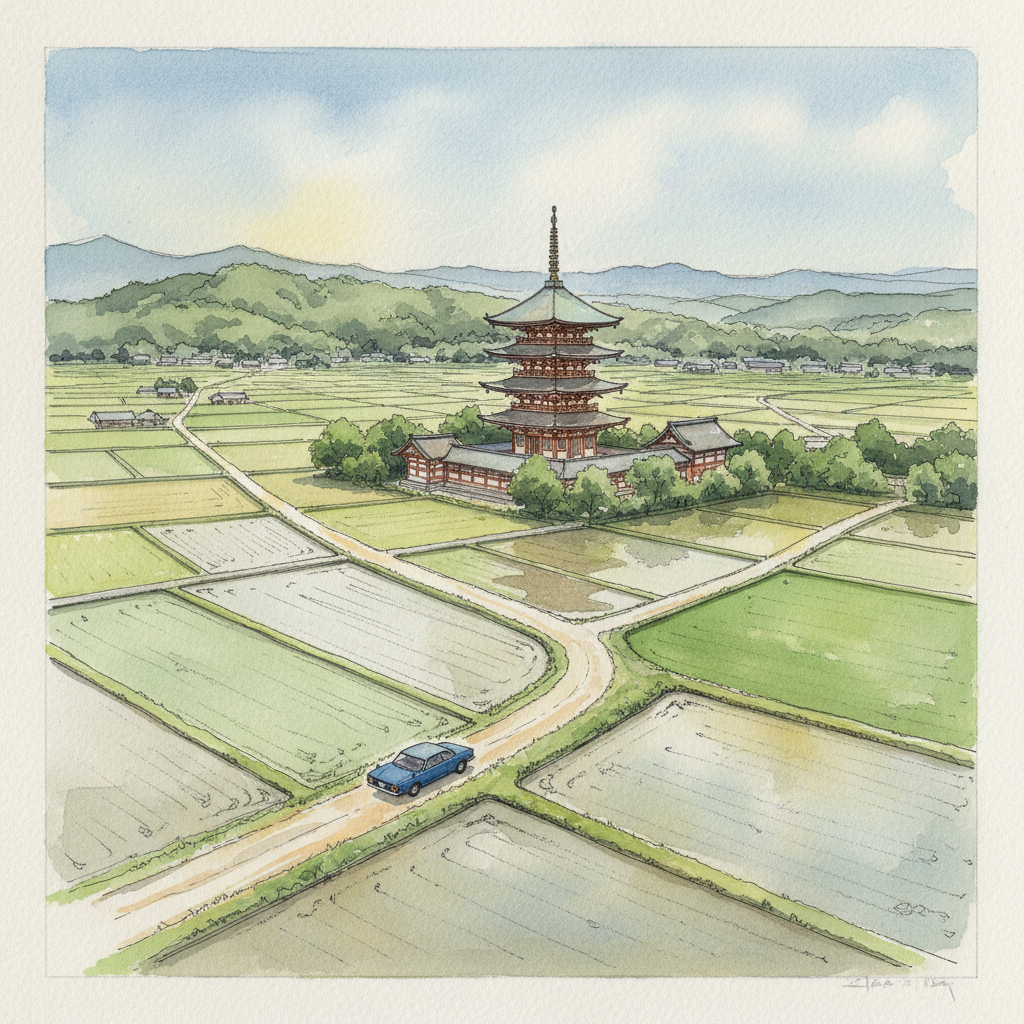
Nara World Heritage, Horyuji, Asuka-dera, Fujiwara-kyo: The Philosophy of Driving in Japan
For years, my world was defined by steel rails and meticulously timed schedules. As a conductor on Kintetsu trains, I traversed the arteries of Kansai, witnessing Japan unfold through a window, a panorama of urban sprawl giving way to tranquil countryside, all perfectly framed and predictable. It was an intimate dance with precision, a privilege to ferry countless souls across this beautiful land. Yet, even then, a different kind of yearning stirred within me – a desire to break free from the tracks, to truly immerse myself in the subtle rhythms of Japan, not just observe them.
This is the fundamental philosophy that underpins every journey I now craft: the unparalleled freedom and profound discovery afforded by the open road. Public transportation, while incredibly efficient and a marvel of engineering – something I deeply respect – is, by its very nature, a path of least resistance, designed for speed and access to major hubs. It delivers you to the doorstep of the iconic, the well-trodden, the postcard-perfect. But Japan, my friends, is so much more than its celebrated landmarks. It is a tapestry woven with countless hidden threads, secret hamlets nestled in verdant valleys, ancient shrines shrouded by mist on forgotten mountain passes, and vistas of breathtaking beauty that remain stubbornly out of reach for the casual rail traveler. This, I call “Secret Japan.”
To truly unlock this enigmatic realm, a car is not merely a mode of transport; it is your passport, your magic carpet, your instrument of exploration. Starting from the bustling heart of Osaka, a vibrant metropolis that pulses with modern energy, you stand at the precipice of an adventure that transcends mere sightseeing. Osaka, with its superb connectivity and lively atmosphere, serves as the perfect launchpad for an automotive odyssey into Japan’s most ancient core. Imagine the exhilaration of peeling away from the city’s embrace in a finely tuned machine – perhaps a Toyota 86 or a Subaru BRZ – its boxer engine hinting at the power and precision awaiting you.
The allure of driving in Kansai lies not just in the destinations, but in the journey itself. It’s in the winding prefectural roads that snake through verdant rice paddies, the sudden reveal of a majestic mountain vista, the unexpected encounter with a charming local “Michi-no-Eki” (roadside station) offering freshly harvested produce. It’s the freedom to chase the golden hour across an open plain, to pause at a spontaneous whim to photograph an ancient stone bridge, or to simply pull over and listen to the symphony of cicadas in a bamboo grove. These are the moments that public transport cannot offer; these are the deeply personal connections forged when you are fully in control, fully present, fully immersed.
As an ex-conductor, I know the beauty of Japan’s efficiency. But as a driver, a traveler, and now an operator of JDM rental cars, I know the intoxicating joy of its spontaneity, its hidden depths, and the profound satisfaction of truly earning your view. This journey we are about to embark upon, tracing the very origins of the Japanese nation through the ancient lands of Nara, is not just a drive; it is an act of communion with history, a visceral experience that connects you to the soul of this incredible country in a way that only a car, a responsive JDM legend, can provide. Prepare to discover a Japan that few ever see, a Japan that beckons you to step off the beaten path and into its timeless embrace.
Nara World Heritage, Horyuji, Asuka-dera, Fujiwara-kyo: The 2-Day Itinerary: Deep Dive
Prepare yourselves, fellow adventurers, for a journey that will etch itself into the very fabric of your memory. This isn’t just a trip; it’s a pilgrimage through the cradle of Japanese civilization, an automotive symphony performed by you and a legendary JDM machine, carving a path through millennia of history. We’ll immerse ourselves in the mystique of Nara’s World Heritage sites – Horyuji, Asuka-dera, Fujiwara-kyo – uncovering the “Secret Japan” that only the dedicated explorer behind the wheel can truly grasp. Our chosen steed for this epic – an 86 or BRZ – will be more than just transport; it will be an extension of your will, a conduit to an unparalleled connection with the ancient roads and profound landscapes.
Day 1: From Osaka's Pulse to Ancient Nara's Embrace
08:00 – Departure from Osaka: The Awakening Engine
The city of Osaka is just beginning to stir. The neon glow of Dotonbori has faded, replaced by the soft, pearly light of dawn. The air is crisp, carrying a hint of morning dew. Your 86 or BRZ awaits, its sleek lines hinting at the journey ahead. Slide into the driver’s seat, the snug embrace of the bolstered seat already signaling a different kind of morning commute. Turn the key. The boxer engine awakens with a purposeful thrum, a low growl that sends a shiver of anticipation down your spine. This isn't just an engine starting; it's the beginning of an adventure. A brief check of mirrors, a smooth engagement of the clutch, and we pull away from the urban grid, heading east.
08:00 – 09:00 – The Drive East: Urban Canvas to Rural Overture
We navigate Osaka's outer fringes – a dance through gentle traffic, the 86/BRZ’s precise steering and responsive throttle making light work of the city streets. Soon, we merge onto the expressways, leaving the urban sprawl behind. The cityscape slowly recedes in the rearview mirror, replaced by more open skies and glimpses of rolling hills on the horizon. The engine settles into a comfortable hum, a melodic companion as we leave the modern world for a rendezvous with antiquity. The roads are smooth, the transitions effortless, offering a fantastic opportunity to familiarize yourself with the car’s balanced chassis and communicative steering.
09:00 – 10:00 – Approaching Horyuji: Verdant Corridors of Time
Exiting the expressway, the landscape transforms dramatically. We enter Nara Prefecture, and the roads become narrower, more intimate. Ancient forests of Japanese cedar and cypress rise majestically on either side, their deep green hues casting long, cool shadows. The air, now noticeably fresher, carries the subtle, earthy scent of damp soil and aged wood. This is where the 86/BRZ truly comes alive. The roads begin to gently curve, following the natural contours of the land. Downshift – the satisfying mechanical click of the short-throw shifter – and feel the surge of torque as the car tracks perfectly through each bend. It's a symphony of engine and road, a preview of the profound history awaiting us. We pass through small, timeless villages, where traditional wooden houses stand guard, hinting at the past.
10:00 – 12:30 – Horyuji Temple: Standing on the Edge of Eternity
As we approach Horyuji, the village feels exceptionally tranquil, the ancient air almost palpable. The car hums to a stop in a quiet parking area, the engine ticking softly as it cools. Stepping out, you are immediately enveloped in an atmosphere of profound serenity. Horyuji is not merely a temple; it is a living, breathing testament to Japan’s Buddhist beginnings, a UNESCO World Heritage site housing some of the oldest wooden structures on Earth. Founded by Prince Shotoku in the early 7th century, its very stones whisper tales of imperial patronage and cultural exchange.
Walk through the massive Nandaimon gate, and you are transported. The vast courtyard stretches before you, dominated by the colossal Goju-no-to (five-story pagoda) and the Kondo (main hall). The sheer scale and meticulous craftsmanship of these structures, built with timbers that have withstood over 13 centuries, are awe-inspiring. Imagine the hands that carved these beams, the minds that designed such enduring beauty. The cypress wood, darkened by time and polished by countless hands, exudes an ancient aroma. Inside the Kondo, the golden statues of Buddhas and Bodhisattvas, bathed in soft, ethereal light, evoke a sense of spiritual peace. Look closely at the intricate carvings, the delicate paintings – each a masterpiece from a nascent era of Japanese art. Spend time wandering the complex, from the serene Daikodo (lecture hall) to the Yumedono (Hall of Dreams), a hexagonal structure of immense spiritual significance. Feel the cool stone beneath your feet, listen to the rustle of leaves in the ancient trees, and let the sheer weight of history settle upon you. This isn't just seeing history; it's touching it, breathing it in.
12:30 – 13:30 – Lunch: A Taste of Nara's Simplicity
After immersing ourselves in Horyuji’s grandeur, our stomachs will undoubtedly be calling. We'll find a charming, unpretentious local eatery in the village – the kind where generations have served simple, honest Japanese fare. This is not haute cuisine, but food that speaks of the land and its traditions. Imagine savoring “Kakinoha-zushi,” pressed sushi wrapped in persimmon leaves, a local Nara delicacy that combines the delicate flavor of mackerel or salmon with the subtle fragrance of the leaf. Or perhaps a bowl of “Somen,” fine wheat noodles, served chilled in summer or warm in a light broth in cooler months, a perfect balance of simplicity and flavor. The taste will be clean, refreshing, a culinary counterpoint to the profound visual feast we’ve just experienced. The atmosphere will be warm, inviting, a glimpse into the everyday life of this historical region.
13:30 – 15:00 – Horyuji to Asuka Village: Unveiling Ancient Pathways
With renewed energy, we climb back into the 86/BRZ. The engine greets us with a familiar purr. Our next destination, Asuka, is the true birthplace of Japan, a place of even deeper antiquity than Nara City itself. The drive is a delight. We leave the main roads, opting for prefecture routes that are less traveled, winding their way through an ever-more pastoral landscape. Rice paddies shimmer in the afternoon sun, reflecting the endless blue sky like a patchwork of mirrors. Small, emerald-green hills dot the horizon, hinting at the ancient Kofun (tumuli) hidden within them. The 86/BRZ's perfectly weighted steering and taut suspension make these winding roads an absolute joy. Each turn is an invitation, each straight a brief moment to enjoy the visceral connection between car and tarmac. You’ll feel the subtle undulations of the road through the steering wheel, a direct conversation with the landscape. The flat-four engine's distinctive thrum echoes off the ancient cypress forests – a modern symphony against a backdrop of millennia.
15:00 – 17:30 – Asuka Village: The Cradle of a Nation
Asuka is a revelation. Unlike the grand, monumental structures of Horyuji, Asuka invites you to explore, to wander, to discover. This was Japan’s first capital, a political and cultural melting pot where Buddhism first took root and Chinese influences shaped a nascent nation. The geological features here – gentle, rolling hills and fertile plains of the Yamato Basin – provided the perfect setting for early settlement. The very air here feels ancient, pregnant with untold stories.
Our first stop: the enigmatic “Ishibutai Kofun.” This massive stone tomb, dating back to the 7th century, is unlike anything else. Its earthen mound has long since eroded, revealing the colossal megalithic chamber – huge granite blocks, some weighing over 70 tons, meticulously fitted together. Standing beneath these ancient stones, you can’t help but feel dwarfed by the ingenuity and sheer manpower of Japan’s earliest engineers. It speaks of powerful leaders and a sophisticated society long before written records became commonplace. Imagine the solemn processions, the rituals performed here.
Next, we’ll drive – with the 86/BRZ effortlessly navigating the narrow, picturesque country lanes – to the vicinity of the “Takamatsuzuka Tumulus.” While the original tomb is closed to protect its precious murals, a faithful replica building allows us to marvel at the vibrant, colorful depictions of court life – celestial maidens, gentlemen – that graced the walls of a 7th-century burial chamber. These images offer an invaluable glimpse into the aesthetics and beliefs of early Japan, a stark contrast to the more somber Kofun. Driving between these sites, the 86/BRZ’s compact size and agile handling are perfectly suited to the intimate scale of Asuka’s historical landscape. The light filtering through the bamboo groves, the distant sound of a farmer working his field – it’s pure “Secret Japan.”
17:30 – 18:00 – Check-in & Relaxation: Asuka/Kashihara Oasis
As the sun begins its gentle descent, painting the sky in hues of orange and soft purple, we’ll make our way to our chosen accommodation in the Asuka or nearby Kashihara area. We’ll seek out a traditional ryokan or a charming guesthouse that offers a genuine taste of Japanese hospitality. Parking the 86/BRZ – its journey paused for the night – we’ll check in and feel the immediate embrace of tranquility. Take a moment to unwind, perhaps soak in a soothing hot spring – an “onsen” – if available. The mineral-rich waters will melt away any lingering tension from the day’s drive, preparing you for the evening ahead.
18:00 – 20:00 – Evening: Culinary Delights and Starlit Serenity
Dinner at a traditional ryokan is an experience in itself. Expect “Kaiseki Ryori,” a multi-course culinary art form that emphasizes seasonal ingredients, delicate presentation, and a harmonious balance of flavors and textures. Each dish is a miniature masterpiece, a celebration of local produce – perhaps fresh river fish, seasonal vegetables, and locally sourced meats, all prepared with meticulous care. The taste will be exquisite, a blend of subtle umami and vibrant freshness. Alternatively, venture out to a local eatery for a more casual, but equally authentic, experience – perhaps some regional “udon” or “soba” noodles that reflect the area’s culinary heritage.
After dinner, take a leisurely stroll through the quiet village. Away from the city lights, the sky above Asuka truly comes alive. The stars will twinkle with an intensity rarely seen in urban areas, a celestial dome stretching infinitely above these ancient lands. Reflect on the day's journey: the grand majesty of Horyuji, the subtle profundity of Asuka. The whispers of history are almost audible in the cool night air. The anticipation for tomorrow’s continued exploration of Japan’s ancient heart will be a gentle thrum, much like the idle of your 86/BRZ, waiting patiently for dawn.
Day 2: From Ancient Capitals to Modern Horizons
07:00 – 08:00 – Morning Rituals & Departure: Crisp Air, Clear Purpose
Awaken to the gentle sounds of the Japanese countryside – perhaps a rooster crowing, or the distant murmur of a stream. The morning air in Asuka is often crisp and cool, invigorating the senses. Enjoy a traditional Japanese breakfast – “washoku” – a nourishing spread of rice, miso soup, grilled fish, pickles, and perhaps a delicate egg dish. It’s a healthy and hearty start, perfectly fueling you for another day of exploration. With bags packed and spirits high, we return to our 86/BRZ. The car, refreshed like ourselves, awaits our command. The engine fires up with an eager growl, ready to tackle the ancient roads once more.
08:00 – 10:00 – Asuka-dera Temple & Environs: Simplicity and Profound History
We delve deeper into Asuka’s spiritual heart with a visit to Asuka-dera Temple. This temple holds a singular distinction: it is Japan’s first full-fledged Buddhist temple, built in 596 AD. While the original grand complex has diminished over the centuries, the core of its profound history remains. The current main hall houses the Asuka Daibutsu, a majestic bronze Buddha statue that dates back to the temple’s founding. Its serene, almost archaic smile, crafted by a Korean artisan, speaks volumes of the cultural exchange that shaped early Japan. The temple is modest in size today, yet its quiet simplicity belies its monumental importance. Imagine the first Buddhist monks walking these grounds, the sound of their prayers echoing through these very hills.
The drive to Asuka-dera from our accommodation will be a scenic one, the 86/BRZ dancing through narrow country roads lined with rice paddies and small, picturesque farmhouses. The precise steering allows you to place the car exactly where you want it, making the journey as engaging as the destination. The light of the morning sun bathes the landscape in a golden glow, highlighting the subtle contours of the ancient Yamato Plain. We’ll also take some time to explore other smaller, unique sites – perhaps the “Kameishi” (Turtle Stone), a mysterious, large carved stone, or the “Saruishi” (Monkey Stones), adding to the enigmatic charm of Asuka. These scattered ancient artifacts are best accessed by car, allowing for spontaneous stops and discoveries that enrich the narrative of the region.
10:00 – 12:00 – Fujiwara-kyo Remains: The Ghost of a Grand Capital
From the intimate scale of Asuka-dera, we journey a short distance to the expansive fields of Fujiwara-kyo. Here, the landscape opens up dramatically, offering a different kind of historical experience. Fujiwara-kyo was Japan’s first truly planned capital, established by Empress Jito in 694 AD, just before the move to Heijo-kyo (modern-day Nara City). For only 16 years, it was the political and cultural center of Japan, a grand city designed on a grid system, anticipating later capitals. Today, little of the original structures remain – a poignant reminder of impermanence – but the scale of the former palace grounds and the city plan can be grasped through reconstructed pillar bases and informative markers.
Driving through these vast, open fields is an almost spiritual experience. Imagine chariots and courtiers, bustling markets and imperial decrees echoing across these plains. Depending on the season, the fields are alive with color – vibrant yellow rapeseed flowers in spring, lush green rice shoots in summer, or delicate cosmos in autumn. The 86/BRZ, usually at home on winding mountain passes, feels equally exhilarating here, its balanced chassis and responsive engine allowing you to glide smoothly across the open roads that crisscross the ancient capital’s footprint. You can truly feel the “spirit of the land” here, the enduring heart of Japan that drew its earliest rulers to this fertile plain. The silence, broken only by the gentle hum of the engine and the rustle of the wind, invites deep contemplation.
12:00 – 13:00 – Lunch: A Local Gem in Kashihara
For our final ancient capital lunch, we'll head to Kashihara, the modern city that grew around the Fujiwara-kyo area. Here, we can discover another local culinary gem. Perhaps a cozy “kissaten” (Japanese coffee shop) offering delicious light meals and expertly brewed coffee, or a “soba” (buckwheat noodle) shop renowned for its handmade noodles and delicate broth. This is an opportunity to interact with locals, to observe daily life, and to savor flavors that are deeply rooted in the region. The authenticity of these small, family-run establishments offers a wonderful contrast to the grand scale of the history we’ve been exploring, reminding us that Japan’s heart beats in its everyday moments too.
13:00 – 16:00 – Return Journey to Osaka: Reflective Drives and Winding Roads
With our minds filled with millennia of history and our senses invigorated, it’s time to embark on our return journey to Osaka. Instead of retracing our exact route, we’ll seek out alternative prefectural roads, allowing for a fresh perspective on the landscape. This drive is less about discovery and more about reflection, a chance to consolidate the incredible experiences of the past two days. The 86/BRZ – now a familiar and trusted companion – responds to every input with fluid grace. The steering feels even more intuitive, the gear changes more seamless. We’ll enjoy the quiet rhythm of the engine, the subtle shifts in scenery from ancient plains to modern suburbs.
Perhaps we’ll find a segment of road that offers a gentle series of S-curves, where the BRZ’s phenomenal balance and grip can be truly appreciated, providing a final, exhilarating dance between driver, machine, and road. The sun will be higher in the sky, casting long shadows as we gradually move west. The transition from the timeless tranquility of Nara back to the vibrant energy of Osaka is a gradual one, a gentle re-entry into the present. This journey isn't just a physical transit; it's a mental journey too, processing the profound historical immersion. You'll carry the echoes of ancient emperors and monks, the scent of cypress, and the thrilling roar of the boxer engine with you long after the trip concludes. As the Osaka skyline slowly emerges on the horizon, bathed in the late afternoon light, a sense of accomplishment settles over you. You haven't just visited Japan; you've driven deep into its very soul.
Nara World Heritage, Horyuji, Asuka-dera, Fujiwara-kyo: Expert Advice & Cultural Nuances
Having navigated every conceivable road in Japan, from the bustling cityscapes to the most remote mountain passes, and with the unique perspective of a former Kintetsu conductor, I've gathered invaluable insights that I'm eager to share. This isn't just about driving; it's about connecting with Japan on a deeper level, embracing its idiosyncrasies, and discovering its hidden treasures.
The Michi-no-Eki: More Than Just a Rest Stop
One of Japan’s most charming and essential cultural institutions for road-trippers is the “Michi-no-Eki” – the roadside station. Forget the sterile, identical highway service areas of other countries. Michi-no-Eki are vibrant hubs, each a unique reflection of its local community. They are treasure troves of regional specialties: freshly harvested produce from nearby farms, artisanal crafts unique to the area, and a dizzying array of local snacks and delicacies. You might find “Kakinoha Mochi” (sweet rice cakes wrapped in persimmon leaves) unique to Nara, or freshly brewed local sake. Many Michi-no-Eki boast excellent, affordable restaurants serving local cuisine that you won't find anywhere else, often using ingredients sourced from within a few kilometers. Some even feature small museums, art galleries, or even “ashiyu” (foot onsen) where you can soak your tired feet. Stop frequently, explore, and treat them as an integral part of your cultural immersion. They are windows into the genuine, regional heart of Japan, often providing insights and flavors far beyond what a typical tourist guide offers.
Unearthing Hidden Local Gems
The beauty of driving an 86 or BRZ is the freedom it grants to deviate from the planned route, to follow a tantalizing sign, or to simply let curiosity be your guide. While our itinerary covers the major historical sites, Japan’s true magic often lies in its understated, unadvertised corners. Keep an eye out for small, unassuming shrines tucked away amidst residential areas or deep within a bamboo grove. These “jinja” (shinto shrines) or “tera” (Buddhist temples) often hold centuries of local history and offer a profound sense of peace away from the crowds. Look for “kissaten” (traditional Japanese coffee shops) that might be family-run for generations, offering superb coffee and a glimpse into local life. Don't be afraid to pull over and explore a local “shotengai” (shopping street) in a small town; you might discover unique souvenirs or a delightful, hole-in-the-wall eatery serving the best ramen or soba you've ever tasted. My advice: use your smartphone’s translation app, and don't hesitate to engage with locals – even with limited Japanese, a smile and a few polite phrases go a long way. They often hold the keys to the most authentic experiences.
Driving with Respect: Navigating Japanese Roads
While the allure of an 86 or BRZ on winding Japanese roads is undeniable, it’s crucial to drive with respect and awareness. Remember, Japan drives on the left-hand side, and while this might take a little getting used to, the excellent road signage (often in English) and polite driving culture make it straightforward. Speed limits are generally lower than in many Western countries and are strictly enforced, especially in residential areas. Japanese drivers are typically courteous and patient, so reciprocate that politeness. Pedestrians and cyclists always have priority, particularly near schools or residential streets. Be mindful of narrow roads, especially in older towns or rural areas – the compact size and maneuverability of the 86/BRZ will be a distinct advantage here. Lastly, remember that while you’re enjoying the thrill of the drive, you are a guest in these communities. Respect local customs, park only in designated areas, and ensure your presence enhances, rather than detracts from, the serene beauty of the places you visit.
Nara World Heritage, Horyuji, Asuka-dera, Fujiwara-kyo: Detailed Logistics & Pre-Trip Tips
Embarking on a JDM road trip through Japan’s ancient heart is an exhilarating prospect, but successful execution hinges on understanding the practicalities. From navigating modern traffic to mastering the nuanced art of gas station etiquette, here’s everything you need to know to ensure a seamless and utterly thrilling journey in your 86 or BRZ in 2026.
Current Traffic Realities in 2026
Japan’s roads, particularly its expressways, remain remarkably efficient. In 2026, while major arteries around Osaka can experience congestion during peak morning and evening commute hours (typically 7:00-9:30 AM and 5:00-7:30 PM), our route largely skirts heavy urban centers once we’ve departed Osaka. The expressways leading towards Nara and the local roads within Nara Prefecture – especially those connecting Horyuji, Asuka, and Fujiwara-kyo – are generally serene and free-flowing. This allows ample opportunity to savor the driving dynamics of your 86/BRZ without constant stop-and-go frustrations. Always check real-time traffic updates via your car’s navigation system or a smartphone app before you set off, especially if departing Osaka during peak times. However, for the most part, you'll find Japan's rural roads a driver's paradise.
Mastering the ETC Card: Your Gateway to Smooth Travel
The Electronic Toll Collection (ETC) card is not merely a convenience; it’s an essential tool for any road trip in Japan. Attempting to navigate Japan’s extensive toll road network without one will result in endless fumbling for cash, slower passage through toll gates, and potentially missing out on ETC-only lanes or discounts. The system is elegant: a small card inserted into a device in your 86/BRZ communicates wirelessly with toll gates, automatically deducting fees. It offers seamless, non-stop passage through tolls, allowing you to maintain your momentum and focus on the road. Most rental companies provide ETC cards, often requiring a separate deposit or agreement for toll charges which are settled upon return. Ensure you understand how your rental’s ETC system works and its associated costs before you set off. It significantly enhances the flow and enjoyment of expressway driving.
The Art of the “Mantan”: Japanese Gas Station Etiquette
Filling up your 86 or BRZ in Japan is an experience in itself. You’ll encounter two main types of gas stations: “full-service” (where attendants pump your gas, clean your windows, and often even guide you out of the station) and “self-service.” While self-service is common, I highly recommend experiencing a full-service station at least once for the quintessential Japanese hospitality. When you pull up to a full-service station, an attendant will guide you to a pump. Roll down your window and, with a smile, simply say “Mantan, Regyuraa, Onegai-shimasu!” (full tank, regular unleaded, please!). If your 86/BRZ requires high-octane – and these performance machines often do – specify “Mantan, Hai-oku, Onegai-shimasu!” (full tank, high-octane, please!). The attendant will likely ask if you need a receipt (“Reshiito irimasu ka?”) and perhaps clean your windshield. It's a small but memorable cultural interaction. For self-service stations, look for “Regular” (red nozzle) or “High-Octane” (yellow nozzle), follow the on-screen instructions (often available in English), and pay at the pump. Remember, Japan has an unwavering commitment to cleanliness, so rest assured the facilities will be immaculate.
Parking Prowess: Fitting into Japan’s Spaces
Japanese parking spaces, especially in urban areas or popular tourist spots, can be noticeably narrower and shorter than what you might be accustomed to. The compact size and excellent maneuverability of your 86 or BRZ will be a distinct advantage here. Practice your parallel and reverse parking! Most parking lots, even smaller ones, are coin-operated (“koin paakingu”) or ticket-based. Pay close attention to the signage, which will indicate fees, operating hours, and any restrictions. Always park in designated spaces; illegal parking can result in fines or towing. At popular attractions like Horyuji, dedicated “ryokin paakingu” (paid parking) lots are usually available and clearly marked. Embrace the challenge – successfully parking your JDM machine perfectly into a snug Japanese spot is a small victory in itself!
The Exhilaration of Driving a JDM (MT Car): A Symphony for the Senses
This is where the true magic happens. Driving an 86 or BRZ – a purpose-built, rear-wheel-drive JDM legend with a manual transmission – through Japan’s ancient landscapes is an unparalleled sensory experience. It’s not just about getting from A to B; it’s about the journey itself, the intimate connection between driver, road, and machine. Feel the short-throw shifter click precisely into gear, the clutch engaging with predictable yet rewarding feedback. Hear the distinctive thrum of the horizontally opposed boxer engine as you rev-match on downshifts, the exhaust note singing a glorious tune through winding prefectural roads. The precise steering communicates every nuance of the tarmac, allowing you to carve through gentle curves and tight corners with exhilarating confidence. This is driving stripped down to its pure essence: feedback, control, and immense satisfaction. It’s a dance, a conversation, an extension of your very will. For the adventurer and car enthusiast, there is no greater joy than truly piloting one of Japan’s finest driving machines through the land that birthed it.
Nara World Heritage, Horyuji, Asuka-dera, Fujiwara-kyo: Comprehensive FAQ
Planning a memorable JDM road trip to Japan’s ancient heart naturally raises a few questions. As someone who's lived and breathed Japanese roads and JDM culture, I’ve got the answers to ensure your adventure is as smooth as possible.
What are the requirements for driving in Japan with an international license?
To drive in Japan, you need an International Driving Permit (IDP) issued by a signatory country to the 1949 Geneva Convention, along with your original domestic driver's license and your passport. Make sure your IDP is valid and aligns with the dates of your trip. Without these three documents, you cannot legally drive in Japan.
What kind of insurance should I get for my rental car?
When renting your 86 or BRZ, standard rental agreements typically include basic third-party liability insurance. However, for complete peace of mind, I strongly recommend opting for additional coverage such as a Collision Damage Waiver (CDW) or a Non-Operation Charge (NOC) waiver. CDW reduces your financial liability for damages to the rental vehicle, while NOC covers charges incurred if the vehicle is out of commission due to damage during your rental. Always clarify the deductible amounts and ensure you understand what is and isn't covered before you drive off.
I'm not confident driving a manual transmission (MT) car. Should I still choose an 86 or BRZ?
If you're an enthusiast, absolutely! The Toyota 86 and Subaru BRZ are renowned for being incredibly user-friendly and forgiving manual transmission cars. Their light clutch action and smooth shifter make them a joy to drive, even if you haven't driven an MT in a while. Japan's roads are generally well-maintained, and traffic outside major cities is usually manageable, providing a perfect environment to reacquaint yourself with the joy of shifting gears. Start slow, get accustomed to the car’s feel, and you’ll quickly find a rhythm. The immersive experience of truly piloting a JDM legend through ancient landscapes is an immense reward, making the initial apprehension well worth it.
What are the winter road conditions like in the Nara World Heritage area?
Nara Prefecture generally experiences mild winters, especially in the plains where Horyuji, Asuka-dera, and Fujiwara-kyo are located. Snowfall is relatively rare in these areas and usually melts quickly if it does occur. However, if you plan your trip during the colder months (December to February), especially if you intend to venture into higher elevations or mountain passes, it's wise to check local weather forecasts. Rental cars are typically equipped with all-season tires, and specialized snow tires can be provided upon request (and sometimes for an additional fee) if more severe winter conditions are anticipated. Always prioritize safety and exercise caution if encountering any icy patches or unexpected snow.
Are there charging stations for electric vehicles (EVs) in the area?
While our chosen 86 or BRZ is a petrol-powered JDM icon, Japan is actively expanding its EV charging infrastructure. You'll find public charging stations at many Michi-no-Eki (roadside stations), major rest areas along expressways, and increasingly at convenience stores and shopping centers throughout Nara and the surrounding regions. While not directly relevant for our gasoline-powered journey, it's a useful piece of information for future explorations of Japan's evolving automotive landscape.
Nara World Heritage, Horyuji, Asuka-dera, Fujiwara-kyo: The Final Call: CTA
You’ve walked the hallowed grounds where Japan was born, gazed upon the oldest wooden structures on Earth, and felt the whispers of emperors in sprawling, ancient plains. You’ve traced the winding paths that connect millennia of history, all from behind the wheel of a magnificent machine, feeling every nuance of the road beneath you. This wasn't merely a trip; it was a deeply personal odyssey, an intimate dance with ancient Japan that only the freedom of the open road – and the thrill of a JDM legend – could provide.
The memories forged, the senses ignited, the connection to history deepened – these are the indelible marks of an adventure truly lived. If you're ready to carve your own path through the heart of ancient Japan, to feel the pulse of history resonate through the very car you command, then the next step is clear. For the ultimate Japanese driving experience, where passion for performance meets profound cultural immersion, look no further. Omoshiro Rent-A-Car Osaka Chuo is not just a rental agency; it’s your gateway to unlocking these unparalleled journeys. They offer meticulously maintained JDM vehicles, including the very Toyota 86 and Subaru BRZ that will transform your Japanese exploration from a mere sightseeing tour into a visceral, unforgettable expedition. Stop dreaming and start driving. Book your legend today and let the engines roar through the ancient, captivating landscapes of Nara!
