
Todai-ji, Daibutsu, Impact, World Heritage, History - The Philosophy of Driving in Japan
For years, my world was defined by schedules, steel tracks, and the rhythmic clatter of a Kintetsu train. As a conductor, I saw Japan in fleeting glimpses – a blur of urban landscapes, the green expanse of rice fields, the distant, misty silhouette of mountains. It was a privileged perspective, a profound understanding of Japan's intricate public transport network. Yet, even then, a nagging curiosity tugged at me: what lay beyond the station platforms? What secrets did the winding roads, the forgotten passes, and the isolated coastal stretches hold?
That curiosity, that hunger for the unscripted journey, eventually led me away from the rails and onto the asphalt. And in doing so, I discovered a Japan that few tourists, even seasoned ones, ever experience. This is the Japan you can only unlock with the keys to your own vehicle, preferably a spirited JDM machine like an 86 or BRZ.
Think about it: the bullet train, the shinkansen, is a marvel of efficiency. It's fast, punctual, and undeniably comfortable. But it's also a gilded cage. You're whisked from one major city center to another, seeing Japan from a controlled, curated perspective. You arrive, you see the pre-approved sights, and you leave. There's no room for spontaneity, no detours down that intriguing side road, no stopping to marvel at a vista that suddenly opens up around a bend. You miss the subtle shifts in the landscape, the unique scent of the local air, the quiet hum of a truly rural village.
Driving from Osaka, the vibrant heart of Kansai, offers an entirely different narrative. It's a tale of freedom, of discovery, of genuine immersion. Osaka serves as the perfect launchpad, a bustling metropolis that quickly gives way to scenic highways and then, inevitably, to the kind of exhilarating backroads that truly connect you to the soul of Japan. Imagine leaving the neon glow of Dotonbori behind, the urban hum gradually fading into the growl of an engine, the world outside becoming a vibrant, tactile experience rather than a framed picture.
This is where the concept of 'Secret Japan' comes alive. These aren't just hidden temples or secluded beaches; they are the moments of unexpected beauty found on a mountain pass as the morning mist burns off, revealing valleys painted in hues of emerald and jade. They are the impromptu stops at a tiny, family-run ramen shop whose existence is known only to locals. They are the thrill of navigating a perfectly banked curve in your 86 or BRZ, the precise feedback from the steering wheel telling you stories of the road beneath. Public transport, for all its undeniable merits, simply cannot deliver this intimate, raw, and utterly personal connection. It's about moving from point A to point B. Driving, especially a car built for engagement, transforms the journey into the destination itself. It’s about experiencing the very fabric of the landscape, not merely observing it. It's about the feeling of Japan, not just seeing it.
Todai-ji, Daibutsu, Impact, World Heritage, History - The 2-Day Itinerary: Deep Dive

Prepare yourselves, adventurers and automotive enthusiasts, for a journey that transcends mere sightseeing. This isn't just a trip to ancient Nara; it's an odyssey designed to ignite your senses, challenge your driving skills, and connect you with the profound spirit of Japan. We’ll be embarking from the bustling heart of Osaka, steering our chosen chariot – a Subaru BRZ, its flat-four engine a low thrum of anticipation – towards the timeless majesty of Todai-ji and the formidable Daibutsu. This 2-day itinerary is meticulously crafted to immerse you in history, engage you with culture, and deliver an unforgettable driving experience.
Day 1: From Osaka's Urban Pulse to Nara's Ancient Heartbeat
8:00 AM – The Unveiling: Osaka Departure
The morning air in Osaka still holds a whisper of the night's energy, but a new kind of excitement is stirring. You arrive at the designated meeting point, the anticipation a palpable thrum in the air. There it sits, glinting under the nascent sun: a pristine Subaru BRZ, its sleek lines promising agility and engagement. The door opens with a satisfying thud, the scent of fresh leather and high-quality plastics greeting you. You slide into the low-slung bucket seat, your hands instinctively gripping the small, leather-wrapped steering wheel. The short-throw gear lever feels perfectly weighted. A turn of the key, or perhaps a push of a button, and the 2.4-liter boxer engine barks to life with a satisfying growl, settling into a purposeful idle. This isn’t just a car; it’s a co-conspirator in your adventure.
We ease out of the city, navigating Osaka’s early morning traffic. The BRZ, with its responsive throttle and precise steering, makes light work of the urban sprawl. The engine note, a subtle symphony through the well-insulated cabin, rises and falls with each gentle acceleration. Soon, the towering buildings begin to thin, giving way to the expanding suburban landscape. The expressways – a marvel of Japanese engineering – stretch ahead, offering a smooth, efficient escape from the concrete jungle. Here, the BRZ cruises effortlessly, its aerodynamic profile cutting through the morning air.
9:00 AM – Highway Hypnosis: Osaka to Nara Expressway
As we merge onto the Hanshin Expressway and then transition to the Kinki Expressway towards Nara, the landscape begins its subtle transformation. The industrial complexes gradually recede, replaced by a patchwork of verdant fields, small towns nestled in shallow valleys, and the gentle undulations of the Kansai plain. The sky above, a canvas of soft blues and nascent whites, stretches out before us. The BRZ’s flat-four engine hums contentedly, a reassuring presence as we eat up the miles. This isn't just travel; it's a sensory unfolding. The distant mountains, often shrouded in a delicate morning mist, begin to sharpen into focus, their ancient peaks beckoning us deeper into Japan's storied past. The occasional tunnel offers a brief, exhilarating burst of engine reverberation before spitting us back into the open air.
9:45 AM – The Approach to Nara: Winding Roads and Verdant Views
Exiting the main expressway, we begin our descent into the historical heartland of Nara. The roads subtly shift from broad, multi-lane arteries to narrower, more engaging routes. This is where the BRZ truly comes alive. The steering becomes more communicative, transmitting the texture of the asphalt directly to your fingertips. The road begins to weave and undulate, tracing the contours of the low hills. You find yourself downshifting, feeling the precise engagement of the gears, and allowing the engine to sing a little higher as we navigate gentle sweeping bends. The scenery transitions from open plains to increasingly dense pockets of forest, ancient trees standing sentinel over unseen pathways. The air grows noticeably fresher, carrying the scent of damp earth and distant pine.
10:15 AM – Arrival & Parking: Navigating Nara Park
Arriving in Nara, the first impression is one of gentle antiquity. Traditional Japanese architecture begins to dot the landscape, harmonizing with the natural surroundings. Parking can be a delightful challenge here, especially near Nara Park and Todai-ji. This is where your driving prowess and awareness of your compact BRZ come in handy. We'll navigate towards one of the larger, clearly marked paid parking lots, perhaps near the Kintetsu Nara Station or slightly to the east, allowing for a pleasant walk through the periphery of Nara Park. Remember to pay close attention to signs and follow local instructions. The precision of Japanese parking, often demanding tight maneuvers, becomes another subtle joy in the BRZ's nimble handling.
10:45 AM – The Grand Approach: Nandaimon Gate & Todai-ji
Stepping out of the BRZ, the transition is immediate and profound. The low thrum of the engine is replaced by the murmur of human voices and, more distinctly, the soft rustle of autumn leaves, or the gentle warmth of the summer breeze. As you walk through Nara Park, the famed deer, revered as messengers of the gods, greet you with curious, unblinking eyes. Their presence is a charming, almost surreal introduction to this ancient city. But the true spectacle awaits. Ahead, looming into view, is the colossal Nandaimon Gate, the 'Great South Gate' of Todai-ji. This immense wooden structure, guarded by two fierce-looking Nio statues carved by master sculptors Unkei and Kaikei in the 13th century, is a breathtaking testament to human craftsmanship and devotion. Standing beneath its massive eaves, you feel a profound sense of scale, a preparation for the even grander sight to come.
11:15 AM – The Daibutsu-den: Awe and Immensity
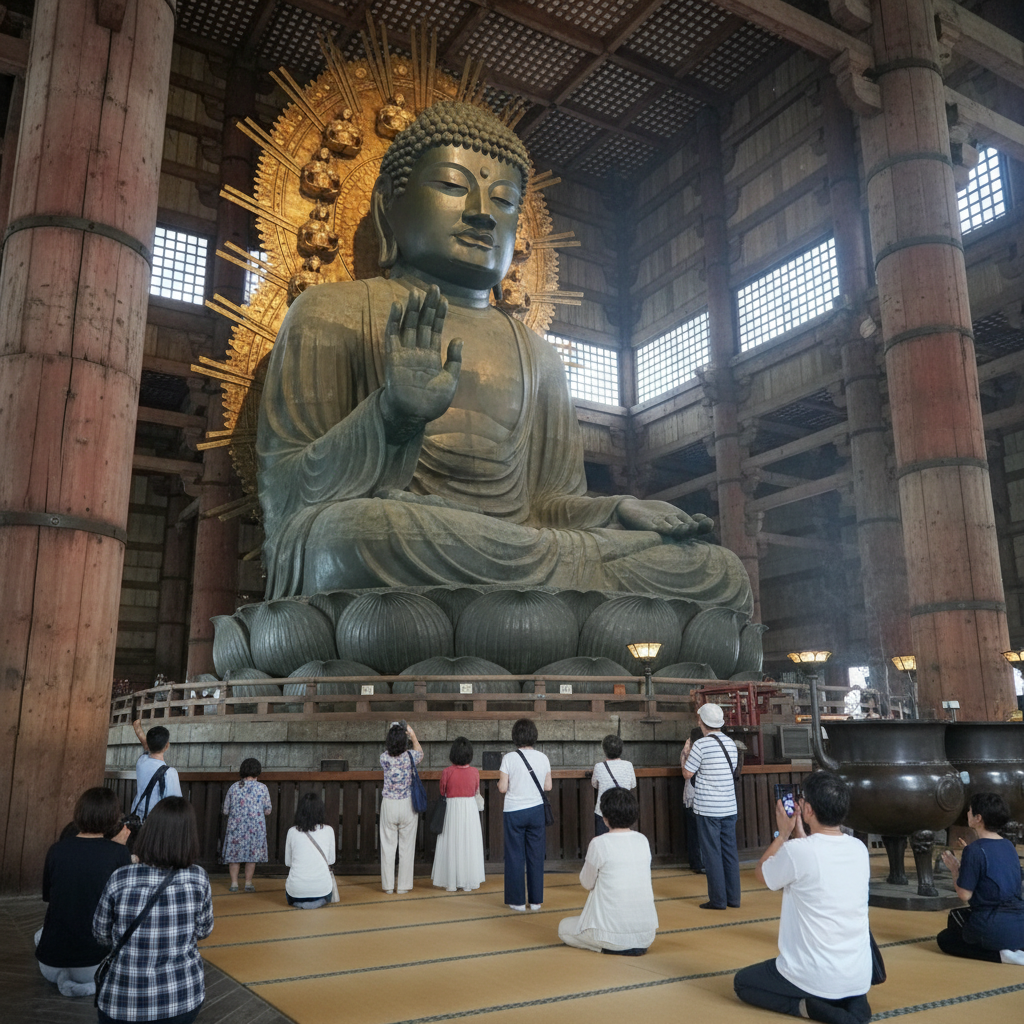
Beyond the Nandaimon, a wide, gravel path leads you to the Daibutsu-den, the Great Buddha Hall. The sheer size of this wooden edifice, despite being only two-thirds its original scale after reconstruction, is staggering. It is the largest wooden building in the world, its vast roofline soaring towards the heavens, its ancient timbers groaning with the weight of centuries. As you approach, the overwhelming 'impact' (迫力) of Todai-ji truly begins to sink in. This isn’t just a building; it’s a monument to a civilization’s faith and engineering prowess, rebuilt from the ashes of war and natural disaster countless times. The air here feels thick with history, saturated with the prayers and aspirations of generations.
Stepping inside the cavernous hall, the world outside seems to recede. And then, you see him. The Daibutsu. The Great Buddha. Seated majestically, nearly 15 meters (50 feet) tall, a bronze colossus bathed in the soft, filtered light of the hall. His serene expression, the vastness of his presence, is utterly captivating. This isn't just a statue; it's a profound spiritual experience. You crane your neck, taking in the intricate details of his robes, the powerful sweep of his shoulders, the delicate curl of his hair. The bronze, aged over centuries, holds a dark, burnished glow, reflecting the countless flickering prayers offered before him. He has witnessed more than a thousand years of Japanese history – empires rising and falling, wars, natural calamities – yet he remains, a silent, unwavering beacon of peace. The scale is so immense that you feel yourself shrink, a tiny speck in the presence of such ancient, enduring power. Take your time here. Walk around the statue, marvel at the secondary bodhisattvas, and reflect on the sheer human effort and unwavering devotion that brought such a masterpiece into being.
12:30 PM – Whispers of the Past: Todai-ji’s Hidden Gems
Beyond the Great Buddha Hall, explore the surrounding Todai-ji complex. The bell tower, with its immense bell rung for special occasions, offers a glimpse into Buddhist rituals. The beautiful Shoro (Belfry) stands on a hill, offering tranquil views. Consider a quick detour through the Kagami-ike pond, its still waters reflecting the grandeur of the Daibutsu-den. These quieter corners allow for reflection, a moment to absorb the monumental experiences you’ve just had. The sheer volume of ancient timber, the craftsmanship evident in every joint and beam, tells a story of an advanced civilization. The geological setting, nestled in the gentle hills surrounding the Nara basin, provided both protection and resources for this monumental undertaking.
1:30 PM – Culinary Connection: Nara’s Local Flavors
Leaving the sacred grounds, your appetite will surely be piqued. For lunch, let’s forgo the obvious tourist traps and seek out a genuine Nara culinary experience. We'll aim for a smaller, family-run eatery nestled on a quiet side street, perhaps specializing in kakinoha-zushi (persimmon leaf sushi), a local delicacy. Imagine the delicate aroma of cured mackerel or salmon, pressed with vinegared rice and wrapped in the fragrant, slightly astringent persimmon leaf. It’s a taste that speaks of local tradition and ingenuity. Or perhaps a bowl of heartwarming udon or soba, made with local ingredients, the broth rich and savory, the noodles perfectly chewy. The ambiance will be one of quiet warmth, the clatter of chopsticks and hushed conversations creating a symphony of local life. The simple, fresh flavors are a perfect counterpoint to the grandeur of Todai-ji, grounding you back in the delicious realities of Japanese culture.
2:45 PM – Tranquil Reflections: Isuien Garden & Yoshikien Garden
After the monumental impact of Todai-ji, a dose of tranquility is in order. A short walk will lead us to Isuien Garden, a stunning example of a traditional Japanese strolling garden, incorporating distant Mount Wakakusa and Todai-ji’s Nandaimon Gate as ‘borrowed scenery’. The meticulously manicured moss, the placid ponds reflecting the azure sky, the delicate bridges, and the teahouses – every element is designed to create a sense of harmony and peace. Adjacent to it lies Yoshikien Garden, equally beautiful but often less crowded, offering three distinct garden styles: a pond garden, a moss garden, and a tea ceremony garden. Here, the subtle play of light and shadow, the gentle ripple of water, and the hushed quiet invite contemplation. It’s a perfect opportunity to slow down, to breathe in the crisp air, and to appreciate the artistry of Japanese landscape design. The vibrant green of the moss, the carefully placed rocks, and the seasonal flowers paint a living masterpiece.
4:30 PM – The Echoes of Faith: Kofuku-ji Temple
From the serene gardens, we’ll make our way to Kofuku-ji Temple, another World Heritage site and one of Nara's most historically significant temples, dating back to the 7th century. While parts of it are still undergoing restoration, its iconic five-story pagoda, Japan's second tallest, is an undeniable landmark. The vibrant vermillion and white structure stands proudly against the sky, a testament to enduring faith and architectural brilliance. Walk around the grounds, observe the octagonal hall, and feel the centuries of devotion emanating from this sacred place. The contrast between the sheer scale of Todai-ji and the elegant, understated beauty of Kofuku-ji offers a fuller picture of Nara’s spiritual legacy.
5:30 PM – Scenic Retreat: Drive to Accommodation
As the late afternoon sun casts long shadows, painting the sky in hues of orange and purple, we’ll retrieve our BRZ. The city's gentle hum will guide us as we leave the immediate tourist hub. For an authentic and serene experience, we'll head towards a traditional ryokan nestled slightly outside Nara's bustling center, perhaps in the picturesque hills to the east or south. The drive there will be a pleasure, navigating winding roads that climb gently, offering glimpses of the setting sun over the distant plains. The BRZ's headlights will cut through the deepening twilight as we ascend, the engine note a steady companion. The crisp evening air, carrying the scent of pine and damp earth, will invigorate your senses. Arriving at the ryokan, typically a low-slung, elegant wooden structure, you’ll be greeted with warm hospitality. The soothing tranquility of a traditional Japanese inn, perhaps with an onsen (hot spring), will be the perfect balm after a day of profound historical exploration.
7:00 PM – Kaiseki Delights: A Taste of Japanese Artistry
Dinner at the ryokan will be an experience in itself: a meticulously prepared kaiseki meal. This multi-course feast is not just food; it's an edible work of art. Each dish, from delicate sashimi to perfectly grilled local fish, seasonal vegetables, and savory broths, is presented with exquisite beauty and precision. The flavors are subtle yet profound, celebrating the freshest local ingredients. You'll savor each bite, appreciate the textures, and marvel at the intricate presentation. Paired with a fine sake, the meal becomes a journey through Japanese culinary philosophy. The setting, often a private dining room overlooking a small garden, enhances the serene atmosphere. It’s a moment to reflect on the day’s wonders, the profound history you’ve witnessed, and the sheer joy of cultural immersion.
9:00 PM – Stargazing and Serenity: An Evening of Reflection
After dinner, perhaps a leisurely soak in the onsen, the warm mineral waters easing any lingering fatigue. The quiet of the ryokan, broken only by the chirping of crickets or the gentle rustle of leaves, is a stark contrast to the urban symphony of Osaka. Step outside onto a balcony or into the garden, and look up. Away from city lights, the sky can often be a breathtaking canvas of stars. The cool night air, the scent of nature, and the quietude offer a perfect end to a day steeped in ancient history and cultural discovery. The journey in your BRZ, and the deep dive into Nara's heritage, culminates in a profound sense of peace and satisfaction.
Day 2: Winding Roads, Hidden Vistas, and the Thrill of the Drive
8:00 AM – Awakening to Nature: Traditional Breakfast & Departure
Awakening to the gentle morning light filtering through shoji screens, you'll be treated to a traditional Japanese breakfast. Imagine grilled fish, miso soup, steamed rice, pickled vegetables, and perhaps some delicate tofu. It’s a nourishing, flavorful start to the day, preparing you for another day of exploration. The crisp morning air invigorates you as you step back into the BRZ, its engine purring gently to life. Today is about savoring the drive, exploring the roads less traveled, and discovering vistas only accessible by car. It’s about the pure, unadulterated joy of connecting with Japan’s landscape through the lens of a performance car.
9:00 AM – The Ascent: Mount Wakakusa and Scenic Drives East of Nara
Our journey today begins with an ascent into the hills east of Nara, venturing beyond the immediate tourist hotspots. We'll aim for roads that wind through the foothills of Mount Wakakusa and further into the Yoshino-Kumano National Park area, even if not reaching the park itself, the periphery offers spectacular driving. The BRZ, designed for precisely this kind of spirited driving, comes into its own. The tarmac unfurls ahead, a ribbon of asphalt draped over rolling hills. You’ll feel the car’s balanced chassis, its low center of gravity, and the precise, communicative steering as you carve through turns. Downshift, feel the engine revs climb with a satisfying snarl, and accelerate out of the corner, the scenery blurring beautifully at the periphery of your vision. This isn’t about speed; it's about rhythm, about flow, about becoming one with the machine and the road. The views open up dramatically with altitude, revealing panoramic vistas of the Nara basin stretching out to the west, often shrouded in a soft, ethereal mist in the early morning. The forests here are ancient, deep, and tranquil, their canopy forming a tunnel of dappled sunlight.
10:30 AM – The Hidden Sanctuary: Kasugayama Primeval Forest & Beyond
Beyond the well-trodden paths of Nara Park lies the Kasugayama Primeval Forest, a UNESCO World Heritage site and a sacred natural area preserved since the 9th century. While driving directly into its deepest parts is restricted, the winding roads bordering it offer glimpses into this mystical landscape. We'll explore routes that hug its perimeter, perhaps heading towards the quieter areas around Tsukigase Plum Valley (depending on season, but beautiful even without plums) or venturing further southeast. The roads become even more intimate here, narrower, sometimes single-lane, demanding heightened focus and rewarding you with profound solitude. The BRZ’s compact size is a distinct advantage, allowing confident navigation of these paths. You might encounter small, forgotten shrines nestled in the trees, their ancient stones covered in moss, their presence adding to the mystique of 'Secret Japan.' The air here is clean, smelling of damp earth and ancient trees, a profound connection to the land.
Imagine a series of S-curves, perfectly cambered, calling for a delicate dance between throttle and brake. The BRZ responds with exhilarating precision, its chassis eager to change direction, its tires gripping the asphalt with unwavering confidence. The exhaust note, a deeper, more resonant thrum here in the open countryside, bounces off the dense foliage. This is driving as it was meant to be – an engagement, a conversation between driver, car, and road.
12:00 PM – Lunch with a View: Michi-no-Eki or Local Eatery
For lunch, we'll seek out a Michi-no-Eki (roadside station) or a small, locally-loved restaurant in one of the quaint towns we encounter. Michi-no-Eki are far more than just rest stops; they are community hubs, showcasing regional produce, local crafts, and often serving delicious, unpretentious food. You might find exquisite local teas, unique pickles, or freshly baked goods. For lunch, perhaps a hearty bowl of local ramen or a simple, perfectly prepared teishoku (set meal) featuring seasonal ingredients. The flavors are honest, comforting, and reflective of the region. Dining amongst locals, observing their daily rhythms, is an enriching cultural experience that simply cannot be replicated by tourist-oriented establishments.
1:30 PM – Post-Lunch Drive: Southern Nara's Serene Landscapes
With appetites satisfied, we continue our exploration into the more rural and serene parts of southern Nara. This region is characterized by gently rolling hills, tranquil rivers, and charming traditional villages that seem untouched by time. The roads here are less traveled, offering extended stretches where the only sounds are the wind, the rustling leaves, and the joyous thrum of the BRZ's engine. You'll drive past terraced rice paddies, their water shimmering under the sun, reflecting the endless sky. Small, ornate Buddhist temples and Shinto shrines dot the landscape, often marked by ancient cedar trees. This is a chance to truly unwind, to soak in the pastoral beauty of Japan, and to enjoy the pure, unadulterated pleasure of driving a beautifully balanced sports car through a stunning natural environment. The gentle curves and moderate speeds allow for a more contemplative drive, eyes scanning the horizon for the next breathtaking view.
3:00 PM – A Final Glimpse of History: Tsubosaka-dera Temple (Optional)
If time permits, consider a detour to Tsubosaka-dera Temple, a mountain temple with a fascinating history and incredible views. Famous for its large stone Buddha statues, including an immense seated Buddha carved into the mountainside, it offers a different perspective on Buddhist art and devotion. The drive up to the temple can be a delightful series of switchbacks, challenging yet rewarding. From its lofty perch, the temple offers expansive views over the surrounding mountains and valleys, a truly 'Secret Japan' vista. The tranquility and spiritual power of the place are palpable, a serene counterpoint to the earlier grandeur of Todai-ji.
4:30 PM – The Homeward Journey: Reflection on the Road
As the afternoon wanes and the sun begins its slow descent, we begin our return journey towards Osaka. The route might take us through different prefectural roads, offering new perspectives on the Kansai landscape. The feeling is one of quiet satisfaction. The BRZ, having performed flawlessly, feels like an extension of yourself. You’ve not just visited Nara; you’ve experienced it, felt its ancient pulse through your feet on the pedals, heard its whispers through the engine’s song, and seen its hidden beauty through the panoramic view from your cockpit. The memories of the colossal Daibutsu, the serene gardens, the winding roads, and the delicious local food will already be etched in your mind. The cityscape of Osaka will gradually reappear on the horizon, a familiar beacon inviting us back to the modern world, but forever changed by the ancient power and profound beauty we've embraced on this unforgettable journey.
The journey back to Osaka becomes a contemplative experience. The rhythmic hum of the engine, the subtle vibrations through the steering wheel, and the darkening sky outside the windows combine to create a meditative atmosphere. You recall the sheer scale of the Daibutsu, the intricate details of Todai-ji’s architecture, the playful deer, and the profound serenity of the gardens. But just as vividly, you remember the precise feedback of the BRZ's steering through a tight hairpin, the satisfying 'thwack' of a perfectly executed gear change, and the sensation of being utterly connected to the road beneath you. This is the difference: not just seeing Japan, but feeling Japan, living it. The roads that seemed merely functional on the way out now feel like old friends, traversed with confidence and enjoyment. The transition from ancient wonders to modern vibrancy is seamless, made possible by the freedom of your own four wheels. As the glittering skyline of Osaka emerges, a sense of accomplishment settles in, a testament to a journey well-driven and deeply experienced.
Todai-ji, Daibutsu, Impact, World Heritage, History - Expert Advice & Cultural Nuances
Having navigated every conceivable road in Japan, from bustling cityscapes to remote mountain passes, I've gathered a wealth of insights that can elevate your road trip from good to absolutely legendary. This isn't just about getting from A to B; it's about embracing the nuances of Japanese driving culture and tapping into the authentic experiences that often lie just beyond the typical tourist radar.
Embrace the Michi-no-Eki: More Than Just a Rest Stop
Forget the sterile, cookie-cutter service stations of other countries. Japan's 'Michi-no-Eki' (道の駅), or roadside stations, are cultural hubs. As a former train conductor, I appreciate efficiency, but as a driver, I crave authenticity, and Michi-no-Eki deliver both. They are strategically placed across the country, often in scenic locations, and each one is a microcosm of its surrounding region. Expect to find meticulously clean restrooms, which, trust me, is a luxury you'll appreciate on a long drive. But don't stop there! Dive into the local produce sections – you'll discover seasonal fruits and vegetables you've never seen, often grown by local farmers. Sample regional snacks, from freshly baked bread to unique local sweets. Many Michi-no-Eki boast their own restaurants serving delicious, unpretentious local cuisine, often at very reasonable prices. These aren't just places to stretch your legs; they're opportunities to engage with local culture, taste authentic flavors, and pick up unique souvenirs that truly reflect the area. They offer an invaluable window into 'Secret Japan', providing a genuine connection to the communities you're driving through.
Unearthing Hidden Gems: How Locals Discover the Best
The secret to finding those truly authentic, off-the-beaten-path experiences? Look for the locals! If you see a parking lot packed with Japanese license plates, especially during lunch or dinner, that's your cue. These are the places that don't need English menus or Instagram hashtags; their reputation is built on quality and word-of-mouth. Don't be shy about venturing down a narrow street or into a seemingly unassuming alleyway. Japanese culinary culture often hides its best treasures in plain sight. Be prepared for a language barrier, but a smile and a few universal gestures often bridge the gap beautifully. You might end up in a tiny, generational noodle shop where the broth recipe has been perfected over decades, or a small pottery studio showcasing exquisite local craftsmanship. These encounters are often the most memorable, leaving you with stories far richer than any guidebook can provide. The thrill of discovery is amplified when you're behind the wheel of your 86 or BRZ, granting you the freedom to chase these whispers of authenticity.
Driving in Japan: Nuances for a Smooth Journey
While driving in Japan is generally a highly civilized and pleasant experience, there are a few cultural nuances to keep in mind. Firstly, remember to drive on the left side of the road. This will become second nature quickly, especially in a right-hand drive car like the 86 or BRZ. Japanese drivers are incredibly polite and considerate; aggressive driving is rare. Speed limits are strictly enforced, often through subtle speed cameras, so adhere to them diligently – typically 40-60 km/h in urban areas and 80-100 km/h on expressways. Pay close attention to road signs, which are often in both Japanese and English. Pedestrians always have the right of way, even if they're not explicitly in a crosswalk; always be prepared to stop. Lastly, be mindful of narrow roads, especially in older towns or rural areas. The 86 or BRZ's compact dimensions are a blessing here, but always exercise caution and anticipate oncoming traffic around blind corners. Japanese drivers will often flash their lights as a courtesy to let you know of a hazard ahead or to yield, rather than as an aggressive signal. Embrace this polite rhythm, and your drive will be as smooth as the 86 or BRZ's gear changes.
Todai-ji, Daibutsu, Impact, World Heritage, History - Detailed Logistics & Pre-Trip Tips
Preparation is the cornerstone of any great adventure, and a Japanese road trip in a JDM icon like the 86 or BRZ is no exception. As someone who's spent years traversing these islands, both by rail and by road, I can tell you that a little foresight goes a long way in ensuring your journey is as exhilarating as it is seamless. Let's delve into the practicalities that will make your drive truly unforgettable in 2026.
Navigating 2026 Traffic & Technology
Japan’s road infrastructure is world-class, but like any developed nation, traffic can be a factor. In 2026, real-time navigation systems are your best friend. Modern rental cars often come equipped with excellent in-car GPS units, usually voice-guided in English. However, having a reliable smartphone app like Google Maps or Waze (if available and updated for Japan) as a backup is highly recommended. These apps offer real-time traffic updates and can often reroute you around unexpected congestion. When departing Osaka or returning in the late afternoon, expect higher traffic volumes, especially on expressways. Planning your itinerary to avoid peak morning (7 AM - 9 AM) and evening (5 PM - 7 PM) rush hours for major city entry/exit points will significantly enhance your driving pleasure.
The ETC Card: Your Gateway to Seamless Toll Roads
Japanese expressways are toll roads, and while cash payment is possible, an Electronic Toll Collection (ETC) card is an absolute game-changer. It’s like having an invisible hand pay your tolls as you cruise through dedicated ETC lanes without stopping. This isn’t just about convenience; it often grants access to discounted rates on certain routes and at specific times. When renting your 86 or BRZ, inquire about renting an ETC card along with the car. It's a small investment that saves immense time and hassle, allowing you to maintain the flow and rhythm of your drive without constantly fumbling for change. Imagine effortlessly gliding through toll gates, the 86 or BRZ’s engine maintaining its smooth hum, while others queue for manual payment. It’s part of the seamless Japanese driving experience.
Fueling Your Adventure: Japanese Gas Stations
Finding gas stations (ガソリンスタンド, gasorin sutando) is generally easy, even in rural areas. Most modern stations are self-service, but you'll still find full-service stations, especially off major routes. If you opt for full service, a few key phrases will be helpful. The most important? "Mantan!" (満タン!), which means "full tank." You'll also likely be asked "Regular?" (レギュラー?), "High-oku?" (ハイオク? - high octane), or "Diesel?" (軽油? - kei-yu). For your 86 or BRZ, high-octane (ハイオク) is typically recommended for optimal performance. The attendants are usually incredibly polite and efficient, often bowing and guiding you out of the station. Self-service stations can be intimidating at first, as instructions are primarily in Japanese. Look for the color-coded nozzles (red for regular, yellow for high-octane, green for diesel) and follow the touch-screen prompts, often with an English language option. Payment is usually by credit card or cash. Take a moment to appreciate the precision and cleanliness of even the most unassuming Japanese gas station – it's a testament to their national ethos.
Parking Prowess: Mastering the Art of Japanese Parking
Parking in Japan, especially in popular tourist areas or city centers, can require a bit of strategy. Always look for designated paid parking lots (駐車場, chūshajō). Street parking is rare and usually illegal, leading to quick fines and potential towing. Many parking lots operate on a pay-per-hour or fixed-rate system, often with clear pricing displayed. In busier areas, multi-story car parks are common. Their spaces can be compact, but your 86 or BRZ’s nimble handling and precise dimensions make navigating them a joy, not a chore. Be mindful of automated parking systems where your car is lifted onto a platform – follow all instructions carefully. For popular attractions like Todai-ji, arriving early or parking slightly further away and enjoying a scenic walk through Nara Park can save you time and stress. The satisfaction of slotting your JDM machine perfectly into a tight spot is a small victory in itself!
The Unparalleled Thrill of a JDM (MT) Drive
This is where the true magic happens. Driving an 86 or BRZ with a manual transmission in Japan is an experience that transcends mere transportation. It’s an intimate dance with the road, a symphony of man and machine. The short, crisp throws of the gear lever, the perfectly weighted clutch pedal, the immediate response of the engine as you blip the throttle for a downshift on a winding mountain road – these are moments of pure driving euphoria. The connection you feel through the steering wheel, the feedback from the chassis, the visceral growl of the boxer engine through a tunnel… it’s a living, breathing experience that an automatic transmission simply cannot replicate. It’s about being an active participant in your journey, not just an observer. This is why these cars are iconic, why they capture the hearts of enthusiasts worldwide. They transform every mundane commute into an opportunity for enjoyment, and every scenic route into a canvas for driving artistry. Embrace the stick shift; it’s the key to unlocking the true spirit of a Japanese road trip.
Todai-ji, Daibutsu, Impact, World Heritage, History - Comprehensive FAQ
Embarking on a road trip through Japan, especially in a specialized JDM vehicle, naturally brings up a few questions. As someone deeply familiar with both driving and the intricacies of Japanese travel, I'm here to address your concerns and ensure you feel confident and prepared for your adventure.
Do I need a special license to drive in Japan?
Yes, to legally drive in Japan as a foreign visitor, you'll need three crucial documents. First, you must possess a valid international driving permit (IDP) issued under the 1949 Geneva Convention. This permit must be obtained in your home country before you travel to Japan. Second, you’ll need your original, valid driver's license from your home country. These two documents must always be carried together. Finally, your passport is also required for identification. Please ensure that your international driving permit is current and valid for the entire duration of your stay. For certain countries that are not signatories to the 1949 Geneva Convention, an official Japanese translation of your national license is required instead of an IDP. Always verify the specific requirements for your nationality well in advance of your trip.
What about car insurance?
When renting a car in Japan, comprehensive insurance is standard and highly recommended. Rental companies typically offer a basic liability package, but it's always wise to opt for additional coverage, such as a Collision Damage Waiver (CDW) and Non-Operation Charge (NOC) coverage, which protects you from having to pay for the vehicle's downtime if it's damaged. Understand the deductible (the amount you pay before insurance kicks in) and ensure you're comfortable with the level of coverage. Don't hesitate to ask your rental provider for a detailed explanation of their insurance policies in English. Peace of mind is priceless when exploring new roads.
I'm nervous about driving a manual transmission (MT) car. Any tips?
It's completely normal to feel a little apprehensive, especially if you're not accustomed to driving a stick shift regularly, or if you're dealing with left-hand traffic for the first time in an MT car. However, the 86 and BRZ are renowned for their incredibly forgiving and engaging manual transmissions. The clutch engagement is smooth, and the gear throws are precise and satisfying. If you're confident in your basic MT skills, you'll quickly adapt. My advice: practice a bit in a quiet area before heading out onto main roads. Focus on smooth clutch release and precise shifts. If, however, you genuinely feel uncomfortable, discuss automatic transmission options with your rental provider. While the manual offers an unparalleled connection to the car and the road, your safety and enjoyment are paramount.
What are the road conditions like in winter, especially around Nara?
Nara, being in the Kansai region, generally experiences milder winters compared to Japan's northern or mountainous areas. However, light snowfall can occur, particularly in January and February. Major roads and expressways are usually well-maintained and quickly cleared. In the unlikely event of significant snowfall or icy conditions, especially on the winding mountain roads we've discussed, winter tires (studless tires) or snow chains become essential. Rental companies will typically equip cars with winter tires during the colder months if you're traveling to snow-prone areas. Always check local weather forecasts before venturing out, and if conditions are severe, consider adjusting your itinerary. Safety first, always.
Todai-ji, Daibutsu, Impact, World Heritage, History - The Final Call: Your Ultimate Japanese Road Trip Awaits
As the engine cools down after two days of exhilarating exploration, and the memories of ancient wonders and thrilling drives settle in, you'll realize this wasn't just a trip; it was an awakening. You didn't just see Japan; you felt its pulse, experienced its history through the grand majesty of Todai-ji and the Daibutsu, and embraced its hidden beauty through the winding roads only accessible to the adventurous driver. The whisper of wind through ancient cedars, the subtle aroma of local cuisine, the precise engagement of gears in your 86 or BRZ – these are the threads that weave together a tapestry of unforgettable moments, a narrative far richer than any guidebook could ever tell. You've forged your own path, leaving behind the well-worn tourist trails for an authentic, visceral connection with the heart of Japan.
Are you ready to truly live this adventure? To shed the constraints of public transport and feel the unparalleled freedom of the open road in an iconic Japanese machine? To carve your own story through the landscapes that have inspired poets and emperors for centuries? To experience the thrill of a finely tuned JDM car as it becomes an extension of your will, navigating every curve and climb with precision and passion?
Your journey begins now. Don't just dream about Japan; drive it. Feel the legend. Feel the heritage. Feel the performance. For the ultimate Japanese road trip, where every turn reveals a new wonder and every mile is an exhilarating experience, look no further. We understand the passion for driving, the desire for authenticity, and the thrill of a true JDM adventure. Visit us at Omoshiro Rent-a-car Osaka Chuo. We're not just renting cars; we're handing you the keys to an unforgettable journey, backed by the knowledge of a former Kintetsu conductor who knows these roads like the back of his hand, and a fleet of meticulously maintained JDM vehicles like the spirited 86 and BRZ. Let us help you craft your ultimate Japanese road trip. The road is calling, and your dream car awaits.
