
Shigi-san, Chogosonshi-ji, Tiger, Good Fortune, Drive - The Philosophy of Driving in Japan
Ah, Japan. The land of immaculate efficiency, polite service, and, of course, the Shinkansen. As a former conductor on the storied Kintetsu railway lines, I can attest to the sheer poetry of a train journey: the rhythmic click-clack, the fleeting glimpses of landscapes through a window, the precision of arrival and departure. It's a symphony of engineered excellence, a marvel of modern travel. And for the vast majority of visitors, it's the only Japan they ever truly experience.
But what if I told you there's another Japan? A deeper, more intimate Japan that hums just beyond the reach of the last station platform? A Japan of hidden valleys, mist-shrouded mountain passes, and ancient traditions nestled in verdant folds of the earth, waiting to be discovered by those with the spirit of an adventurer and the keys to a truly special machine. This, my friends, is the Japan you unlock with a car.
Forget the rigid timetables, the crowded carriages, the need to conform to a pre-packaged itinerary. With a car, particularly a spirited JDM icon like an 86 or BRZ, you dictate the rhythm of your journey. You choose the detour that catches your eye, the secluded viewpoint whispered about only by locals, the tiny ramen shop tucked away down a forgotten lane. The freedom is intoxicating, the potential for serendipitous discovery, boundless. Especially when based in Kansai, with Osaka as your launchpad, the entire western half of Honshu unfurls before you like a meticulously hand-drawn map, each line a potential adventure.
Public transportation, for all its undeniable merits, streamlines your journey, compresses it into a series of predictable movements. But driving? Driving expands it. It transforms transit from a means to an end into an integral part of the experience. The winding roads become pathways to enlightenment, the engine's song a soundtrack to your awakening, and the shifting gears a dance with the very soul of the landscape. It's not just about reaching your destination; it's about the pure, unadulterated joy of the journey itself, a philosophy deeply ingrained in the heart of any true Japanese car enthusiast. So, let's cast aside the train tickets for a moment and embrace the open road. Let's chase the elusive 'Secret Japan,' beginning with the auspicious slopes of Shigi-san and the legendary Chogosonshi-ji.
Shigi-san, Chogosonshi-ji, Tiger, Good Fortune, Drive - The 2-Day Itinerary: Deep Dive
Day 1: Osaka's Roar to Shigi-san's Mystical Ascent
07:00 AM: The Awakening of the Beast in Osaka
The morning sun, still gentle, casts long shadows across the concrete canyons of Osaka. But for you, the day begins with a palpable buzz of anticipation. You're not just renting a car; you're embarking on an odyssey. Walking towards your waiting JDM marvel – let's imagine a pristine, raven-black 86, its lines sharp, purposeful, a silent promise of exhilaration – you feel a connection. The subtle scent of leather and new car permeates the air as you slip into the driver's seat. The dashboard glows to life, the satisfying click of the seatbelt, the precise engagement of the clutch, the short, decisive throw into first gear. The 86's Boxer engine rumbles to life with a low, throaty growl, a promise of the spirited journey ahead. This isn't just a car; it's an extension of your adventurous spirit, a finely tuned instrument for exploring the soul of Japan.
07:30 AM: Navigating the Urban Tapestry
Your initial drive takes you through the waking arteries of Osaka. The city, a colossal living organism, begins its daily rhythm. You'll glide past convenience stores already abuzz with activity, salarymen darting across intersections, and the aroma of freshly brewed coffee mingling with the faint, sweet scent of distant bakeries. The 86, nimble and responsive, slices through the urban flow with effortless grace. You feel the immediate feedback through the steering wheel, the precise balance of the chassis. It's a reminder that even in the city, this car is eager to dance. Soon, the towering buildings begin to thin, giving way to more suburban landscapes, a gradual fading of concrete into verdant green.
08:30 AM: The Expressway's Embrace - Towards Nara
Merging onto the expressway, the 86 stretches its legs. The steady hum of the tires on smooth asphalt, the distant mountains gradually growing larger on the horizon – these are the initial brushstrokes of your canvas. The journey towards the Nara Prefecture is a testament to Japan's infrastructural prowess: impeccably maintained roads, clear signage, and efficient traffic flow. You pass through tunnels carved through ancient rock, emerging into breathtaking vistas of rolling hills and neatly cultivated fields. This stretch, while a highway, is not merely transit; it’s a prelude, a cleansing of the urban palate before the true flavors of the countryside unfold. The 86 eats up the miles with refined urgency, its engine a constant, reassuring companion.
09:30 AM: The Scent of Mountain Air - Approaching Shigi-san
As you exit the expressway and delve deeper into Nara, the air visibly changes. The crispness of mountain air replaces the city's mingled scents. The roads begin to narrow, the curves become more pronounced. This is where the 86 truly comes alive. The precise steering, the taut suspension, the way it leans into each bend with eager confidence – it's a driving enthusiast's dream. You're no longer just moving; you're flowing with the landscape. The route to Shigi-san, while not a grand serpentine pass, offers delightful winding sections that foreshadow the adventure to come. The initial climbs are gentle, but the scenery grows increasingly dramatic, with dense forests of cedar and cypress beginning to dominate the views.
10:30 AM: First Glimpse and Local Flavors - Base of Shigi-san
You arrive at the base of Shigi-san, a mountain steeped in history and spiritual energy. The air here is cool and carries the faint scent of damp earth and ancient timber. Before ascending to the main temple complex, you pause at a local eatery, perhaps a small, unassuming shop specializing in *kaki no ha zushi* – sushi wrapped in persimmon leaves, a Nara specialty. The delicate flavor of cured mackerel or salmon, infused with the subtle fragrance of the leaf, is a perfect, light refreshment. Paired with a warm cup of hojicha, it’s a quiet moment of immersion, a taste of local life that public transport visitors often miss. From here, you can already sense the mountain's presence, an almost palpable spiritual weight drawing you upwards.
11:30 AM: The Ascending Drive – Road to Chogosonshi-ji
Now, the real driving begins. The road to Chogosonshi-ji is a winding ribbon of asphalt, rising steadily through a tunnel of dense green. This isn't a race track; it's a respectful ascent, but one that rewards a driver who understands the art of the turn. The 86, with its perfectly balanced chassis and low center of gravity, carves through the corners with a satisfying precision. The engine, a symphony of mechanical harmony, sings through the mid-range as you shift through the gears, downshifting smoothly before each hairpin, feeling the car settle, then powering out with a surge of momentum. Each curve reveals a new vista – a glimpse of the Yamato plain stretching out below, or the intricate canopy of trees that seem to embrace the road. The journey itself is a meditative experience, a gradual shedding of the mundane world as you climb towards the sacred.
12:30 PM: Arrival at the Tiger's Domain – Chogosonshi-ji
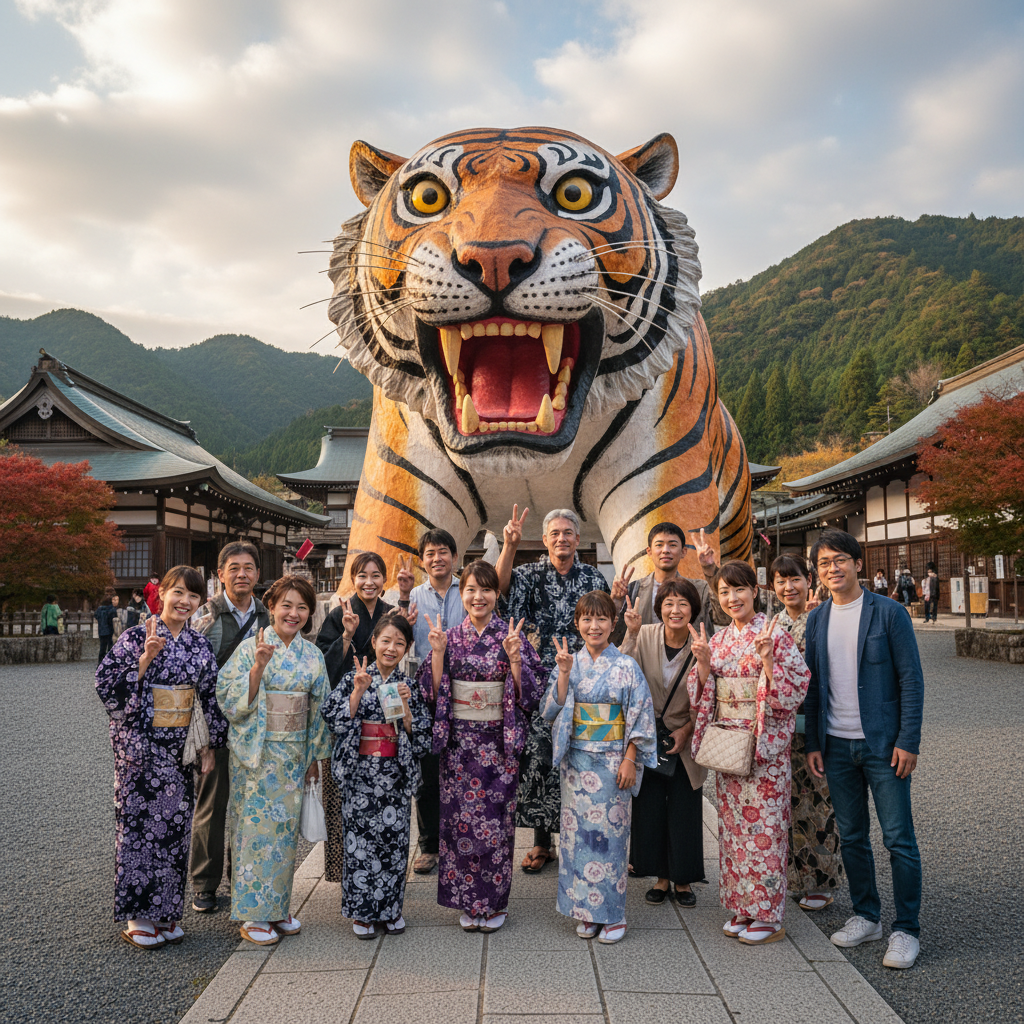
You emerge from the winding ascent into the spacious parking area of Chogosonshi-ji. The first thing that strikes you, even before stepping out of the car, is the sheer scale. And then, you see it – the colossal, vibrant yellow 'Tora-no-Okami' (Tiger God) statue. It stands guard, larger than life, its watchful eyes fixed on the approaching visitors. This isn’t just any temple; it’s the Temple of the Tiger, a place where this magnificent creature is revered as a messenger of Bishamonten, the god of warriors and treasures. Its history dates back to the 6th century, founded by Prince Shotoku himself, who, during a battle, sought divine intervention and was blessed by Bishamonten appearing in the sky, specifically during the Hour of the Tiger on the Day of the Tiger in the Year of the Tiger. Talk about auspicious! This confluence of circumstances cemented the tiger's sacred status here, making Chogosonshi-ji a powerful site for those seeking *kaiun* – good fortune and success.
01:00 PM: Lunch Amidst Ancient Serenity
Having parked your 86 with a sense of accomplishment, you make your way towards one of the small, charming eateries nestled within or just outside the temple grounds. Here, the cuisine is often simple yet profoundly satisfying. Consider a hearty bowl of *somen* noodles, served either hot in a delicate broth or chilled with a dipping sauce, adorned with seasonal vegetables. Or perhaps a traditional *teishoku* set meal featuring grilled fish, rice, miso soup, and an array of pickles. The atmosphere is one of serene contemplation, the distant sound of temple bells harmonizing with the murmur of conversation. It's sustenance for both body and soul, preparing you for the deeper exploration of this unique complex.
02:00 PM: The Roaring Guardians and the Path to Fortune
Your exploration begins in earnest. Start at the main gate, the *Nandaimon*, feeling the centuries of history emanating from its sturdy timbers. As you walk, the immense, cheerful tiger statue, Tora-no-Okami, commands attention. Its playful, almost cartoonish demeanor belies the serious power it represents. Further along, you'll encounter a series of smaller, more realistic tiger statues guarding pathways, their presence a constant reminder of the temple's unique spiritual connection. The very air seems charged with an ancient energy, a sense of protection and prosperity.
02:30 PM: The Main Hall and Kaidan Meguri
Ascend the steps to the main hall, the *Hondo*, a magnificent structure perched precariously on the mountainside. The architecture is striking, with its *kakezukuri* (stage-like) construction offering panoramic views of the surrounding mountains and the distant plain. Inside, the hushed reverence is almost overwhelming. The scent of incense hangs heavy, mingling with the aged wood. Here, you can offer prayers for good fortune, prosperity, and safety. But the true gem for the adventurous spirit lies beneath: the *Kaidan Meguri*, a pitch-black underground passage. Descend into its inky darkness, hands outstretched, navigating by touch alone. It's a symbolic journey through the darkness of ignorance to the light of enlightenment, and legend has it that if you can find the key hidden within, your wishes for good fortune will be granted. Emerging back into the daylight, blinking, you feel a renewed sense of clarity and purpose.
03:30 PM: Pagodas, Caves, and Waterfalls
Chogosonshi-ji is a sprawling complex. Wander through its various sub-temples and structures. The vibrant vermilion *Tahoto* pagoda, a multi-storied masterpiece, stands out against the green foliage, housing a statue of the enshrined Bishamonten. Explore the *Bishamonten-do*, another important hall dedicated to the deity. Don't miss the Fudo-Myoo Waterfall, a serene spot where purifying waters cascade down rocks, a place for quiet reflection. The entire complex is built into the mountain, meaning paths are often steep, winding, and reveal unexpected shrines and views around every corner. Take your time, letting the ancient stones and towering trees whisper their stories. The vibrant colors of the temple architecture – vermilion, gold, deep green – contrast beautifully with the natural hues of the forest, a visual feast for the senses.
05:30 PM: Descending with a Sense of Awe
As the afternoon wanes, you begin your descent from the temple grounds, carrying with you a profound sense of peace and auspicious energy. The tiger statues seem to bid you farewell, their watchful gazes a blessing for your journey. Reaching your 86, you feel a fresh surge of excitement. The drive down the mountain is equally exhilarating, the descent offering a different perspective, with sweeping views that open up before you. The setting sun may begin to paint the western sky with hues of orange and purple, promising a beautiful end to a truly inspiring day.
06:30 PM: Checking into Your Ryokan Retreat
Your accommodation for the night will be a traditional Japanese ryokan, perhaps nestled in a quiet village near Shigi-san, or slightly further afield towards Ikoma or the outskirts of Nara city for a broader selection. Pulling up in your 86, the contrast between the sleek, modern lines of the car and the timeless elegance of the ryokan is striking. The gentle welcome, the removal of shoes at the entrance, the soft rustle of kimono – it’s an immediate embrace of Japanese hospitality. Your room, a sanctuary of tatami mats, sliding shoji screens, and a low table, invites relaxation. The subtle scent of cypress wood and freshly brewed green tea fills the air.
07:30 PM: Onsen Bliss and Kaiseki Feast
After settling in, it’s time for the ultimate Japanese indulgence: the onsen. Slip into a yukata and head to the communal bath. The mineral-rich hot spring water works its magic, soothing tired muscles and washing away the day’s journey. The feeling of the warm water against your skin, perhaps under a canopy of stars if it's an outdoor rotenburo, is pure bliss. Following your revitalizing bath, prepare for a kaiseki dinner. This multi-course culinary experience is a masterpiece of seasonal ingredients, exquisite presentation, and delicate flavors. Each dish, a work of art, is a testament to Japan’s profound respect for nature and culinary craftsmanship. From thinly sliced sashimi to perfectly grilled local vegetables, tempura, and simmering stews, every bite is a journey for the palate. Paired with local sake, it's a truly unforgettable dining experience, enjoyed in the peaceful ambiance of your ryokan.
09:30 PM: Stargazing and Serenity
After dinner, perhaps a quiet stroll in the ryokan garden, or simply sitting by your room's window, gazing at the starlit sky. The mountain air is cool and clean, the only sounds the chirping of crickets or the distant murmur of a stream. This is the profound tranquility that city life rarely affords. As your futon is prepared by attentive staff, you drift off to sleep, your mind filled with images of giant tigers, ancient prayers, and the joyful hum of your 86, ready for tomorrow's adventures.
Day 2: Scenic Drives, Local Discoveries, and the Return Journey
07:00 AM: Sunrise and Traditional Breakfast
Wake up refreshed to the gentle glow of dawn. If your ryokan offers a view, watch as the sun paints the eastern sky with soft pastels, gradually illuminating the mountains. A traditional Japanese breakfast awaits: grilled fish, miso soup, steamed rice, pickles, tamagoyaki (rolled omelet), and various small side dishes. It’s a nourishing and wholesome start to the day, distinctly different from Western breakfasts, yet equally satisfying. Fuelled by this authentic meal, you feel ready to embrace the day's driving and discoveries.
08:30 AM: Revisit or New Vista – Exploring Shigi-san Further
Before departing the Shigi-san area, you have a choice. Perhaps you wish to revisit a particular corner of Chogosonshi-ji that captured your imagination, seeing it in the morning light. Or, you might choose to explore another part of the Shigi-san mountain range. There are other smaller shrines, perhaps a less-frequented hiking trail leading to an observation deck with even more expansive views. Imagine driving a different section of the Shigi-san Skyline Road, a scenic toll road that offers breathtaking panoramas over the Nara Basin and, on clear days, even beyond to Osaka. The 86 handles these undulating roads with graceful precision, its engine a happy companion through the twists and turns.
10:00 AM: Descending and a Taste of Local Craft
With the mountain's blessings still lingering, you begin your final descent from Shigi-san. The drive down is just as engaging, with the road unfolding beneath the wheels of your 86, the views progressively widening. Instead of rushing back, take a deliberate detour. Head towards a small artisan village or market often found in the valleys. Perhaps a pottery studio where local ceramics are crafted, or a shop selling regional sake or local produce. These aren't on typical tourist maps, but they offer genuine interaction and unique souvenirs, a real piece of the local culture to take home.
11:30 AM: Unearthing a Culinary Gem – Lunch
For lunch, eschew the guidebooks and seek out a spot that caters to local palates. This is where your driving freedom truly shines. Drive until you see a restaurant with a bustling parking lot filled with local cars, perhaps a humble façade hiding culinary excellence. It might be a family-run soba noodle shop known for its hand-cut noodles and rich broth, or a tonkatsu (pork cutlet) restaurant that's been perfecting its recipe for generations. The flavors will be authentic, the atmosphere warm and welcoming. This is the taste of real Japan, far from the tourist traps, a delicious reward for your adventurous spirit.
01:00 PM: The Yamato River Valley Drive – A Scenic Detour
Now for some more spirited driving. Instead of backtracking directly, take a scenic detour through the Yamato River Valley. This area offers a different kind of beauty: fertile plains, historic mounds (kofun), and ancient river systems. The roads here can be a delightful mix of gentle curves and long, sweeping stretches, perfect for letting the 86 breathe. You'll feel the connection to Japan's ancient past, driving through landscapes that have been cultivated for millennia. The Boxer engine's torque comes into play as you accelerate out of gentle corners, the exhaust note echoing subtly against the surrounding fields and low hills. It’s a driving experience that’s both relaxing and engaging, a testament to the versatility of your JDM companion.
02:30 PM: Coffee and Contemplation at a Roadside Haven
Find a quaint roadside café, perhaps one converted from an old farm building or nestled beside a small, gurgling stream. In Japan, even simple coffee shops often exude an understated elegance. Sip on a meticulously prepared cup of pour-over coffee, perhaps accompanied by a piece of local confectionery. As you relax, reflect on the past two days: the ancient tiger guardians of Chogosonshi-ji, the thrilling mountain passes, the peaceful ryokan stay, and the delicious local encounters. The sun, now higher in the sky, casts a warm glow, and you feel a profound sense of accomplishment, of having truly explored beyond the surface.
04:00 PM: The Homeward Bound Drive – Osaka Beckons Anew
With a renewed spirit, you begin the final leg of your journey back to Osaka. The roads gradually become more familiar, the signs for the city growing more frequent. This return journey is not simply an end; it’s a time for reflection. The 86, your faithful companion, continues to deliver a connected and engaging ride. You savor the feel of the steering wheel, the precise action of the pedals, the satisfying shift of gears. You’ve seen Japan from a perspective few tourists ever do – not through a window of a speeding train, but through the panoramic windscreen of a finely engineered JDM sports car, every curve and every vista intimately experienced. The transition from rural tranquility back to urban vibrancy is a gradual one, the distant skyline of Osaka growing larger with each passing kilometer, a testament to the journey you've just completed.
06:00 PM: Return to Osaka - A Satisfying Conclusion
Arriving back in Osaka as dusk begins to settle, you pull your 86 into the designated return spot. The engine, now quiet, ticks as it cools, a soft sigh after a magnificent two days. You step out, feeling invigorated, a little tired perhaps, but immeasurably richer for the experience. The keys feel heavier, imbued with the memories of winding roads, ancient temples, and the pursuit of good fortune. You haven't just visited Japan; you've driven its soul, discovered its secrets, and unleashed your inner adventurer. This is the unparalleled joy of exploring Japan by car.
Shigi-san, Chogosonshi-ji, Tiger, Good Fortune, Drive - Expert Advice & Cultural Nuances
Navigating Japan by car isn't just about the vehicle; it's about understanding the nuances of the road and the culture that surrounds it. As someone who has traversed this country countless times, both on rails and on asphalt, I can tell you that a little local knowledge goes a long way in enriching your journey.
The Delightful World of Michi no Eki (Roadside Stations)
Forget the sterile, impersonal rest stops you might be accustomed to. Japan’s “Michi no Eki” are cultural institutions, vibrant hubs that are far more than just places to refuel and stretch your legs. Each one is a microcosm of its local region, a celebration of its unique produce, crafts, and culinary delights. Pulling into a Michi no Eki, especially in a region like Nara, is an experience in itself. You'll find stalls laden with freshly harvested fruits and vegetables, often picked that very morning by local farmers. Imagine plump, sun-ripened peaches in summer, crisp apples in autumn, or sweet strawberries in spring. Beyond produce, you’ll discover artisanal goods – handmade pottery, textiles, regional sweets, and local sake that you won't find in urban supermarkets. Many feature excellent, often surprisingly gourmet, restaurants serving regional specialties, from hearty udon to local fish dishes. They are perfect for an authentic, unpretentious meal or to simply grab a unique souvenir. My advice? Always stop. You never know what culinary treasure or charming local craft you’ll stumble upon. They are essential stops for experiencing the true, unvarnished flavors of rural Japan.
Unearthing Hidden Local Gems
The magic of driving is the ability to deviate from the well-trodden path. To find those hidden gems that often go unmentioned in guidebooks, you need a discerning eye and a willingness to explore. Look for small, hand-painted signs in Japanese, often advertising local soba shops, artisan workshops, or obscure historical sites. Notice where local cars are parked – a packed parking lot at a seemingly nondescript restaurant is often a strong indicator of culinary excellence. Don't be afraid to pull over and wander into a small side street. Sometimes, the most memorable experiences come from these unplanned discoveries. Engage with locals if you can, even with a few Japanese phrases; a simple "Oishii desu ka?" (Is it delicious?) about a menu item can spark a friendly interaction and lead to an unforgettable recommendation. These are the moments when you truly connect with the heart of Japan, away from the tourist crowds.
Driving Etiquette and Safety on Japanese Roads
Japanese roads are generally immaculate, and drivers are remarkably polite, but there are a few things to keep in mind:
- Patience is a Virtue: Especially on mountain roads or through small villages, speed limits are strictly adhered to, and passing opportunities are rare. Embrace the slower pace; it’s part of the journey.
- Narrow Roads: Many rural and residential roads are incredibly narrow, sometimes barely wide enough for two cars to pass. Always be mindful of oncoming traffic, pedestrians, and cyclists. Be prepared to slow down or even pull over slightly to allow others to pass.
- Traffic Lights: Pay close attention to traffic lights. Japanese lights often have an extra yellow arrow for turning, indicating when a turn is permitted even if the main light is still red. Also, be aware that many intersections feature multiple lights for different directions.
- Pedestrian Priority: Pedestrians always have the right of way, especially at crosswalks. Be prepared to stop for them, even if they seem far away.
- Tolls: Most expressways are toll roads. The ETC system (which we'll discuss) makes it seamless, but always be prepared for cash payment if you don't have an ETC card or enter a non-ETC lane.
- Parking: Never park illegally, even for a moment. Fines are steep, and clamping/towing is common. Always use designated parking lots, whether they are paid coin parking lots in urban areas or temple/shrine parking.
- Night Driving: In rural areas, roads can be unlit and winding. Wildlife (deer, boar) can be a hazard. Drive with extra caution at night.
- Hydration and Breaks: Even with the joy of driving an 86, remember to take regular breaks, especially on longer journeys. Michi no Eki are perfect for this. Stay hydrated, especially in warmer months.
By respecting these cultural nuances and driving best practices, your journey through Japan will be not just safe, but deeply rewarding and truly authentic.
Shigi-san, Chogosonshi-ji, Tiger, Good Fortune, Drive - Detailed Logistics & Pre-Trip Tips
To truly savor the unparalleled experience of driving a JDM legend like the 86 through Japan, a little preparation goes a long way. Let's cover the essentials to ensure your adventure is as smooth and exhilarating as possible in 2026.
Current Traffic Realities (2026)
Japan's road network remains one of the most efficient and well-maintained in the world. For your Shigi-san adventure, starting from Osaka, expect moderate urban traffic during peak morning hours (roughly 7:30 AM to 9:00 AM) and evening rush (5:00 PM to 7:00 PM). However, once you transition from the city onto the expressways leading out of Kansai, and especially as you venture into the rural and mountainous areas surrounding Shigi-san, traffic typically lightens considerably. Mountain roads, while winding, are generally not congested. Weekends and national holidays can see increased traffic on popular routes and near major tourist spots, so planning your departure early on such days is always a wise strategy. Navigation systems, commonly available in rental cars, are incredibly accurate and will guide you effectively, often indicating real-time traffic conditions. Trust your car's navigation; it's usually spot-on.
The Magic of the ETC Card
If you're planning any expressway travel in Japan, an ETC (Electronic Toll Collection) card is an absolute necessity. Think of it as Japan's version of a transponder system. Without it, you'll be constantly stopping at toll gates, taking tickets, and paying cash (or using a credit card if available, but cash is more reliable). With an ETC card, you simply slow down, drive through the designated ETC lane, and the toll is automatically charged. It's seamless, efficient, and saves immense amounts of time and hassle. Most reputable rental car companies offer ETC cards as an optional extra, which I highly recommend adding to your booking. Your rental will likely come equipped with the ETC reader, you just need the physical card. It makes the expressway experience as fluid as the steering of your 86.
Fueling Your JDM Dream: Gas Station Etiquette
Japanese gas stations, especially in rural areas, often operate with full service, a delightful throwback to a bygone era. Pull up to the pump, and an attendant will usually greet you. Here's a quick guide to make the experience smooth:
- Engine Off: Always turn off your engine when at the pump. It's a safety and courtesy standard.
- "Mantan, Regyuraa, Onegai Shimasu" (満タン、レギュラー、お願いします): This simple phrase means "Full tank, regular gasoline, please." Most JDM cars like the 86/BRZ use regular (レギュラー, *regyuraa*) gasoline. If you're unsure, ask for "High-Oktan" (ハイオク, *haioku*) if your car requires premium, but for an 86, regular is usually fine unless specified.
- Payment: You can pay with cash or credit card. The attendant will often guide you to the payment counter after fueling.
- Service Beyond Fuel: Many attendants will also clean your windshield and even offer to check your tires. It's a level of service that's truly impressive.
As a former Kintetsu conductor, I've seen precision in every detail. It's fascinating to observe the same dedication to service, albeit in a completely different context, at Japanese gas stations. There was one time, early in my driving days, when I accidentally asked for diesel instead of regular – a common mistake for a newcomer! The attendant, with a kind smile and a gentle bow, corrected me, ensuring I didn't ruin my engine. It's these small, courteous interactions that add to the unique charm of traveling here.
Parking Your Precious JDM Steed
Parking in Japan requires a bit of awareness. In cities, coin parking lots (コインパーキング, *koin paakingu*) are ubiquitous. They are clearly marked, and payment is usually made at an automated machine before you exit. Many tourist attractions, like Chogosonshi-ji, have dedicated parking lots, which may charge a fee, typically paid at an attendant's booth or a machine. Always park within the lines, and never in unauthorized areas. Even for a quick stop, finding a proper parking spot is crucial. The compact size and maneuverability of an 86 make parking relatively easy, even in tighter spaces, but always be observant of signs and markings.
The Pure Exhilaration of a JDM (MT Car)
Driving an 86 or BRZ with a manual transmission through the winding roads around Shigi-san is more than just transport; it’s an immersive, tactile experience. There's a profound connection between driver and machine that automatic transmissions simply cannot replicate. You feel every nuance of the road through the steering wheel, every surge of power as you perfectly match revs for a downshift, every precise engagement of the clutch as you climb a steep incline. The crisp, short throws of the shifter, the responsive throttle, and the balanced chassis of these cars are engineered for pure driving pleasure. On roads where scenery unfolds rapidly and corners invite precise lines, a manual 86/BRZ transforms your journey into a dynamic dance, amplifying every sensation. It's not just a drive; it's a symphony of steel, rubber, and human input, connecting you directly to the legendary spirit of Japanese automotive engineering.
Shigi-san, Chogosonshi-ji, Tiger, Good Fortune, Drive - Comprehensive FAQ
Embarking on a driving adventure in Japan can bring up a few questions. Here are the answers to some of the most common queries to ensure you're fully prepared for your JDM experience.
Q: What are the requirements for driving in Japan with an international license?
A: To drive in Japan, foreign visitors typically need an International Driving Permit (IDP). For drivers from countries party to the 1949 Geneva Convention, an International Driving Permit (IDP) is required, along with your original domestic license and passport. Please ensure your IDP is valid for the duration of your trip and is issued by an authorized organization in your home country. Drivers from certain countries like Germany, France, Switzerland, Belgium, Taiwan, and Monaco may use a Japanese translation of their domestic license, obtained from the Japan Automobile Federation (JAF), instead of an IDP. Always verify the specific requirements for your nationality before you travel.
Q: What kind of insurance should I get for my rental car?
A: While basic liability insurance is usually included with rental cars in Japan, I highly recommend opting for comprehensive, full-coverage insurance. This typically includes Collision Damage Waiver (CDW) and Non-Operation Charges (NOC) waiver. The CDW covers damage to the rental car itself, while the NOC waiver covers the loss of income to the rental company if the car is damaged and out of service. Accidents can happen, even to the most careful drivers, and having comprehensive coverage provides invaluable peace of mind, allowing you to fully enjoy your drive without financial anxieties.
Q: I'm not used to driving a manual transmission (MT) car. Is it still a good idea to rent an 86?
A: While driving an MT car certainly adds an extra layer of engagement, if you're not confident with a manual, it's best to consider an automatic transmission. Safety is paramount. However, if you have some experience and are just a little rusty, Japan's well-maintained roads and generally polite drivers can provide a relatively forgiving environment to reacquaint yourself. Begin your journey in less congested areas, practice smooth starts and shifts, and take your time. The 86's manual transmission is known for being forgiving and precise, making it a joy to operate once you get into the rhythm. If you truly crave the MT experience, but are hesitant, consider a short practice session on quiet roads before tackling winding mountain passes.
Q: What are the winter road conditions like in the Shigi-san area?
A: While Shigi-san and the surrounding Nara Prefecture are not known for extreme heavy snowfall like the Japan Alps, winter (December to February) can bring occasional snow and icy conditions, especially on higher elevations and shaded mountain roads. If you plan to travel during these months, it's crucial to check local weather forecasts. Rental cars can often be equipped with snow tires (スタッドレスタイヤ, *sutaddoresu taiya*) or even snow chains (タイヤチェーン, *taiya cheen*) upon request for an additional fee. Always prioritize safety: drive cautiously, reduce speed, and be aware of potential black ice. However, for most of the year outside of peak winter, road conditions are generally excellent.
Shigi-san, Chogosonshi-ji, Tiger, Good Fortune, Drive - The Final Call: CTA
You’ve journeyed with me through the bustling streets of Osaka, felt the exhilarating ascent of Shigi-san, and stood awestruck before the ancient, tiger-guarded halls of Chogosonshi-ji. You’ve tasted the local delicacies, absorbed the quiet wisdom of the mountains, and experienced the profound freedom that only the open road and a spirited JDM machine can offer. This isn't just a trip; it's a transformation, a dive into the heart of 'Secret Japan' that bypasses the predictable and embraces the truly extraordinary. You've heard the engine's song, pictured the winding roads, and felt the promise of good fortune.
Now, it's your turn. The call of the road, the allure of ancient temples, and the thrill of a precision-engineered Japanese sports car are waiting. Don't just dream of this adventure; make it a reality. At Omoshiro Rent-A-Car Osaka Chuo Branch, we don't just provide vehicles; we provide the keys to unforgettable experiences. As a former Kintetsu conductor and a passionate JDM enthusiast, I understand the desire to truly connect with Japan. That's why we specialize in offering a meticulously curated fleet of manual transmission JDM sports cars like the legendary 86 and BRZ, many of them custom-tuned for an even more exhilarating drive. We're here to equip you with the perfect machine to conquer those winding mountain passes, discover hidden gems, and chase your own good fortune with the spirit of the tiger.
Stop simply observing Japan from a train window. It’s time to grip the wheel, feel the road, and author your own epic Japanese driving saga. Your adventure begins here. Book your JDM dream car today and unlock the Japan you never knew existed. The open road, the roar of the 86, and the secrets of Shigi-san await!