
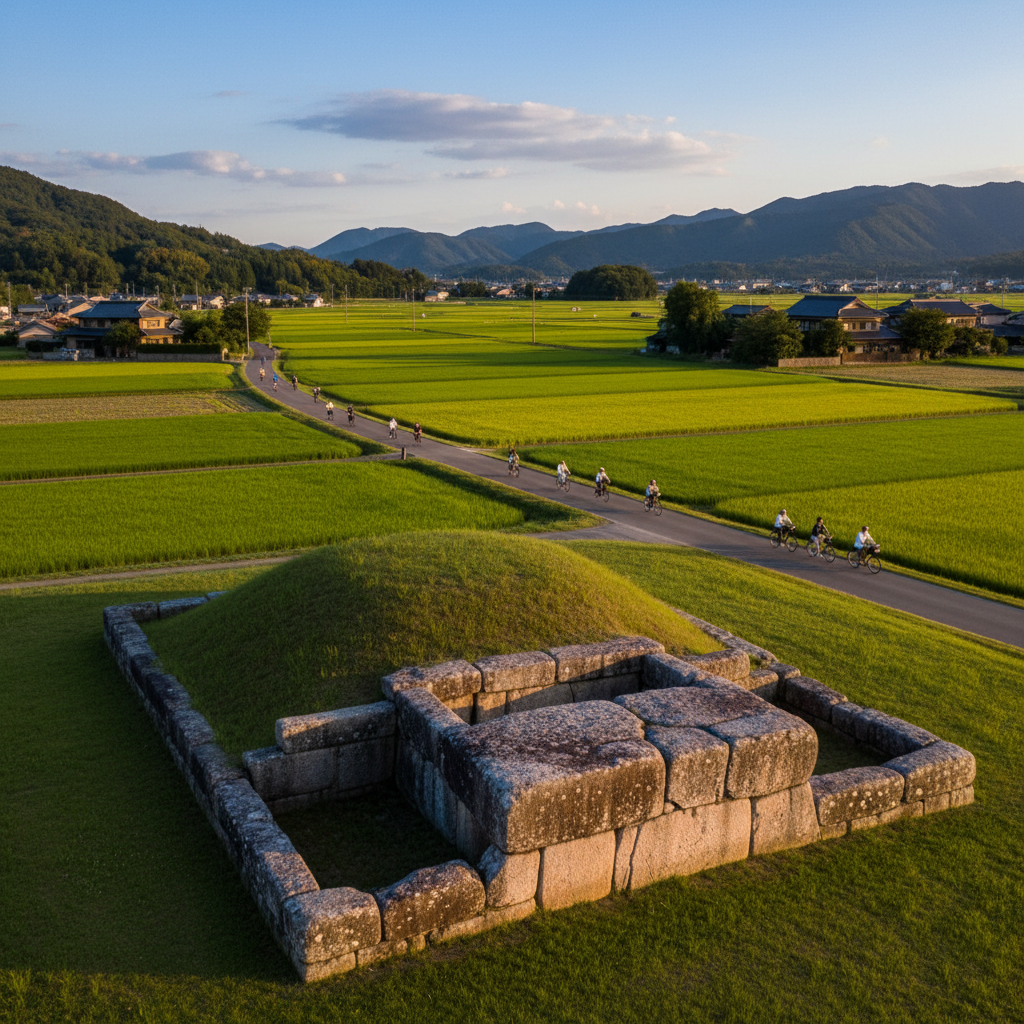
Asuka, Ancient Romance, Ishibutai Tumulus, Historic Sites, Cycling - The Philosophy of Driving in Japan
As a man who spent years navigating the intricate ballet of schedules and steel as a Kintetsu train conductor, I can tell you there's an undeniable poetry to Japan's rail network. It's efficient, punctual, a marvel of modern engineering. Yet, in the quiet corners of my soul, where the true spirit of adventure resides, I always knew there was another Japan – a Japan utterly unreachable by the rigid tracks of a timetable. This is the Japan that calls to the explorer, the one who yearns for the scent of the open road, the exhilarating thrum of a finely tuned engine, and the freedom to chase the sun wherever it dips behind mist-shrouded peaks. This is the Japan you unlock only from the driver's seat of a proper JDM machine, a sleek Toyota 86 or Subaru BRZ, carved for precision and passion.
Consider the allure of Kansai, with Osaka as your vibrant launching pad. Public transport will whisk you to Kyoto's iconic temples or Nara's gentle deer, and rightly so – these are treasures. But what if you’ve seen the postcards? What if your wanderlust whispers for something deeper, something more personal? This is where the magic of a self-driven expedition truly begins. It's the difference between observing a landscape through a window and becoming an integral part of it, feeling the texture of the asphalt, smelling the rice paddies as you drive past, hearing the distant chime of a rural temple bell carried on the wind.
The concept of "Secret Japan" isn't about hidden temples guarded by ancient spirits, though sometimes it feels that way. It's about the serendipitous discoveries, the unscheduled stops at a roadside market brimming with impossible-to-find local delicacies, the breathtaking panoramic view revealed only after a winding climb up a forgotten mountain pass. It's the quiet contemplation afforded by an ancient burial mound, standing solitary in a field, far from the tour buses. These moments, these profound connections to the land and its history, are the exclusive domain of the driver.
From Osaka, the expressways stretch like arteries, connecting you not just to destinations but to a sense of boundless possibility. The legendary Toyota 86 or Subaru BRZ isn't merely a mode of transport; it's a partner in exploration. Its responsive steering, perfectly balanced chassis, and that exhilarating manual gearbox transform every curve into an invitation, every straight into a symphony of speed and control. It’s a machine designed to stir the senses, making the journey as significant as the destination. And when that destination is Asuka – the very cradle of Japan's imperial legacy, a landscape steeped in ancient romance and profound historical silence – the fusion of a dynamic JDM car and these sacred lands creates an experience so rich, so uniquely Japanese, it transcends mere tourism. It becomes a pilgrimage, an active rediscovery of a nation's soul, one gear shift at a time.
Asuka, Ancient Romance, Ishibutai Tumulus, Historic Sites, Cycling - The 2-Day Itinerary: Deep Dive

Day 1: Osaka to Asuka – Unveiling Ancient Mysteries
7:00 AM – The Roar of Anticipation: Osaka Departure
The dawn breaks over Osaka, a city perpetually buzzing with latent energy. But today, the energy is different. It’s the thrill of anticipation, the promise of the open road. At this hour, the streets are still relatively quiet, allowing for a smooth escape. You approach your chosen chariot: a pristine Toyota 86 or Subaru BRZ, gleaming under the morning light. The sight alone quickens the pulse. This isn't just a car; it's a statement, a philosophy. Sliding into the cockpit, the sculpted seats cradle you, the short-throw shifter feels perfectly weighted in your palm. A turn of the key, and the 2.0-liter boxer engine barks to life with a purposeful growl, a promise of performance and exhilaration. There’s no rush, no train to catch. Only the road, the car, and the ancient heart of Japan awaiting.
7:30 AM – Urban Escape: Navigating Osaka's Arteries
With the 86’s precise steering, you glide out of the rental facility and onto Osaka’s main thoroughfares. Even in the city, the car feels alive, eager. The initial kilometers are a familiar dance through urban sprawl, but soon you're merging onto the Kinki Expressway. The cityscape gradually recedes in the rearview mirror, replaced by the subtle greens of suburban parks and distant industrial silhouettes. The engine note settles into a confident hum, and the six-speed manual gearbox sings its own particular song as you smoothly transition through the gears, finding the sweet spot for the highway cruise. This transition from urban jungle to open road is a sensory experience in itself – the subtle shift in air quality, the lessening visual clutter, the widening horizon.
8:30 AM – Highway Serenity and the Path East: Kinki and Nishi-Meihan Expressways
The Kinki Expressway leads seamlessly into the Nishi-Meihan Expressway, guiding you eastwards towards Nara Prefecture. This isn't just a utilitarian drive; it's the beginning of your journey into the past. The road itself is a ribbon of well-maintained asphalt, gently curving through modest hills. Traffic is light at this hour, allowing the 86/BRZ to stretch its legs. The sound insulation is surprisingly good, yet it allows enough of the engine's symphony to filter through, a constant reminder of the mechanical masterpiece beneath the bonnet. The scenery outside transforms from the grey and beige of the city to the lush, variegated greens of the Japanese countryside. You’ll notice meticulously terraced fields, small, compact villages nestled into valleys, and the distinctive architecture of rural homes. This isn't the dramatic mountain landscape yet, but it’s a meditative prelude, allowing your mind to shed the vestiges of modern life and begin to absorb the ancient pulse of the land.
9:30 AM – The First Glimpse of History: Exiting the Expressway and Rural Lanes
After approximately an hour and a half, you take an exit near Kashihara. The transition from the smooth, wide expressway to the narrower, more intimate prefectural roads is immediate and satisfying. Here, the 86/BRZ truly comes into its own. The responsive chassis and tight steering are perfect for navigating the gently winding, tree-lined roads that lead directly into the Asuka village area. These aren't grand, sweeping turns, but subtle undulations and graceful curves that invite a rhythmic dance between throttle and steering input. The air becomes noticeably fresher, carrying hints of damp earth and verdant foliage. You pass small, unassuming shrines half-hidden by ancient trees, and traditional farmhouses with their dark tiled roofs. This is no longer merely driving; it's an immersion, a tactile connection to the very ground that once bore the weight of emperors and the whispers of ancient court intrigues.
10:00 AM – Standing Before Giants: Ishibutai Tumulus (石舞台古墳)
Your first major destination, the Ishibutai Tumulus, appears almost suddenly, a colossal stone structure rising incongruously from a vibrant green field. Parking the 86/BRZ, you feel a sense of profound awe. This isn't a delicate pagoda or a meticulously manicured garden; it's a brutal, magnificent testament to raw power and ancient ambition. Believed to be the final resting place of Soga no Umako, a formidable statesman from the late 6th to early 7th century, the tumulus is essentially the exposed stone burial chamber of what was once a massive earthen mound. The earth has long since eroded away, leaving behind a monumental structure of interlocking granite megaliths, some weighing over 70 tons.
As you walk around and even step inside the cool, cavernous chamber, the sheer scale is overwhelming. The stones are rough-hewn, scarred by millennia of exposure, yet fitted with an astonishing precision that speaks volumes about the advanced engineering capabilities of the Kofun period. Imagine the effort, the manpower, the sheer will required to quarry, transport, and assemble these monstrous blocks with only rudimentary tools. The air inside the chamber is noticeably cooler, a silent, almost reverent atmosphere that hums with the echoes of history. You can feel the weight of centuries, the stories of power struggles, cultural shifts, and the very dawn of a unified Japanese state. The light filtering through the gaps between the stones creates dramatic shadows, making the experience almost sculptural. Outside, the tumulus stands in majestic isolation, a silent sentinel in a landscape of rice paddies, framed by distant, hazy mountains. The vibrant greens and golds of the fields provide a stark, beautiful contrast to the ancient grey stone, creating a truly unforgettable tableau. This site is not just a relic; it’s a visceral portal to a time when gods walked among men and dynasties were forged in stone.
11:30 AM – Flavors of the Ancient Land: Lunch in Asuka Village
Having steeped yourself in the ancient grandeur of Ishibutai, your stomach will undoubtedly be rumbling. Asuka village offers charming, understated dining experiences that perfectly complement the historical ambiance. Steer your 86/BRZ to a local eatery, perhaps one housed in a renovated traditional kominka (old Japanese house), with its dark timber beams and sliding paper screens. The focus here is on local, seasonal ingredients, prepared with a simplicity that allows the flavors to shine. One must-try is Asuka Nabe, a creamy hot pot unique to the region, featuring local chicken and vegetables simmered in a milk-based broth. It's surprisingly hearty and comforting, a taste of ancient rural Japan reimagined for the modern palate. Alternatively, a rustic soba noodle shop might tempt you, serving hand-cut buckwheat noodles with a delicately balanced dashi broth, perhaps accompanied by crispy tempura made from locally sourced mountain vegetables. The conversations are soft, the pace unhurried, allowing you to savor both the food and the profound sense of place. It's a meal that not only nourishes the body but also grounds you further into the historical tapestry of Asuka, connecting you through the generations to the very flavors that sustained its ancient inhabitants.
1:00 PM – Pedal Through Time: Cycling Asuka's Historic Fields
After lunch, it's time to trade four wheels for two and truly immerse yourself in the pastoral beauty and scattered historical gems of Asuka. Park your 86/BRZ (most rental shops offer bicycle parking) and pick up a bicycle. Asuka is renowned for its excellent cycling routes, which are largely flat and wind through picturesque rice paddies, past small shrines, and directly to many of the ancient sites. The feeling of the gentle breeze on your face, the soft whir of the bicycle tires on the paved paths, and the uninterrupted panoramic views are simply sublime. This is where the term "ancient romance" truly takes on a tangible form – pedaling along pathways that have witnessed millennia of history, surrounded by a landscape that feels unchanged since imperial courts graced this land.
The routes are well-marked, and you'll find yourself gliding through fields of emerald green in summer or golden brown in autumn, punctuated by the occasional traditional farmhouse or a lone, ancient tree standing sentinel. The quietude is profound, broken only by the chirping of cicadas in summer or the rustling of leaves in the breeze. This low-speed exploration allows for an intimate connection with the environment, noticing details you might miss from a car: a tiny, intricately carved stone Buddha by the roadside, a farmer tending to his fields with timeless rhythm, or the distinct calls of local birds. It’s a perfect antidote to the speed of the modern world, a deliberate slowing down to match the ancient rhythm of the land.
1:30 PM – Whispers of Art and Astronomy: Takamatsuzuka and Kitora Tumuli
Your cycling journey will naturally lead you to the nearby Takamatsuzuka Tumulus (高松塚古墳) and Kitora Tumulus (キトラ古墳). These are not as visually imposing as Ishibutai, but their significance is arguably even greater. From the outside, they appear as unassuming, grass-covered mounds, carefully preserved. However, within their chambers lie some of Japan's most precious historical and artistic treasures: vividly colored frescoes depicting celestial bodies and court life, dating back to the late 7th to early 8th centuries. While direct entry into the original burial chambers is typically restricted to preserve these delicate artworks, impressive museums and replica chambers (such as the Takamatsuzuka Mural Hall) nearby allow you to experience their beauty and importance firsthand.
At Takamatsuzuka, you’ll marvel at the vibrant depictions of court ladies and gentlemen, their expressions serene, their garments flowing. But it’s the astronomical chart on the ceiling that truly captivates, a precise map of the stars and constellations that reveals a sophisticated understanding of the cosmos by ancient Japanese scholars. Similarly, Kitora Tumulus boasts exquisite murals, including depictions of the Four Gods (Azure Dragon, White Tiger, Vermilion Bird, Black Tortoise) and another intricate astronomical chart. These aren't just decorative elements; they represent a convergence of Chinese cosmology, Buddhist beliefs, and indigenous Japanese artistry. As you stand before the replicas, you feel an immense sense of wonder, connecting with the minds of those who, over a millennium ago, looked up at the same stars and sought to understand their place in the universe. The quiet solemnity of these sites, nestled amidst the tranquil fields, offers a powerful testament to Japan's deep historical and cultural roots, a true encounter with the "Ancient Romance" of its origins.
3:30 PM – Panoramic Reflections: Amakashino-oka (甘樫丘)
After returning your bicycles, a short drive in your 86/BRZ takes you to Amakashino-oka. This modest hill, though not towering, offers arguably the most breathtaking panoramic view of the entire Asuka region. Historically, Amakashino-oka was a strategically important location, once home to the residences of powerful clans and from where emperors gazed upon their fledgling capital. Today, it serves as a stunning vantage point to truly appreciate the topography of ancient Yamato. From its summit, the entire Asuka basin unfurls beneath you like a living map.
You can clearly discern the various tumuli scattered across the landscape, looking like gentle bumps on a vast green carpet. The patterns of rice paddies stretch endlessly, punctuated by clumps of ancient trees and the occasional glimmer of a stream. On a clear day, the distant Yamato Sanzan mountains – Unebi, Miminashi, and Kagu – rise majestically on the horizon, mythical peaks interwoven with ancient poetry and imperial lore. As the late afternoon sun begins its descent, casting long, dramatic shadows across the fields, the colors of the landscape deepen and become incredibly rich. The air is crisp and clean, carrying the scent of earth and distant foliage. It’s a moment of profound contemplation, looking out over a landscape that has witnessed the very birth of a nation, seeing the confluence of nature, history, and human endeavor. The feeling of being suspended in time, gazing upon this pristine vista, is one of the most rewarding moments of the entire journey. It perfectly encapsulates the "Ancient Romance" that defines Asuka, leaving you with a deep, indelible impression.
5:30 PM – Ryokan Retreat: Dinner and Serenity
With the sun beginning to dip below the horizon, painting the sky in hues of orange and purple, it’s time to settle into your accommodation. For an authentic Asuka experience, choose a traditional Japanese ryokan or a charming guesthouse nestled within the village. The welcome is warm, the hospitality impeccable. After checking in, you’ll typically be invited to enjoy a relaxing soak in the ryokan’s bath, perhaps a small, communal onsen, to wash away the day's travel and cycling. The hot water soothes tired muscles, and the quiet ambiance prepares you for the culinary highlight of the evening.
Dinner, often a meticulously prepared kaiseki meal, is an artistic presentation of seasonal and local delicacies. Each dish is a miniature masterpiece, showcasing the freshest ingredients from the surrounding fields and rivers. Expect beautifully arranged sashimi, delicate grilled fish, tempura, and an array of colorful vegetables, all served with precision and grace. The flavors are subtle yet profound, a testament to centuries of culinary tradition. As you dine, reflecting on the day's incredible journey – from the powerful stones of Ishibutai to the intricate frescoes of Kofun and the panoramic views of Amakashino-oka – you feel a deep connection to this ancient land. The silence of the night in Asuka, broken only by the gentle sounds of nature, offers a profound peace rarely found in modern life. The comfortable futon laid out on the tatami floor promises a restful sleep, preparing you for another day of exploration.
Day 2: Deeper into Asuka's Past & Return to Osaka – The Thrill of the Drive
8:00 AM – Echoes of Devotion: Asuka-dera Temple (飛鳥寺)
Awakening to the gentle morning light in Asuka, after a traditional Japanese breakfast at your ryokan, the second day of exploration beckons. Your first stop is Asuka-dera Temple, often cited as Japan's oldest Buddhist temple. Founded in 596 by Soga no Umako (yes, the same powerful figure buried at Ishibutai Tumulus!), it marked a pivotal moment in Japanese history: the formal introduction and establishment of Buddhism. While the original grand structures have long since succumbed to fire and the ravages of time, the present temple, though smaller, still exudes an incredible sense of antiquity and spiritual power.
Within its main hall resides the Asuka Daibutsu, a bronze Buddha statue that is believed to be the original, cast in 609. Its serene, somewhat archaic features bear the marks of its incredible age, having survived countless upheavals. Standing before it, you’re not just looking at a statue; you’re gazing upon a tangible link to a period when Japan was undergoing monumental cultural and spiritual transformation. The air inside the temple is cool and filled with the scent of incense, the silence punctuated only by the occasional flutter of a prayer flag or the soft rustle of ancient pines outside. The surrounding grounds are peaceful, scattered with smaller stone monuments and the remnants of former grandeur. It’s a place that invites quiet reflection, allowing you to absorb the profound influence that Buddhism, introduced from the continent, had on shaping Japan’s art, philosophy, and governance.
9:30 AM – Unearthing Hidden Gems: Kameishi (Turtle Stone) & Sakafuneishi (Boat Stone)
Leaving the serene grounds of Asuka-dera, your 86/BRZ becomes your tool for seeking out the more whimsical, yet equally intriguing, relics of Asuka. These are the scattered, enigmatic stone objects that dot the landscape, shrouded in local folklore and historical mystery. First, head to Kameishi, the "Turtle Stone." This colossal granite boulder, carved to resemble a turtle or frog, lies curiously in the middle of a field. Its exact purpose remains unknown, sparking various theories from ancient water gauges to religious effigies. Its simple yet powerful form, weathering centuries of rain and sun, invites contemplation and a touch of playful imagination.
Further along, you'll discover Sakafuneishi, the "Boat Stone." This large, intricately carved stone object, with its multiple channels and basins, has puzzled archaeologists for decades. Was it an ancient ritualistic bathing site? A miniature garden with flowing water? Or perhaps a sundial? The mystery is part of its charm. Maneuvering your 86/BRZ along these narrow, rural lanes, you gain a sense of true exploration, uncovering these smaller, less-known treasures that offer a more intimate glimpse into the peculiar artistic and engineering sensibilities of Asuka's past. The tactile sensation of the smooth, polished shifter, the responsive brakes, and the precise steering all enhance the joy of these small discoveries, making even the shortest drive a delight.
11:00 AM – The Joy of the Drive: Winding Roads and Scenic Byways
This part of the itinerary is dedicated to the sheer pleasure of driving your 86/BRZ. Asuka and its surrounding Nara countryside are crisscrossed with delightful, less-trafficked roads that are a dream for any driving enthusiast. Head south or east from the central Asuka area, venturing slightly into the hills. Here, the roads narrow further, becoming ribbons of asphalt draped over rolling topography. The 86/BRZ, with its low center of gravity and perfectly balanced weight distribution, truly comes alive.
Engage the manual gearbox, feeling the satisfying mechanical snick as you shift down for a tight corner, blipping the throttle for a perfect rev-match. The engine note, a distinctive, purposeful growl, rises and falls with your inputs, an auditory feedback loop that connects you intimately to the machine. You’ll sweep through gentle S-curves flanked by dense bamboo groves, their slender stalks swaying hypnotically. The occasional tea plantation will unfurl across a hillside, a tapestry of vibrant green. Passing through small, forgotten hamlets, you’ll catch glimpses of ancient moss-covered temples, hidden away from the main routes. The scent of fresh earth and blooming flowers drifts through the open windows, mingling with the subtle aroma of hot brakes and engine oil – the perfume of a spirited drive.
These roads are not about high speed; they're about fluidity, precision, and the pure, unadulterated joy of piloting a beautifully engineered machine through a picturesque landscape. Each corner is an invitation, each elevation change a new opportunity to feel the chassis communicate with the road. This is the essence of JDM driving – a harmonious blend of man, machine, and environment, creating moments of pure driving zen. It's an opportunity to truly appreciate why cars like the 86/BRZ have such a dedicated following, why they transcend mere transportation to become instruments of freedom and passion.
1:00 PM – Rustic Delights: Lunch at a Roadside Gem
After a exhilarating morning of driving, it's time for lunch. Instead of a pre-planned stop, leverage the freedom of your car to seek out a hidden gem. Keep an eye out for small, unassuming restaurants or cafes along the scenic byways. Often, these local spots offer incredibly authentic and delicious food at surprisingly reasonable prices. You might stumble upon a small ramen shop specializing in a rich, regional broth, or a traditional diner (shokudo) serving simple yet satisfying set meals like tonkatsu (pork cutlet) or grilled fish, accompanied by steaming rice and miso soup. The charm lies in the discovery, the feeling that you’ve stumbled upon a place only known to locals. The conversations might be in rapid-fire Japanese, but a warm smile and a few gestures are often all you need. These are the spontaneous, unscripted moments that truly define a memorable road trip in Japan, adding layers of cultural immersion beyond the main attractions.
2:30 PM – A Final Glimpse: High Viewpoint Exit from Asuka
Before heading back towards Osaka, take one last, lingering look at the Asuka region from a high viewpoint. This might be another local hill or a carefully positioned observation deck, offering a different perspective than Amakashino-oka. From here, you can trace the path of your journey, seeing the scattered tumuli, the winding rivers, and the quilt-like patterns of the fields. It's a moment to consolidate your experiences, to appreciate the profound historical significance of this cradle of Japanese civilization, and to etch its serene beauty into your memory. The 86/BRZ waits patiently, a silent witness to your profound connection with Japan’s ancient soul.
3:30 PM – The Homeward Journey: Expressways to Osaka
With a heart full of ancient stories and a mind invigorated by the drive, it’s time to begin the journey back to Osaka. The route mirrors your inbound journey, connecting back to the Nishi-Meihan Expressway. As the landscape slowly transitions from the rural tranquility of Nara back to the more structured environment leading into Osaka, there’s a sense of satisfying completion. The setting sun might cast a golden glow over the distant urban sprawl, creating a dramatic contrast between the timeless beauty you just experienced and the dynamic energy of modern Japan.
This return drive is not merely a means to an end; it’s a time for reflection. The 86/BRZ, having performed flawlessly, now cruises smoothly, its engine a steady, reassuring presence. The responsiveness of the steering, the confidence in its braking, the sheer joy of its manual transmission – these elements have transformed a simple drive into an unforgettable adventure. You realize that this journey through Asuka was more than just visiting historic sites; it was an act of discovery, a personal communion with Japan’s profound past, experienced in the most exhilarating way possible: from behind the wheel of a JDM legend. The city lights of Osaka begin to twinkle in the distance, a welcome sight, but the ancient spirit of Asuka, and the thrill of the drive, will linger long after you park the car.
Asuka, Ancient Romance, Ishibutai Tumulus, Historic Sites, Cycling - Expert Advice & Cultural Nuances
Venturing beyond the well-trodden tourist paths in Japan with a JDM car like the 86 or BRZ is an experience rich with discovery, but a few expert tips can elevate your journey from great to absolutely legendary. As someone who's spent countless hours exploring every nook and cranny of this country by car, and even more years observing its intricate rhythms from a train conductor's vantage, I can tell you that the true magic lies in understanding the subtle cultural nuances.
The Allure of Michi no Eki (道の駅) – Roadside Stations
Forget your stereotypical highway rest stops. Japan's "Michi no Eki" are cultural institutions. These roadside stations are far more than just places to refuel or use the restroom; they are vibrant hubs of local culture and commerce. Each Michi no Eki is unique, reflecting the character of its surrounding region. Near Asuka, you’ll find ones offering exquisite local Nara produce – think fresh strawberries, persimmons, and regional vegetables – often sold directly by the farmers themselves. You can sample local specialties, from unique snacks to artisanal crafts. Many feature small, excellent restaurants serving regional dishes that you won't find anywhere else. They are fantastic places to take a break, stretch your legs, and truly immerse yourself in the local flavors and craftsmanship. I often plan my routes around Michi no Eki, knowing I'll always find something surprising and delicious. They’re perfect for a quick coffee, an authentic local lunch, or picking up souvenirs that genuinely represent the area.
Discovering Hidden Local Gems
The beauty of driving a JDM car in Japan, especially in areas like Asuka, is the freedom to stray from the guidebook. Don't be afraid to take a detour down a promising-looking lane. Some of the most memorable experiences come from stumbling upon a tiny, family-run eatery serving the most incredible ramen, a charming local café tucked away in a quiet village, or a small, moss-covered shrine that radiates an inexplicable ancient energy. Look for places with a few local cars parked outside, or handwritten signs (even if you can't read Japanese, the atmosphere often speaks volumes). These are the spots where you’ll taste truly authentic food, meet genuine locals, and experience a side of Japan that mass tourism never touches. The 86/BRZ, with its nimble size, is perfectly suited for these exploratory jaunts.
Mastering Japanese Driving Etiquette
- Patience is Key: Unlike some Western countries, aggressive driving and tailgating are frowned upon. Maintain a safe distance and be patient.
- Yield to Pedestrians: Pedestrians always have the right of way, even if there isn't a crosswalk. Stop completely and wait for them to cross.
- Indicator Use: Japanese drivers are diligent about using indicators well in advance. Follow suit.
- Overtaking Lanes: On multi-lane expressways, the rightmost lane is for overtaking. Drivers generally return to the left lanes after passing.
- Parking: Parking can be tight, especially in towns. Always look for designated parking lots (有料駐車場 - yuryo chushajo). Don't park on narrow streets; you risk a ticket or, worse, causing an obstruction. Coin parking (コインパーキング - koin parkingu) is common and convenient. The 86/BRZ’s compact dimensions make parking easier, but still requires precision.
- No Honking: Honking is extremely rare and usually only used in emergencies. Avoid it unless absolutely necessary.
By respecting these unwritten rules, you’ll not only ensure a safer journey but also gain a deeper appreciation for the Japanese approach to shared spaces and mutual respect. This thoughtful approach extends to your interaction with the car itself; a JDM vehicle responds best to smooth, deliberate inputs, rewarding you with an unmatched driving experience that mirrors the precision and elegance of Japanese culture.
Asuka, Ancient Romance, Ishibutai Tumulus, Historic Sites, Cycling - Detailed Logistics & Pre-Trip Tips
Embarking on a JDM road trip through Japan requires a bit of foresight and understanding of local customs. As of 2026, Japan’s infrastructure is world-class, but knowing the intricacies can make your adventure truly seamless, especially when you’re piloting an exhilarating machine like the Toyota 86 or Subaru BRZ.
Navigating 2026 Traffic & Road Conditions
Japan's road network is extensive and generally in excellent condition. Expressways (高速道路 - kosoku doro) are fast and efficient, connecting major cities, while prefectural roads (県道 - kendo) and national routes (国道 - kokudo) offer scenic alternatives, particularly in rural areas like Asuka. Traffic in major cities like Osaka can be congested during rush hours (roughly 7-9 AM and 5-7 PM), but once you're on the expressway heading out, it typically flows smoothly. In the Asuka region, you'll encounter minimal traffic, allowing you to truly enjoy the winding roads and picturesque scenery at your own pace. Always rely on a good navigation app like Google Maps or Waze; they provide real-time traffic updates and often suggest the fastest routes, or more importantly, the most scenic ones for a spirited drive in your 86/BRZ.
The Indispensable ETC Card
An Electronic Toll Collection (ETC) card is not just a convenience; it's practically a necessity for any serious road trip in Japan. This small card, inserted into a reader in your rental car, allows for automatic, cashless toll payments on expressways. Without it, you'd be stopping at every toll booth, fumbling for change or cards, significantly slowing your journey and breaking your driving rhythm. When you pick up your 86/BRZ, ensure your rental company provides an ETC card. It’s a game-changer, allowing for uninterrupted flow, especially when the 86 is in its element, eating up kilometers with effortless grace. The smooth pass through the ETC gate, marked by a polite chime, feels like a futuristic embrace of efficiency.
Fueling Up: The Japanese Gas Station Experience
Getting gas in Japan is a unique experience. You’ll encounter both full-service (サービス - saabisu) and self-service (セルフ - serufu) stations. If you opt for full-service, expect an almost ceremonial level of politeness and efficiency. The attendants, often in immaculate uniforms, will direct you, clean your windows, and even empty your ashtray (though with an 86/BRZ, you’re unlikely to be smoking!). The key phrase to remember for a full tank is "Mantan" (満タン - mantan). For unleaded gasoline, ask for "Regular" (レギュラー - regyuraa); for high-octane, it's "High-Octane" (ハイオク - haioku). The attendants will often guide you out with a series of polite bows. At self-service stations, the pumps are typically user-friendly with English instructions available on touchscreens. The smell of gasoline, the vibrant colors of the pumps, and the unique service culture all add to the immersive experience of a Japanese road trip.
The Art of Parking
Parking in Japan, particularly in more populated areas, requires precision. Space is at a premium. Always look for designated parking areas. In towns, coin parking lots (コインパーキング - koin paakingu) are abundant and typically well-maintained. They are often automated, requiring you to pay at a central machine before exiting. In rural areas like Asuka, you’ll find more free parking at tourist sites, though sometimes these are still paid. The compact dimensions and excellent maneuverability of the 86/BRZ make navigating tight parking spaces significantly easier, allowing you to confidently tuck your sports car into spots where larger vehicles might struggle. Always be mindful of local regulations and avoid parking illegally, as fines are strict and swift.
The Unrivaled Exhilaration of a JDM (MT Car)
Driving a manual transmission JDM car like the 86 or BRZ in Japan is not just about getting from A to B; it's an extension of the adventure itself. The tactile feedback of the short-throw shifter, the precise clutch engagement, the immediate responsiveness of the engine – it all creates an unparalleled connection between driver and machine, and between driver and road. As you row through the gears on a winding prefectural road, the engine’s growl echoing off the surrounding hills, you feel every nuance of the asphalt, every subtle shift in terrain. The satisfaction of perfectly executing a heel-and-toe downshift before a hairpin turn, the surge of acceleration as you exit the corner, the sheer mechanical symphony – these are the moments that elevate a simple drive into an art form. It's an intimate dance, a dialogue between your inputs and the car's dynamic response. This isn't just a car; it's a finely honed instrument, designed to extract maximum joy from the act of driving, making your Asuka exploration not just a sightseeing tour, but a thrilling performance, with you in the starring role.
Asuka, Ancient Romance, Ishibutai Tumulus, Historic Sites, Cycling - Comprehensive FAQ
Planning an epic JDM road trip to Japan's ancient heart, Asuka, is exciting, but it's natural to have questions. Here are answers to some of the most common inquiries to ensure your journey is smooth and stress-free.
Do I need an International Driving Permit (IDP) to drive in Japan?
Yes, absolutely. To legally drive in Japan, you need an International Driving Permit (IDP) issued under the 1949 Geneva Convention, your national driver's license, and your passport. Ensure your IDP is valid for the duration of your trip in Japan. Countries like the United States, Canada, the UK, Australia, and many others are signatories to this convention. For specific requirements based on your country of origin, always consult the latest official guidelines from your local licensing authority before your trip. Simply having your national license is not enough; the IDP is a mandatory translation and authorization.
What about insurance for my rental car?
Comprehensive insurance is highly recommended, if not mandatory, when renting a car in Japan. Most reputable rental companies, including those specializing in JDM vehicles, will offer various levels of coverage. Opt for the fullest possible coverage, typically including Collision Damage Waiver (CDW) and Third-Party Liability. This will give you peace of mind in the unlikely event of an accident, protecting you from significant financial responsibility. Always read the terms and conditions carefully and understand what is covered before you sign.
I'm not used to driving a Manual Transmission (MT) car. Will it be difficult in Japan?
While Japan has many narrow roads and some challenging mountain passes, the vast majority of your driving, especially in the Asuka region, will be on well-maintained prefectural roads or expressways. The Toyota 86 and Subaru BRZ are incredibly forgiving manual cars with smooth clutch engagement and precise gearboxes, making them a joy to drive even for those not accustomed to MT daily. If you have some MT experience, you'll adapt quickly. The thrill of rowing through the gears truly enhances the driving experience, especially on the winding country roads. However, if you are genuinely uncomfortable with an MT, it might be wise to practice before your trip or consider if an automatic JDM option is available (though the purist in me highly recommends the manual for the 86/BRZ experience!).
What are the road conditions like in winter?
For the Asuka region, which is in the central part of Nara Prefecture, winter road conditions (December to March) are generally clear of heavy snow or ice. However, if your itinerary includes venturing into higher mountain passes or more northern regions of Nara, you might encounter snow or icy patches. In such cases, snow tires (スタッドレスタイヤ - sutaddoressu taiya) become essential, and some roads might require snow chains. Always check local weather forecasts and road conditions before heading into mountainous terrain during winter. For a standard Asuka trip, you're unlikely to face significant winter driving challenges, but preparedness is always key.
How do I use navigation systems in Japan?
While many rental cars come with built-in navigation systems, they are often entirely in Japanese. For most international travelers, using your smartphone with Google Maps or Waze is the most reliable and user-friendly option. Ensure you have a portable Wi-Fi device or a local SIM card for constant data access. These apps provide excellent real-time traffic updates, public transport information (if needed), and precise directions, often including lane guidance. Download offline maps for areas where cellular service might be spotty, though this is rare in Japan. Enter destinations by phone number (if available) or the English name, and the app will guide you seamlessly through your ancient adventure.
Asuka, Ancient Romance, Ishibutai Tumulus, Historic Sites, Cycling - The Final Call: Your JDM Journey Awaits
You’ve journeyed through time, from Osaka’s dynamic pulse to Asuka’s tranquil, ancient heart. You’ve walked among the colossal stones of the Ishibutai Tumulus, pedaled through fields where emperors once roamed, and gazed upon the celestial maps of ancient astronomers. You’ve savored the subtle flavors of regional cuisine and navigated winding roads, feeling the undeniable connection between the spirit of Japan and the precision engineering of your JDM companion.
This isn't just a trip; it’s an awakening, a visceral exploration of a Japan that transcends typical tourism, a Japan reserved for those who crave authenticity, adventure, and the exhilarating freedom of the open road. The hum of the 86/BRZ engine, the satisfying snick of its manual gearbox, the smell of ancient earth and fresh air – these are the sensations that will forever etch this journey into your memory, making you feel not just like a visitor, but an active participant in Japan’s enduring story.
The images in your mind are vivid, the sensations real. Now, it's time to transform this dream into your reality. If you’re ready to experience this unparalleled blend of ancient history, breathtaking landscapes, and pure driving exhilaration, there’s only one place to begin your adventure: Omoshiro Rent-a-Car Osaka Chuo. We don’t just rent cars; we provide the keys to an unforgettable Japanese experience. Our fleet, curated by an ex-Kintetsu conductor and passionate JDM enthusiast, features meticulously maintained manual transmission vehicles like the iconic Toyota 86 and Subaru BRZ, all ready to connect you with the soul of Japan. Escape the ordinary, embrace the thrill, and book your JDM adventure today. The roads to ancient romance, to secret Japan, are calling. Answer them.
