
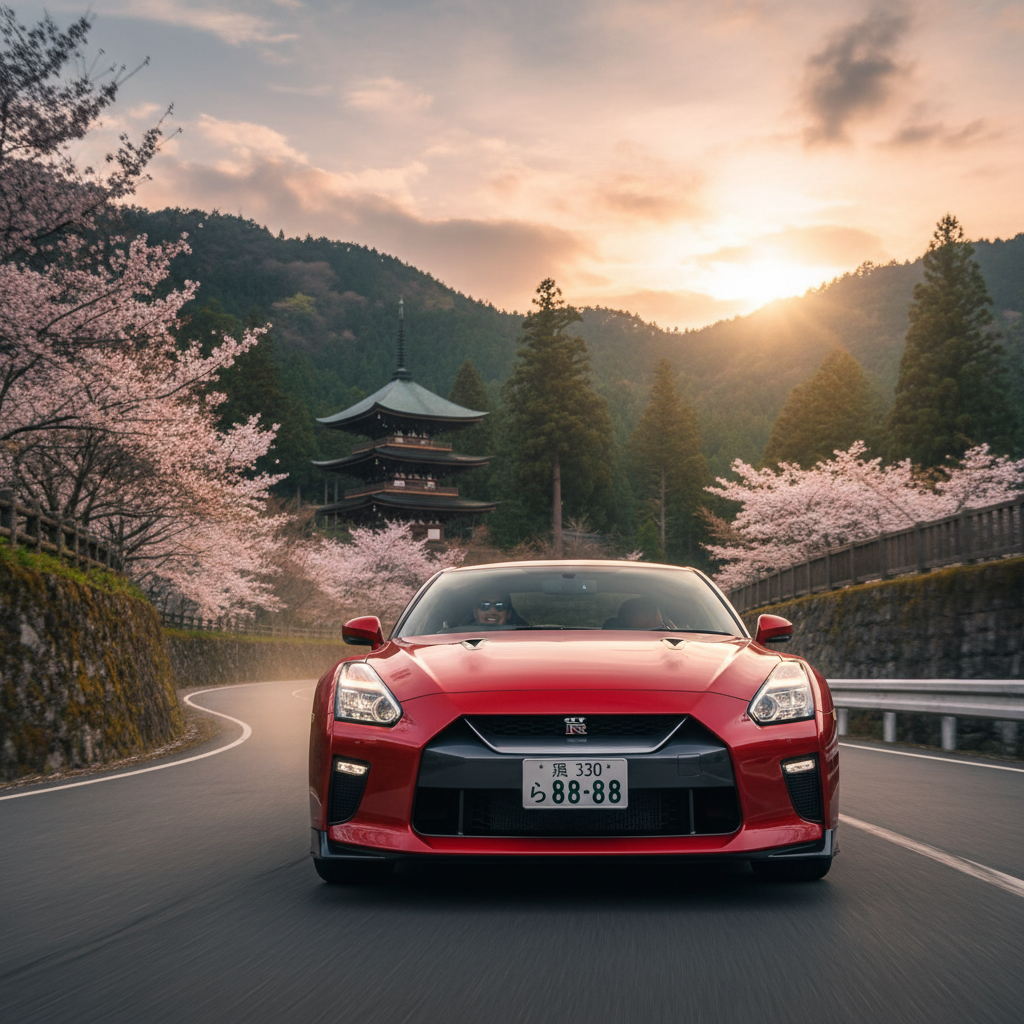
Nara Mount Katsuragi Azalea Recommended Drive Course: The Philosophy of the Open Road
For most travelers, the image of Japan is defined by the rhythmic clicking of train tracks and the polite, automated announcements of the Shinkansen. I know those sounds better than anyone. I spent years as a conductor for Kintetsu Railway, one of Japan’s largest private rail networks. I loved the precision of the rails, the way we carved through the Yamato landscape on a fixed path. But there was always a nagging feeling as I looked out the conductor’s window at the winding mountain roads of Nara: the realization that the true soul of Japan lies exactly where the tracks end.
When you are bound by a rail, you see the Japan that has been curated for the masses. When you hold a steering wheel—specifically the leather-wrapped wheel of a Japanese Domestic Market (JDM) legend—you unlock the "Secret Japan." This is the philosophy of driving in Japan. It is the freedom to stop at a misty mountain pass because the light is hitting the cedar trees just right. It is the ability to chase the seasonal bloom of the azaleas on Mount Katsuragi at your own pace, away from the crowded tour buses. For the modern adventurer, the car is not just a mode of transport; it is a sensory amplifier. In the Kansai region, using Osaka as your base and heading into the ancient heart of Nara via a precision-engineered machine is the ultimate pilgrimage for anyone who respects the art of the drive.

The 2-Day Itinerary: Deep Dive into the Crimson Heart of Nara
Day 1: The Ascent to the Sea of Red
08:00 AM: Departure from Osaka
Your journey begins as the sun starts to glint off the skyscrapers of Osaka. You slide into the bucket seat of a Toyota 86. The cockpit is tight, purposeful. You depress the clutch—it’s firm, communicative—and push the start button. The 2.0-liter boxer engine settles into a steady, mechanical thrum. This is the perfect tool for the Nara mountain roads. Its low center of gravity and rear-wheel-drive layout are designed for the very curves you are about to encounter.
09:00 AM: The Minami-Hanna Expressway
Heading east, you leave the urban sprawl. The Minami-Hanna Expressway serves as your gateway. As you transition from the concrete jungle to the lush greenery of the Yamato Plain, the air changes. It becomes cooler, smelling of wet earth and ancient pine. On this stretch, you feel the 86’s stability. The steering is laser-focused, letting you place the car with millimeter precision as you merge toward the Katsuragi exit.
10:30 AM: Arrival at the Base of Mount Katsuragi
Mount Katsuragi stands at 959 meters, straddling the border between Nara and Osaka. While there is a ropeway, the true enthusiast knows that the drive to the lower station is half the fun. The road begins to tighten. Switchbacks appear. This is where the 86 shines. You downshift to second gear, the rev-match blip echoing off the stone walls. The balance of the chassis is sublime. You aren't just driving; you are dancing with the geography of Nara.
11:30 AM: The One Million Azalea Phenomenon
Parking the car, you take the ropeway or hike to the summit plateau. In mid-to-late May, what awaits you is colloquially known as "Hitome Senbon"—a thousand bushes at a single glance. But that is an understatement. It is a sea of one million azaleas. The entire peak is doused in shades of carmine, magenta, and scarlet. From a distance, it looks as if the mountain is literally on fire. The scent is intoxicating—a subtle, floral sweetness that fills your lungs. Standing there, looking out over the Nara Basin toward Mount Miwa, you realize that no train could ever bring you this close to the sky.
01:30 PM: A Taste of the Land
For lunch, descend to the foothills. You seek out a local spot serving Miwa Somen. These hand-stretched noodles are a Nara specialty, some of the thinnest and finest in Japan. Chilled and served with a dipping sauce infused with dashi and ginger, they provide the perfect refreshment after the sensory overload of the mountain peak. The texture is delicate yet firm—much like the suspension tuning of your JDM ride.
03:30 PM: The Hidden Winding Roads of the Katsuragi Foothills
Instead of heading back, you take the car south toward the Diamond Trail. These are narrow, technical roads used by local tuners and mountain dwellers. The 86’s tires grip the asphalt as you navigate through tunnels of towering Japanese cypress (Hinoki). The dappled sunlight creates a strobe effect on the dashboard. This is the "Secret Japan"—no tourists, just you, the car, and the rhythm of the road.
06:00 PM: Check-in at a Traditional Ryokan
Tonight, you stay in a local inn near Gose. The smell of tatami mats and the sound of a nearby stream replace the city's roar. A soak in a cypress wood bath (hinokiburo) eases your muscles. Dinner is a multi-course Kaiseki feast featuring Yamato-yasai (ancient Nara vegetables) and succulent Nara beef, marbled to perfection and melting like butter on the tongue.
Day 2: Spirituality and the Mechanics of Joy
09:00 AM: Katsuragi Hitokotonushi Shrine
After a breakfast of rice, miso soup, and grilled fish, you fire up the boxer engine again. Your first stop is Hitokotonushi Shrine. Legend says the deity here will grant a single wish if expressed in a single word. As a driver, your word might be "Safety" or perhaps "Speed." The shrine is home to a 1,200-year-old ginkgo tree. Standing beneath its massive canopy, you feel the weight of Japanese history—a history that the car allows you to touch in ways the rail network never could.
11:00 AM: The Technical Challenge of Mount Nijo
Adjacent to Katsuragi is Mount Nijo, the twin-peaked mountain. The roads here are even more demanding. It’s a test of your heel-and-toe technique. The 86’s pedals are perfectly spaced for this. You brake hard, roll your foot to blip the throttle, and slide into second gear. The car rotates beautifully. You can feel the mechanical limited-slip differential working to find traction as you power out of the apex. This is why you chose a JDM car. It’s not about raw horsepower; it’s about the purity of the connection between man and machine.
01:00 PM: Michi-no-Eki Katsuragi
You stop at the "Roadside Station" Katsuragi. This is more than a rest stop; it’s a cultural hub. You stock up on persimmon leaf sushi (Kakinoha-zushi), a traditional Nara travel food where the tannins in the leaves preserve the salted mackerel and salmon. You find yourself chatting with a local elderly man who admires the 86. He tells you about how the roads used to be gravel when he was a boy. This connection—this shared appreciation for the machine—is the hallmark of a road trip.
03:00 PM: The Slow Drive Back Through the Nara Plains
As the sun begins to dip, casting long shadows across the rice paddies, you take the scenic route back toward Osaka. You pass through small villages where time seems to have stood still. The orange glow of the sunset reflects off the 86’s hood. You realize that this 2-day loop has given you more insight into the Japanese spirit than a month of riding the rails ever could. The azaleas were the destination, but the drive was the purpose.
Expert Advice & Cultural Nuances for the Japanese Road
Driving in Japan is an exercise in mutual respect and subtle communication. As someone who has spent decades observing the flow of Japanese traffic—both from the conductor’s cab and the driver’s seat—I can tell you that the "Roadside Station" (Michi-no-Eki) culture is your best friend. These are not the grimy truck stops of North America. They are pristine, locally-managed centers where you can find the freshest regional produce and hidden-gem restaurants that don't appear on Google Maps. If you see a crowd at a Michi-no-Eki, stop. There is likely a seasonal delicacy waiting for you.
When driving mountain passes (Touge), be mindful of the "Center Line." Many roads in Nara are barely wide enough for two cars. Local drivers are exceptionally skilled at tucking their mirrors in. If you see a local approaching quickly, find a small turnout and let them pass. A flash of the hazard lights (two or three blinks) is the universal Japanese "Thank You." This silent etiquette creates a harmony on the road that is uniquely Japanese. Also, keep an eye out for "Shika" (deer), especially in Nara. They have no fear of cars and can appear suddenly from the cedar forests.
Detailed Logistics & 2026 Pre-Trip Tips
In 2026, navigating Japan by car is easier than ever, but it requires preparation. First, ensure your vehicle is equipped with an ETC (Electronic Toll Collection) card. The expressways around Osaka and Nara are almost entirely cashless now. Without an ETC card, you’ll find yourself fumbling for change at increasingly rare manual booths. Most rental cars come with a card slot, but you need to ensure the card itself is provided.
When you pull into a gas station, you’ll often encounter "Full Service." Attendants will swarm the car, guide you into the spot, and even clean your windows and mirrors. To fill the tank with high-octane (recommended for the 86/BRZ), simply say "Hai-oku, Mantan" (High-octane, full tank). They will even hold a rag under the nozzle to ensure not a single drop of fuel touches your pristine paintwork. This level of service, known as *Omotenashi*, is something you won't find at a train station.
Parking in Nara’s rural areas is generally easy, but in the towns, look for the "Coin Parking" lots with the yellow "P" signs. Do not park on the street in rural villages; it is considered disrespectful to the local community. And for the JDM purists: driving a manual transmission (MT) 86 or BRZ in Japan is a spiritual experience. The gear shifts are short and notched, the clutch bite point is intuitive, and the pedal feel is designed for enthusiasts. It’s a reminder that even in an age of automation, there is no substitute for human control.
Comprehensive FAQ: Navigating the Technicalities
What kind of license do I need?
To drive in Japan, you must possess an International Driving Permit (IDP) issued under the 1949 Geneva Convention. This must be accompanied by your original home-country driver's license and your passport. Note that permits issued under the 1968 Vienna Convention are not valid in Japan. Some countries (like Switzerland, Germany, and France) require a Japanese translation of the license instead of an IDP. Always verify your specific country’s requirements before travel.
Is insurance mandatory?
Yes. Standard rental agreements include basic insurance, but I highly recommend opting for the full coverage (CDW and NOC) to avoid any out-of-pocket expenses in the rare case of a mountain-road scrape.
Are the mountain roads dangerous in winter?
For this azalea course in May, the roads are perfect. However, if you were to visit in winter, Mount Katsuragi can see snow and black ice. JDM sports cars like the 86 are not ideal for these conditions without studless winter tires. Always check the forecast if you are traveling outside the spring/summer window.
Is it hard to drive a Manual Transmission JDM car?
If you have experience with MT, the 86 and BRZ are very forgiving. They feature hill-start assist and a very communicative tachometer. The gear pattern is a standard 6-speed. Just remember that the steering wheel is on the right side, and you will be shifting with your left hand—an adjustment that takes most drivers about 15 minutes to master.
The Final Call: Start Your Engine
The azaleas of Mount Katsuragi will bloom and fade in a matter of weeks, but the memory of the drive will stay with you forever. The scent of the mountains, the roar of the boxer engine, and the sight of a crimson peak against a deep blue sky—this is the Japan you came to find. Don't leave your journey to a train schedule. Take control of your destiny.
At Omoren Osaka Chuo (Omiro-Rent-a-Car), we specialize in providing the tools for this transformation. As a former conductor who traded the rails for the road, I personally ensure that our fleet of Toyota 86s and Subaru BRZs is maintained to the highest standards. We don't just rent cars; we provide the keys to the Secret Japan. Our shop is conveniently located in the heart of Osaka, ready to serve as your launchpad into the ancient winding roads of Nara. The mountain is calling, the azaleas are in bloom, and your 86 is waiting. Book your journey today and experience Japan the way it was meant to be seen—from behind the wheel.