
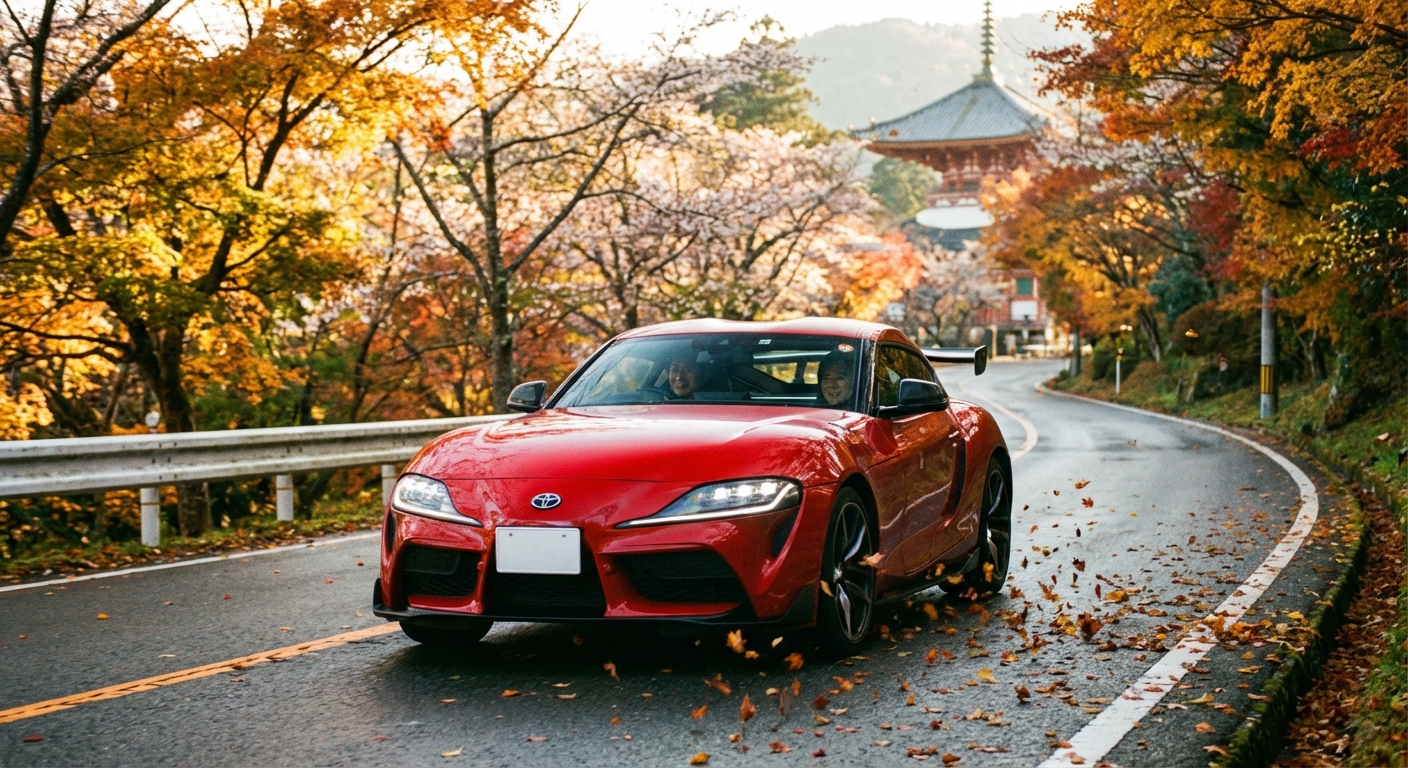
The Ultimate Todai-ji and Kasuga Taisha Recommended Drive Course: A JDM Pilgrimage through Nara’s Ancient Heart
1. The Philosophy of Driving in Japan: Beyond the Rails
For years, I lived my life by the second. As a conductor for Kintetsu Railway—one of Japan’s most storied private rail lines—my existence was governed by the rhythmic click-clack of steel wheels on tracks and the unwavering precision of the timetable. I knew the Kansai region through the glass of a cockpit, watching the landscapes of Osaka and Nara blur past in a predictable, linear fashion. Trains are the lifeblood of Japan, a marvel of engineering and social harmony. But there is a ceiling to that experience. You are a passenger in someone else’s story, confined to where the iron allows you to go.
When I hung up my uniform and traded the conductor’s watch for the steering wheel of a JDM (Japanese Domestic Market) sports car, my perspective on travel shifted 180 degrees. I realized that the "Secret Japan"—the one where the mist clings to the cedars and the scent of ancient incense meets the sharp, metallic tang of a cooling engine—is only accessible by road. To truly understand Nara, specifically the spiritual nexus of Todai-ji and Kasuga Taisha, you cannot simply arrive at a station and walk with the crowds. You must approach it through the winding mountain passes, feeling the weight of the car shift through every hairpin turn. This is the philosophy of the Todai-ji Kasuga Taisha Recommended Drive Course.
In a car, specifically a machine like the Toyota 86 or Subaru BRZ, the journey becomes an extension of your own intent. You aren't just visiting a temple; you are navigating the geography that allowed that temple to exist for over a millennium. Driving allows you to find the silence between the tourist spots. It allows you to chase the sunrise over the Yamato Plain and retreat into the mountains when the midday crowds peak. This guide is born from my dual life: the technical discipline of a railwayman and the unbridled passion of a petrolhead who has driven every backroad from Hokkaido to Kyushu. Today, we focus on Nara, the cradle of Japanese civilization, through the lens of a driver.

2. The 2-Day Itinerary: A Deep Dive into the Nara Hinterlands
Day 1: The Sacred Ascent and the Great Buddha
08:00 – The Departure: Osaka to Nara via the Hanshin Expressway
Your journey begins in the neon heart of Osaka. Slide into the bolstered seat of a Toyota 86. The cockpit is intimate, designed for one purpose: communication between man and machine. As you fire up the 2.0-liter boxer engine, the low-frequency thrum vibrates through the chassis—a stark contrast to the silent electric whir of modern commuter trains. We head east, merging onto the Hanshin Expressway No. 13 Higashi-Osaka Line. As the city skyline fades, the Ikoma mountain range rises like a green wall. This is the gateway to the ancient capital.
09:30 – Arrival at Nara Park: The Gravity of History
While most take the train to Kintetsu Nara Station, we approach from the north, avoiding the congested main arteries. Our first stop is the legendary Todai-ji. Parking a sports car in Nara requires a bit of local knowledge; look for the smaller lots near the northern edge of the park to avoid the heavy bus traffic. Walking toward the Nandaimon (Great South Gate), the sheer scale of the 8th-century timberwork hits you. This isn't just a building; it’s a testament to human will. Inside the Daibutsuden (Great Buddha Hall), the largest wooden building in the world, sits the 15-meter-tall bronze Vairocana Buddha. The air here is thick with centuries of prayer and the scent of sandalwood. As a former conductor, I appreciate the logistics of this place—how did they transport these massive timbers 1,300 years ago without the horsepower we enjoy today?
11:30 – Kasuga Taisha: The Path of Ten Thousand Lanterns
From Todai-ji, a short, scenic drive through the deer-filled park leads us to Kasuga Taisha. This Shinto shrine is famous for its bronze and stone lanterns. The drive up the approach is flanked by towering ancient cedars. Shintoism is about the divinity in nature, and as a driver, you feel this in the way the road contours to the land. The vermillion pillars of the shrine pop against the deep green of the Kasugayama Primeval Forest, a UNESCO World Heritage site where logging and hunting have been banned since the 9th century. This is a place to reflect on the concept of 'Kegare' (impurity) and 'Harae' (purification)—much like how a fresh oil change and a car wash can reset the soul of a driver.
13:00 – Lunch: Kakinoha-zushi and Local Flavors
Drive toward the outskirts to find a quiet spot for Kakinoha-zushi (sushi wrapped in persimmon leaves). This was the original "fast food" for travelers in the Edo period. The salt-preserved mackerel and vinegared rice, infused with the fragrance of the leaf, provide the perfect light fuel for an afternoon of technical driving.
14:30 – The Highlight: Nara Okuyama Driveway
This is why you brought the 86. The Nara Okuyama Driveway is a 12.5-kilometer toll road that is arguably the best driving course in the region. It is split into three sections: the Shin-Wakakusayama course, the Kasugayama course, and the Takisaka course.
- Shin-Wakakusayama Section: A paved, winding ascent that offers panoramic views of Nara city. The 86’s steering shines here—precise, communicative, and rewarding. You can feel the tires biting into the asphalt as you climb toward the summit of Mt. Wakakusa.
- Kasugayama Section: This is where things get truly special. This part of the road is *unpaved*—a well-maintained gravel path that cuts through the heart of the primeval forest. Driving a low-slung RWD car here requires finesse. You aren't going fast; you are listening to the crunch of gravel and watching the light filter through the dense canopy. It is one of the few places in Japan where you can drive through a protected ancient forest.
- Takisaka Section: The descent. Watch for the stone Buddhas carved into the rock faces along the side of the road. It’s a spiritual technical course that tests your braking and line choice.
17:00 – Sunset at Mt. Wakakusa Summit
Park at the summit lot. As the sun dips below the horizon, the lights of Nara and distant Osaka begin to twinkle. The silhouette of the 86 against the twilight sky is a sight to behold. This is the moment where the mechanical and the mystical merge.
Day 2: The Skyline and the Hidden Valleys
09:00 – The Shigi-Ikoma Skyline
After a night in a traditional ryokan, we head to the Shigi-Ikoma Skyline. If the Okuyama Driveway was the spiritual appetizer, this is the main course for driving enthusiasts. Spanning the ridge between Nara and Osaka, this toll road offers high-speed sweepers and tight technical sections. In the 86, you’ll find yourself dancing between second and third gear. The balance of the chassis is perfection; there’s no unnecessary weight, just pure feedback. You’ll pass through Hozan-ji, a temple dedicated to the god of joy and business, tucked into the cliffs of Mt. Ikoma.
12:00 – Technical Deep Dive: Why the 86?
As you pause at a lookout point, let’s talk shop. Why do I insist on the 86 or BRZ for this Nara drive? Nara’s roads aren't about brute horsepower; they are about flow. A GT-R is too wide for some of these mountain passes, and a Supra is too heavy. The 86, with its naturally aspirated boxer engine, requires you to work for the power. You have to keep the revs high, feeling that surge at 5,000 RPM. It’s a car that rewards a driver who understands momentum—much like how a conductor understands the inertia of a thousand-ton train. It’s the perfect tool for carving through the Yamato landscape.
14:00 – The Backroads of Asuka
A 40-minute drive south of Nara Park brings you to Asuka, the village where the Japanese state was first formed. Here, the roads narrow, winding through terraced rice fields. Look for the 'Ishi-butai' megalithic tomb. The contrast of a modern JDM masterpiece parked next to a 7th-century stone structure is the essence of my Japan: a country that moves forward without ever forgetting its roots.
3. Expert Advice & Cultural Nuances
Driving in Japan is an exercise in mutual respect. As a former railway employee, I can tell you that the Japanese value 'Omotenashi' (hospitality) and 'Wa' (harmony). This extends to the road.
- The 'Michi-no-Eki' Culture: These are 'Roadside Stations.' They aren't just rest stops; they are hubs for local produce, crafts, and gourmet food. In Nara, look for stations that sell 'Yamato-cha' (local green tea) or handmade mochi. It’s the best place to mingle with local drivers and see some impressive local cars.
- The Silent Language: When someone lets you merge, a brief double-flash of your hazard lights is the universal 'thank you.' It’s a small gesture, but it goes a long way in maintaining the harmony of the road.
- Hidden Gems: While Todai-ji is the star, don’t miss Shin-Yakushi-ji. It’s a smaller temple with twelve incredible warrior statues. It’s much quieter, and the drive there through the residential Nara lanes is a masterclass in precision driving.
- Wildlife Warning: Nara is the city of deer. They are considered messengers of the gods, but to a driver, they are unpredictable hazards. Be especially careful at dawn and dusk. A deer-strike in a lightweight sports car will ruin your pilgrimage faster than anything else.
4. Detailed Logistics & Pre-Trip Tips
Driving a manual JDM car in 2026 is a rare privilege, but it requires preparation.
- The ETC Card: Essential. Most tolls on the Nara driveways and expressways are automated. Ensure your rental comes with an ETC card, or you’ll be fumbling for change at every gate, breaking your driving flow.
- The Gas Station Experience: Most stations in the Nara countryside are 'Full Service.' Pull up, and the attendants will greet you with a loud "Irasshaimase!" (Welcome!). To fill the tank, simply say "High-octane, Mantan" (Full tank of high-octane). They will often wipe your mirrors and windows while you wait—a level of service that mirrors the precision of the Kintetsu line.
- The JDM Factor: If you are driving an 86 or BRZ, remember that these are low cars. When entering steep parking lots or navigating the gutters of narrow Nara streets, take an angled approach to avoid scraping the front lip. The 6-speed manual is a joy, but in heavy Nara traffic, your left leg will get a workout. Embrace it; it’s part of the connection.
- Parking: Never park on the street in Nara. Use the 'Coin Parking' lots. They are ubiquitous and relatively cheap. The 86 fits perfectly in standard Japanese spots, but always check the 'flap' height on the automated locks to ensure your undercarriage is clear.
5. Comprehensive FAQ
Q: What license do I need to drive in Japan?
A: To drive in Japan, you must have an International Driving Permit (IDP) issued under the 1949 Geneva Convention, along with your valid home country driver's license and your passport. Residents of certain countries (like Switzerland, Germany, France, etc.) require a Japanese translation of their license instead. Always check your country’s status before booking. Note that an IDP issued under the 1968 Vienna Convention is NOT valid in Japan.
Q: Is the 86/BRZ difficult to drive on mountain roads?
A: Quite the opposite. It was designed for them. However, if you are used to high-torque turbocharged cars, you will need to adjust your shifting patterns to keep the engine in its power band. The steering is very direct, so small inputs result in immediate changes.
Q: Can I visit Todai-ji and Kasuga Taisha in one day?
A: Yes, they are within walking distance of each other. However, to do the full drive course, including the Okuyama Driveway and the Skyline, two days is highly recommended to avoid rushing.
Q: What happens if I get a flat tire or have mechanical issues?
A: Most reputable rental services provide 24/7 roadside assistance. In the mountains of Nara, cell service is generally excellent, so you are never truly stranded.
6. The Final Call: Your Nara Adventure Awaits
As a former conductor, I used to tell passengers to mind the gap between the platform and the train. Now, as a specialist in the Japanese driving experience, I tell you to bridge the gap between being a tourist and being an explorer. Nara is a city of layers—ancient wood, moss-covered stone, and winding asphalt that begs to be driven.
There is no better way to honor the engineering spirit of Japan than by taking a purpose-built sports car through the very heart of its history. The 86 is waiting. The mountains are calling. The bells of Todai-ji are ringing, but this time, you won't be hearing them from a train window. You'll be hearing them from the open window of your cockpit, with the engine idling and the road stretching out before you.
Ready to trade the tracks for the open road? Book your JDM legend today at Omoshiro Rent-a-Car Osaka Chuo. We don’t just provide cars; we provide the keys to a Japan you never knew existed. Your pilgrimage starts here.