
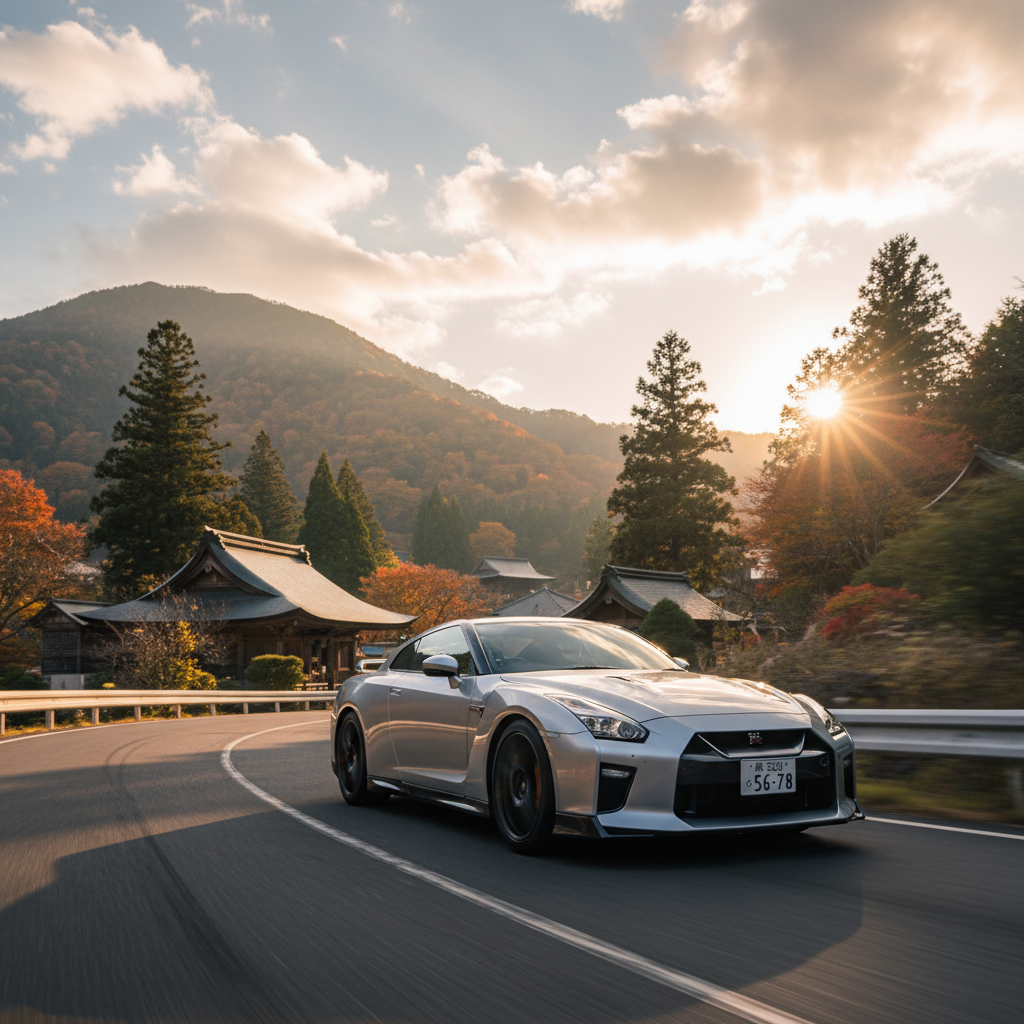
Nara Yamato Sanzan Scenic Recommended Drive Course: The Ultimate JDM Pilgrimage
1. The Philosophy of Driving in Japan: Beyond the Steel Tracks
For years, my world was defined by the rhythmic clatter of steel on steel. As a conductor for the Kintetsu Railway, one of Japan’s most iconic private rail networks, I lived by the second. I saw the landscapes of Nara, Osaka, and Kyoto through the rectangular frame of a train window, restricted by the unwavering path of the rails. While the Japanese rail system is a marvel of human engineering—an artery that keeps the heart of the nation beating—it has its limitations. It shows you the Japan that is prepared for visitors. It takes you to the stations, the hubs, the crowded plazas. But it cannot take you to the Secret Japan.
The Secret Japan exists in the gaps between the stations. It lives on the narrow, winding ridges of the Yamato Basin, where the mist clings to the cedars and the smell of ancient incense wafts through air that hasn't changed in a millennium. To truly experience the spiritual cradle of Japanese civilization, you need to step off the platform and behind the wheel of a machine that communicates with the asphalt. You need the tactile feedback of a manual gearbox, the low center of gravity of a JDM legend, and the freedom to turn down a road simply because the light hitting the moss-covered stone wall looks right.
As someone who now operates a JDM-specific rental shop in the heart of Osaka, I have transitioned from the conductor’s whistle to the roar of a Boxer engine. The shift from public transport to private exploration is more than just a change in logistics; it is a shift in consciousness. When you drive through Nara—specifically the area surrounding the Yamato Sanzan (The Three Mountains of Yamato)—you are not just a tourist; you are a navigator of history. The road becomes a time machine, and your car, preferably a Toyota 86 or a Subaru BRZ, becomes your conduit to the gods. In this guide, I will take you on a journey that no train ticket can buy. We are heading into the deep Nara, the Yamato landscape, where the very foundations of the Japanese state were laid over 1,300 years ago.

2. Nara Yamato Sanzan Scenic Recommended Drive Course: The 2-Day Itinerary
This itinerary is designed for the driver who demands more. It is for the traveler who wants to feel the mechanical grip of their tires on ancient mountain passes and witness sunrises that have inspired poets for centuries. We will be using the Toyota 86—a car that embodies the 'Jinba Ittai' (horse and rider as one) philosophy—to conquer the undulating terrain of the Yamato Basin.
Day 1: The Gateway to the Gods
08:00 | Departure from Central Osaka
The journey begins in the urban jungle of Osaka. As you fire up the 2.0-liter naturally aspirated engine of your 86, the cold-start bark echoes against the concrete. We head east, bypassing the standard tourist buses. Our goal is the Nishi-Meihan Expressway, but the real magic starts once we exit at Koriyama and head south toward Kashihara. The transition from the neon-soaked skyline to the emerald green of the Nara countryside is abrupt and intoxicating.
09:30 | Mount Miminashi: The Symmetrical Sentinel
The first of the Yamato Sanzan is Mt. Miminashi. Rising 139 meters above the plain, its near-perfect volcanic cone shape makes it an iconic landmark. In the Manyoshu, Japan’s oldest collection of poetry, these mountains were personified in a legendary love triangle. Mt. Miminashi is the 'silent' mountain, standing witness to the passage of time. The drive around its base offers smooth, sweeping curves that allow you to warm up the tires and get a feel for the 86's precise steering. We stop at a small local clearing to photograph the car against the mountain—the sharp, modern lines of the JDM silhouette contrasting with the ancient, organic curves of the peak.
11:30 | Mount Unebi: The Spiritual Anchor
We navigate through the charming, narrow streets of Kashihara toward Mt. Unebi. At 199 meters, it is the tallest of the three. It sits adjacent to the Kashihara Jingu, a shrine of immense proportions dedicated to Japan’s first emperor, Jimmu. Driving the 86 through the approach roads, you feel the weight of history. The gravel paths crunched under the tires of 19th-century carriages; today, they resonate with the low hum of our exhaust. We take a moment to walk the shrine grounds, the scent of Japanese cypress (hinoki) thick in the air, before returning to the driver’s seat. The 86’s bucket seats hold you tight as we prepare for the most technical part of the day.
13:00 | Local Delicacies: Kakinoha-zushi in the Foothills
Lunch is not just a meal; it’s a cultural immersion. We stop at a small, family-run shop near the base of Mt. Unebi to pick up Kakinoha-zushi—sushi wrapped in persimmon leaves. The leaves have antibacterial properties, a tradition from the days before refrigeration. Eating this inside the car, parked by a bubbling stream with the windows down, you can hear the mechanical 'ticking' of the cooling engine. The vinegared rice and salted mackerel provide the perfect energy boost for the afternoon climb.
15:00 | Mount Kagu: The Heavenly Descent
Mt. Kagu is said to have fallen from heaven. It is the most sacred of the three, mentioned in the oldest myths as a place where the gods descended. The road leading to the base of Mt. Kagu is a driver’s dream—a series of tight hairpins and sudden elevation changes. Here, the Subaru-engineered Boxer engine shines. Keeping the revs high, you feel the linear power delivery as you exit each corner. The 86's rear-wheel-drive layout allows for a playful yet controlled rotation. As the sun begins to dip, the golden hour light filters through the ancient forests, turning the road into a ribbon of fire.
18:00 | Overlooking the Basin: Amakashi-no-oka
We end Day 1 at the Amakashi-no-oka lookout. From here, you can see all three mountains—Miminashi, Unebi, and Kagu—forming a perfect triangle. This was the center of the Japanese world during the Asuka period. As the sky turns a deep purple, the lights of the modern town below begin to twinkle, but the silhouettes of the mountains remain eternal. It is a moment of profound peace, broken only by the distant sound of a downshifting sports car in the valley below.
Day 2: The Winding Path of the Ancients
09:00 | Asuka Village: Driving through an Open-Air Museum
Day 2 is about the Asuka region, the cradle of Japanese Buddhism and early statecraft. The roads here are exceptionally narrow, bordered by rice paddies and ancient burial mounds (kofun). This is where the compact dimensions of the 86/BRZ become a massive advantage. While large tour buses struggle, we zip through the village lanes. We visit the Ishibutai Kofun, a massive stone tomb that looks like a prehistoric megalith. The sight of a high-performance JDM machine parked near a 7th-century tomb is the ultimate expression of the 'Old meets New' Japan.
11:00 | The Tanzan Shrine Hill Climb
From Asuka, we head east toward the Tanzan Shrine. This is the 'Nikko of Kansai,' famous for its unique thirteen-story wooden pagoda. The drive up to the shrine is a legendary stretch of road for local enthusiasts. It’s a steep ascent with rhythmic S-curves that demand focus. Heel-and-toe downshifting becomes second nature as you negotiate the climb. The 86's chassis stiffness is apparent here; there is zero body roll, just pure, unadulterated grip. The air grows cooler as we climb higher into the mountains, the scent of damp earth and cedar becoming more intense.
14:00 | Hidden Nara: The Backroads to Sakurai
Instead of taking the main highway back, we take the 'blue' roads—the local prefectural routes that wind through forgotten hamlets. We pass through Sakurai, stopping at the Ohmiwa Shrine, one of the oldest in Japan, where the mountain itself (Mt. Miwa) is the deity. There is no main hall here, only a gate through which you worship the forest. The spiritual energy is palpable. Driving through these sacred groves, you feel a sense of responsibility to the machine and the land. The engine note is kept low out of respect, the tires whispering over the aged tarmac.
16:30 | The Sunset Run: Nishi-Meihan Return
As we begin our journey back to Osaka, we catch the sunset on the Nishi-Meihan Expressway. The 86 settles into a comfortable cruise. The feedback through the steering wheel tells you everything about the road surface, even at high speeds. Your mind drifts back to the sights of the day—the moss on the stone lanterns, the sharp peak of Mt. Miminashi, and the perfect balance of the car through the Tanzan pass. You realize that you have seen more of the heart of Japan in 48 hours than most people see in a lifetime of train travel.
3. Expert Advice & Cultural Nuances
Driving in Nara is a privilege, and like all privileges, it comes with a set of unspoken rules. To truly enjoy this Nara Yamato Sanzan Scenic Recommended Drive Course, you must understand the cultural landscape as well as the physical one.
The Magic of Michi-no-Eki
Japan’s 'Roadside Stations' (Michi-no-Eki) are not your typical highway rest stops. They are community hubs that showcase the best of the local region. In Nara, these stations are gold mines for fresh produce, local crafts, and incredibly high-quality food. Stop at 'Michi-no-Eki Asuka' to try the local strawberry soft-serve ice cream or buy hand-carved cedar chopsticks. It’s also the best place to talk to local car enthusiasts. If you see a group of modified cars in the corner of the lot, don’t be shy—a simple 'Kirei desu ne' (It’s beautiful) goes a long way.
The Etiquette of the Narrow Road
In the Asuka and Yamato Sanzan area, you will frequently encounter roads that are only wide enough for one car. This is where the 'mercy' of the Japanese driver shines. If you see an oncoming car, look for a 'taihisho' (a small turnout). The driver who has the easier path to pull over usually does so. A quick flash of the hazard lights after passing is the universal Japanese 'thank you.' As a former conductor, I can tell you that timing and rhythm are everything. Keep a steady pace, but always be prepared to yield.
Hidden Gems: The Local Soba Shop
Avoid the restaurants with English menus on the main road. Instead, look for a 'Noren' (fabric curtain) hanging over a wooden door in a side street. If you see a few local 'Kei' trucks parked outside, you’ve found the right place. Ordering a bowl of 'Kake Soba' in a 200-year-old farmhouse while looking out at a Zen garden is an experience that transcends luxury. The simplicity of the food reflects the purity of the drive.
4. Detailed Logistics & Pre-Trip Tips
As we head into 2026, the infrastructure for international drivers in Japan has never been better, yet the soul of the JDM experience remains wonderfully analog. Here is what you need to know to make your Nara Yamato Sanzan Scenic Recommended Drive Course seamless.
The JDM Experience: Why the 86/BRZ?
You might be tempted by a luxury sedan, but the Nara backroads demand a car with a soul. The Toyota 86 and Subaru BRZ were designed for exactly these kinds of roads. They are lightweight, rear-wheel drive, and offer a visceral connection to the road. Driving a manual transmission (MT) car in Japan is becoming a rare art form. The satisfaction of a perfect rev-match downshift as you approach an ancient bridge is a high that no automatic can replicate. It’s about the mechanical symphony—the intake growl, the exhaust note, and the click of the shifter.
Gas Station Culture
Most gas stations in the Nara countryside are full-service. When you pull in, an attendant will likely guide you with loud, energetic shouts. Simply say 'High-ok, mantan' (Premium, full tank). They will often wash your mirrors and give you a towel to wipe your dashboard. It’s a level of service that shocks most Westerners. When you leave, they will often stand in the road and bow as you drive away. It makes you feel like a racing driver leaving the pits.
ETC and Tolls
The Electronic Toll Collection (ETC) system is vital. All our rental cars come equipped with an ETC card reader. This allows you to glide through toll booths without stopping, with the fees being settled when you return the car. It saves time and prevents the awkward reach for the ticket machine from a low-slung sports car seat.
Parking in Antiquity
Nara’s historical sites are well-preserved, meaning parking can be tight. Always look for the 'P' sign. Avoid parking on the side of narrow farm roads, as this can block local tractors. Most shrines have dedicated parking lots, some of which are gravel—be mindful of your car's lower clearance if you are driving a modified JDM model.
5. Comprehensive FAQ
Q: What kind of license do I need to drive in Japan?
A: This is the most critical point. You must have an International Driving Permit (IDP) issued under the 1949 Geneva Convention, along with your valid home country license and your passport. Note that permits issued under the 1968 Vienna Convention are NOT valid in Japan. If you are from certain countries like Switzerland, Germany, or France, you need a Japanese translation of your license provided by JAF (Japan Automobile Federation). Always check the latest requirements before you fly.
Q: Is driving a manual (MT) car difficult in Nara?
A: While Nara has some narrow streets, the main drive course is very manageable for anyone comfortable with a manual gearbox. The 86 has a very forgiving clutch and great hill-start assist features. If you are an enthusiast, there is no better way to experience these roads.
Q: What about insurance?
A: Full coverage is highly recommended. Our rental packages include comprehensive insurance options to give you peace of mind while navigating unfamiliar territory. We handle the paperwork so you can focus on the apexes.
Q: Is Nara driveable in winter?
A: The Yamato Basin rarely sees heavy snow, but the surrounding mountains can get icy in January and February. For our 2026 winter season, we equip our fleet with studless winter tires upon request. However, for the best 'scenic' experience, spring (cherry blossoms) and autumn (red maples) are unbeatable.
6. The Final Call: Your JDM Adventure Awaits
The tracks of the Kintetsu Railway will always hold a special place in my heart, but my soul belongs to the asphalt. The Nara Yamato Sanzan is more than just a cluster of hills; it is the physical manifestation of Japan’s origin story. To see it from the cockpit of a Toyota 86, feeling the vibrations of the road and the pulse of the engine, is to connect with this country on a level that most tourists never even realize exists.
You’ve read about the mist on Mt. Kagu, the precision of the 86’s steering on the Tanzan climb, and the flavor of the persimmon-wrapped sushi. Now, it’s time to stop reading and start driving. At Omoshiro Rent-a-Car Osaka Chuo, we don't just rent cars; we provide the keys to a different dimension of travel. Our fleet of meticulously maintained JDM legends, including the 86 and BRZ, is waiting for you in the heart of Osaka. Whether you are a seasoned track veteran or a romantic adventurer, we have the perfect machine for your Yamato pilgrimage. Don't settle for the standard tourist path. Claim your freedom, hear the roar of the Boxer engine, and discover the Secret Japan with us. Book your car today and let the mountains of Yamato be your guide.