
1. Nara Wakakusayama Summit Night View Recommendations - The Philosophy of Driving in Japan
For over a decade, I navigated the complex iron arteries of the Kansai region as a conductor for Kintetsu Railway. I lived by the clock, the rhythmic click-clack of steel on steel, and the predictable flow of commuters. It was a world of efficiency, safety, and fixed tracks. But every time my train passed through the Nara basin, I would look up at the emerald slopes of Mount Wakakusa (Wakakusayama) and wonder what lay beyond the station platforms. The truth is, as much as I love the Japanese rail system, it is a system of constraints. To truly experience the 'Secret Japan'—the one that smells of mountain pine, feels the bite of a crisp evening wind, and glows with the amber lights of an ancient capital—you must break free from the rails. You need four wheels, a steering wheel that talks back to you, and the freedom of the open road.
Driving in Japan, particularly the transition from the neon-soaked skyline of Osaka to the silent, sacred forests of Nara, is a spiritual journey. In an era where travel has become a series of checked boxes and Instagram filters, taking the helm of a Japanese Domestic Market (JDM) legend like the Toyota 86 or the Subaru BRZ transforms a simple trip into an epic narrative. This isn't just about getting from point A to point B; it’s about the sensation of the rear-wheel-drive platform dancing through the hairpins of the Nara Okuyama Driveway. It’s about the contrast between the high-tech precision of a modern sports car and the timeless serenity of a mountain that has been protected for over a thousand years. When we talk about Nara Wakakusayama Summit night view recommendations, we aren't just talking about a viewpoint; we are talking about the ultimate intersection of man, machine, and nature.
The philosophy of the drive is simple: escape the 'tourist bubble.' While thousands of visitors crowd the deer park in central Nara, few ever witness the panoramic majesty of the summit after dark. By choosing to drive, you unlock the ability to see the world at your own pace. You can stop at a hidden shrine tucked into a cedar grove, or spend an extra hour watching the sky turn from violet to indigo over the Yamato Plain. This guide is my love letter to those who seek that thrill—the professional's perspective on how to conquer the roads of Nara and witness a night view that is officially recognized as one of the 'New Three Major Night Views of Japan.'

2. Nara Wakakusayama Summit Night View Recommendations - The 2-Day Itinerary: Deep Dive
Day 1: The Ascent into the Heart of Yamato
10:00 AM: The Awakening in Osaka
Your journey begins in the heart of Osaka. As you settle into the low-slung bucket seat of a Toyota 86, the first thing you’ll notice is the ergonomics. Everything is designed for the driver. You click the seatbelt, depress the clutch, and press the start button. The 2.0-liter boxer engine fires to life with a characteristic growl—a sound that promises agility. We head east, leaving the skyscrapers behind, merging onto the Hanshin Expressway. The urban sprawl slowly gives way to the rolling hills of the Ikoma mountain range.
11:30 AM: Entering the Ancient Capital
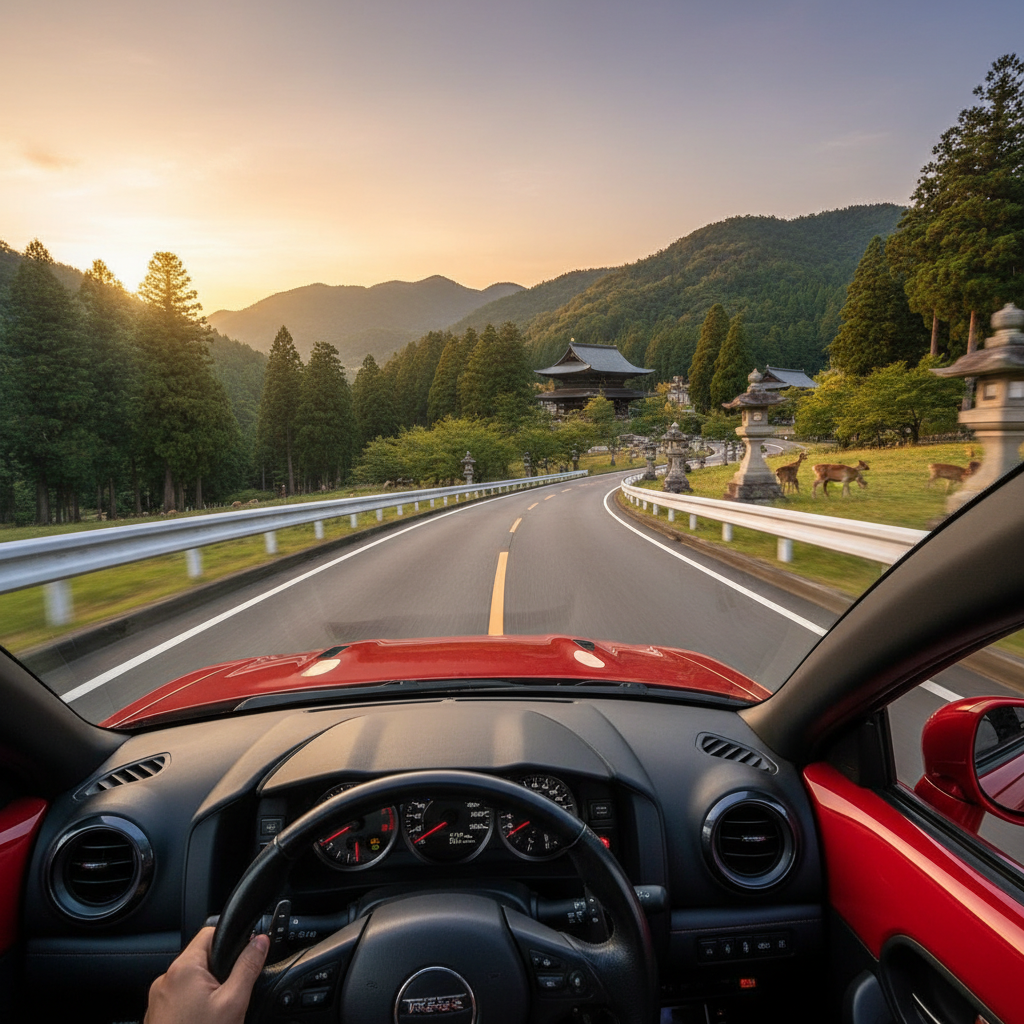
As you cross the border into Nara Prefecture, the air changes. It feels heavier with history. We bypass the main tourist traffic of Nara Park and head toward the northern entrance of the Nara Okuyama Driveway. This is where the 86 really starts to shine. The road is narrow, winding, and shrouded in ancient trees. The steering is telepathic; you feel every grain of the asphalt through the thin-rimmed wheel. We aren't racing; we are flowing with the mountain.
1:00 PM: Lunch at a Hidden Mountain Retreat
Before we reach the summit, we stop at a small, family-run soba shop nestled near the entrance of the Kasuga Primeval Forest. Here, the water used for the noodles comes directly from the mountain springs. The 'Zaru Soba' is served cold, allowing you to taste the earthy sweetness of the buckwheat. The simplicity of the meal mirrors the Zen philosophy of the surrounding forest—a UNESCO World Heritage site where logging has been prohibited since the year 841.
3:00 PM: The Shin-Wakakusayama Course
We continue our climb along the 'Shin-Wakakusayama' section of the driveway. This part of the road is a masterpiece of civil engineering, hugging the contours of the mountain. In a Subaru BRZ, the suspension works beautifully here, soaking up mid-corner bumps while keeping the chassis perfectly flat. You’ll pass through tunnels of green—maple leaves in summer, fiery reds in autumn. Stop at the intermediate lookouts to catch glimpses of the Todai-ji Temple’s Great Buddha Hall from above. Even from this height, the scale of the wooden structure is staggering.
5:30 PM: The Golden Hour at the Summit
Arrival at the Wakakusayama Summit parking lot. At an altitude of 342 meters, you are standing on a three-tiered dormant volcano covered in grass. As the sun begins its descent, the entire mountain is bathed in a golden hue. The local deer, considered messengers of the gods, roam the summit freely. They are less aggressive here than in the lower park, silhouetted against the setting sun like something out of a myth. This is the moment to appreciate the lines of your JDM machine against the backdrop of the sunset. The metallic paint of the 86 catches the dying light, highlighting the aggressive fenders and the low-profile stance.
7:00 PM: The 'Million Dollar' Transformation
As twilight fades, the Yamato Plain begins to sparkle. This is the core of our Nara Wakakusayama Summit night view recommendations. To your left, the lights of Nara City; straight ahead, the distant glow of Osaka and even Kobe on a clear night; and to your right, the quiet darkness of the mountains. The view is 180 degrees of pure luminescence. Unlike the skyscraper views of Tokyo, this view feels organic. You see the grid-like patterns of the ancient capital, the dark patches where temples and forests sit, and the pulsing veins of the highways connecting the modern world. The wind picks up, carrying the scent of cedar and cold earth. It is a moment of profound silence, broken only by the occasional cry of a deer or the distant hum of the city below.
9:00 PM: The Descent and Check-in
Descending the mountain at night is an experience in itself. Your headlights cut through the pitch-black forest, reflecting off the eyes of the deer at the roadside. Precision is key. You heel-and-toe into the corners, the rev-match blip of the engine echoing off the rock faces. We check into a traditional Ryokan located on the outskirts of Nara, where a private onsen (hot spring) awaits to soothe your muscles after a day of spirited driving.
Day 2: Exploration and the Return Journey
9:00 AM: Sunrise over the Pagodas
After a traditional breakfast of grilled fish, miso soup, and Nara’s famous tea-rice porridge (chagayu), we take a different route. We drive toward the southern end of the park to visit the Kasuga Taisha Shrine. Driving the 86 through the lantern-lined approaches feels like traveling back in time. The contrast of the car's modern engineering against the vermilion-painted wood of the shrine is a photographer's dream.
11:30 AM: The Secret Winding Roads of the Nara Hinterland
We head further south toward the village of Asuka, the cradle of Japanese civilization. The roads here are even more technical. We’re talking second and third-gear corners where the balance of the BRZ allows you to rotate the car with the throttle. These are the roads where the JDM legends were forged. We pass through terraced rice fields that have been cultivated for centuries. The geology here is fascinating; the granite foundations of the mountains have dictated the path of the roads, resulting in a natural 'rhythm' to the drive.
1:30 PM: A Culinary Stop in a Restored Farmhouse
Lunch is at a 'Kominka' (restored traditional house) that specializes in 'Yamato-Yasai'—heirloom vegetables local to Nara. The flavors are intense and pure. Eating here, surrounded by the wooden beams and paper screens, you realize that the JDM car you’re driving is an extension of this same Japanese craftsmanship—a dedication to perfecting a specific craft, whether it's farming, architecture, or automotive engineering.
4:00 PM: The Final Peak - Mount Ikoma
On our way back to Osaka, we take the Skyline drive over Mount Ikoma. This provides a final, stunning view of the Osaka skyline from the opposite direction. It’s the perfect bookend to the Wakakusayama experience. You can see the skyscrapers of Umeda and the port of Osaka, a stark contrast to the quiet antiquity of Nara.
6:00 PM: The Urban Re-entry
As we merge back into the Osaka traffic, the 86 becomes a civil city car again. The air conditioning hums, the infotainment system guides you through the neon labyrinth. But as a driver, you are changed. You’ve tasted the mountain air and felt the pulse of the ancient capital through the tires. You understand why the car is more than a tool—it’s a key to a world that most tourists will never see.
3. Nara Wakakusayama Summit Night View Recommendations - Expert Advice & Cultural Nuances
To truly master the roads of Nara, one must understand the 'Michi-no-Eki' (Roadside Station) culture. These aren't just rest stops; they are local hubs of culture and commerce. In Nara, you will find stations selling 'Kakinoha-zushi' (persimmon leaf-wrapped sushi), a local delicacy designed to be preserved during mountain travels. Always stop at these stations. They offer the freshest local produce and are the best places to interact with local car enthusiasts. You’ll often find a row of beautifully maintained JDM cars in the parking lots—everything from vintage Skylines to modern Supras. A polite nod or a 'Konnichiwa' goes a long way here.
Driving etiquette in Japan is governed by a sense of 'Omoiyari' or consideration for others. On the narrow mountain passes of the Nara Okuyama Driveway, you may encounter local residents or even the occasional maintenance truck. It is customary to pull into a turnout and let faster drivers pass, or to give a short hazard-light flash as a 'thank you' when someone lets you merge. This silent communication is the heartbeat of the Japanese road.
Be mindful of the wildlife. The deer in Nara are sacred, but on the mountain roads, they are a hazard. During the 'rutting season' in autumn, they can be unpredictable. When driving your 86 or BRZ at night, keep your high beams ready and your speed moderate. The thrill comes from the precision of the handling, not the top speed on the straights. Also, pay attention to the toll gates. The Nara Okuyama Driveway is a private toll road. It is divided into three sections, and the 'Summit' route is specific. Ensure you have small change or an ETC card ready.
4. Nara Wakakusayama Summit Night View Recommendations - Detailed Logistics & Pre-Trip Tips
As we move into 2026, the logistics of driving in Japan have become incredibly streamlined, yet some traditional rules remain paramount. First and foremost: the car. While many rental agencies offer standard economy cars, choosing a JDM sports car like the Toyota 86 or Subaru BRZ is essential for this route. These cars are designed for Japanese roads—they are compact enough for the narrow passes but offer the mechanical grip needed for the mountain hairpins. The low center of gravity provided by the boxer engine makes the descent from Wakakusayama an absolute joy.
The ETC System: Electronic Toll Collection (ETC) is your best friend. Most modern rental cars come equipped with an ETC card reader. This allows you to pass through toll gates without stopping, with the fees being settled when you return the car. This is particularly useful for the Hanshin Expressway and the Nara-bound routes.
The Gas Station Experience: In Japan, you will find 'Full Service' and 'Self Service' stations. If you go to a full-service station, the staff will often bow, guide you to the pump, and even clean your windshield. To fill the tank, simply say 'Regular Mantan' (Regular, full tank) or 'High-Oku Mantan' (High-octane/Premium, full tank) for the 86/BRZ. They will even help you exit the station by stopping traffic.
Parking: In Nara, parking is strictly enforced. Always use designated 'Coin Parking' lots. They are everywhere and usually operate with a simple gate or a flap system under the car. At the Wakakusayama Summit, there is a dedicated parking area which is free after you have paid the driveway toll. Note that the driveway has specific operating hours, usually closing around 10:00 PM or 11:00 PM depending on the season, so plan your night view accordingly.
The JDM High: There is a specific psychological state that comes with driving a manual (MT) JDM car in its natural habitat. The mechanical 'clunk' of the shifter, the weight of the pedals, and the view over the hood—it creates a connection to the machine that is rare in modern driving. Don't be intimidated by the right-hand drive (RHD) setup; within 30 minutes, it becomes second nature.
5. Nara Wakakusayama Summit Night View Recommendations - Comprehensive FAQ
Q: What kind of license do I need to drive in Japan?
A: This is the most critical point. To drive in Japan, you must possess both your original domestic driver's license and an International Driving Permit (IDP) issued under the 1949 Geneva Convention. Note that IDPs issued under the 1968 Vienna Convention are NOT valid in Japan. Some countries (like Switzerland, Germany, France, etc.) require an official Japanese translation instead of an IDP. Always bring your passport as well. For detailed requirements, refer to the official guidelines regarding the Geneva Convention standards.
Q: I’m worried about driving a manual car on the 'wrong' side of the road. Is it difficult?
A: Most drivers adapt quickly. The pedals are in the same order (Clutch-Brake-Gas). The main challenge is the turn signal and windshield wiper stalks being swapped, but you'll get used to it after a few accidental wipes! The Toyota 86 is very forgiving for manual drivers, with a hill-start assist and a clear clutch engagement point.
Q: Can I see the night view in winter?
A: Yes, but be prepared. Nara can get snow in January and February. While the driveway is usually kept clear, if there is a heavy snow warning, you will need winter tires or the road may be closed. However, winter offers the clearest air and the most sparkling night views.
Q: Are there any hidden costs?
A: The main costs are the rental fee, fuel, tolls (the Nara Okuyama Driveway costs roughly 1,800 to 2,500 yen for the full course), and parking. Insurance is highly recommended and usually included in premium rental packages.
6. Nara Wakakusayama Summit Night View Recommendations
You’ve read about the philosophy, you’ve envisioned the winding roads, and you can almost hear the roar of the boxer engine as it climbs toward the stars. The Nara Wakakusayama Summit night view isn't just a destination; it’s the climax of a story that you write yourself. Why settle for a crowded train and a fixed schedule when you can have the keys to a piece of Japanese automotive history? The mountain is waiting, the deer are silent witnesses to the sunset, and the city lights of Nara are about to flicker to life just for you.
At Omoshiro Rent-a-Car Osaka Chuo, we don’t just rent cars; we provide the instruments for your Japanese symphony. As a former conductor, I know the value of a smooth journey, but as a car lover, I know the value of a thrilling one. Our fleet of meticulously maintained Toyota 86s and Subaru BRZs is ready to take you to the summit. Located in the heart of Osaka, we are your gateway to the legendary roads of Nara and beyond. Don't just visit Japan—drive it. Book your JDM experience today and see the night view you’ll remember for a lifetime.