
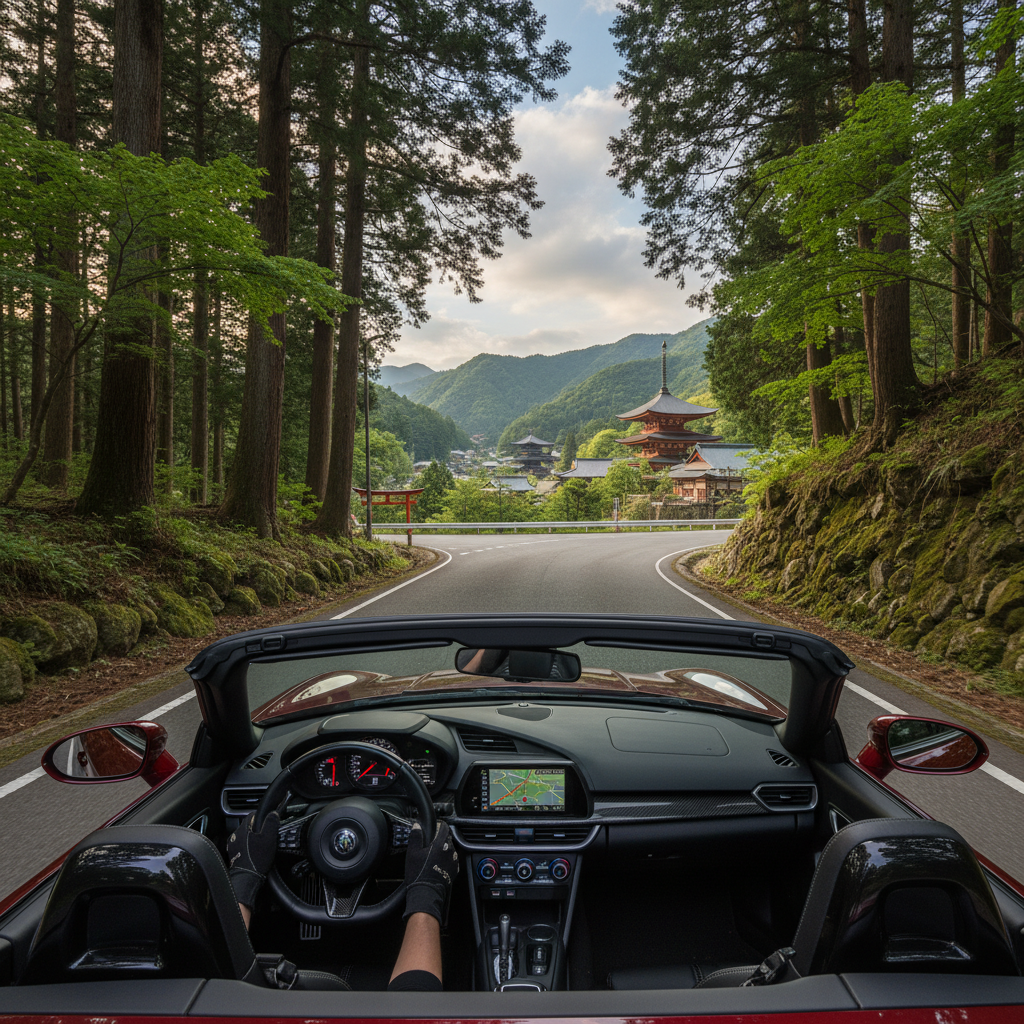
Nara Tanzan Shrine Autumn Leaves Recommended Drive Course: The Ultimate JDM Fall Foliage Guide
There is a specific kind of magic that happens in the mountains of Nara when the humidity of the Japanese summer finally breaks, replaced by the crisp, biting clarity of autumn. For most travelers, Nara is synonymous with the bowing deer of Nara Park or the towering bronze Great Buddha of Todai-ji. These are magnificent, certainly. But they are the "Public Face" of Nara. To find the soul of the Yamato region—the cradle of Japanese civilization—you have to leave the train tracks behind. You have to take the wheel.
1. The Philosophy of Driving in Japan: Beyond the Iron Track
I spent years of my life working as a conductor for Kintetsu Railway, one of Japan’s most storied private rail lines. I know the rhythm of the tracks, the precise timing of the doors, and the efficiency of the Japanese rail system better than most. The trains in Nara are a marvel of engineering, whisking commuters through tunnels and over valleys with surgical precision. But as a conductor, looking out from the back of the train, I always saw something else: the narrow ribbons of asphalt that snaked away from the stations, disappearing into the mist-shrouded cedar forests where the tracks couldn't follow.
When you are on a train, you are a passenger in someone else’s story. You see what the engineers want you to see. When you are behind the wheel of a JDM (Japanese Domestic Market) sports car, you are the protagonist. In a region as geographically complex and spiritually dense as Nara, the "Secret Japan" only reveals itself to those who can stop at a moment's notice—when the light hits a roadside maple tree just right, or when a hidden torii gate beckons from a side path too narrow for any bus.
Driving in Nara, particularly during the autumn leaf season (koyo), is not just about transportation; it is a sensory immersion. It’s about the mechanical symphony of a Toyota 86’s boxer engine echoing off ancient stone walls. It’s about the tactile feedback of a leather-wrapped steering wheel as you navigate hairpins that were originally carved as pilgrimage footpaths over a millennium ago. For the enthusiast, the drive is the destination. The way the car dances through the Tofumine mountains on the way to Tanzan Shrine is as much a part of the pilgrimage as the shrine itself.

2. Nara Tanzan Shrine Autumn Leaves Recommended Drive Course: The 2-Day Itinerary
This is not a checklist; it is a narrative. We start in the neon-lit concrete canyons of Osaka and transition into the deep, crimson-soaked history of the Yamato plains. For this journey, our weapon of choice is the Toyota 86 (or its twin, the Subaru BRZ). Its low center of gravity and rear-wheel-drive layout are perfectly suited for the technical mountain passes of Nara.
Day 1: The Ascent to the Crimson Throne
09:00 AM: The Departure from Osaka
You slide into the bucket seat of the 86. The cockpit is intimate, focused. As you push the start button, the 2.0-liter engine settles into a purposeful hum. Departing Osaka, you head east toward the Nishi-Meihan Expressway. As the skyline of Osaka fades in your rearview mirror, the Ikoma mountains rise ahead of you like a green wall. This is the boundary between the modern world and the ancient.
10:30 AM: Entering the Yamato Valley
Exit at Tenri and head south toward Sakurai. As you transition onto Route 169, the scenery changes. The houses become more traditional, with heavy tiled roofs and weathered wood. You are now driving through the oldest part of Japan. To your left is Mount Miwa, a mountain so sacred that the shrine at its base has no main hall—the mountain itself is the deity.
11:30 AM: The Technical Climb to Tanzan Shrine
This is where the 86 truly comes alive. From Sakurai, you take Prefectural Road 155, winding upward toward the Tofumine plateau. The road is a series of rhythmic swells and tight technical corners. The 86’s steering is telepathic; every input is rewarded with immediate rotation. As you climb, the air temperature drops, and the colors begin to shift. The green of the cedars is suddenly punctuated by flashes of vermillion and gold.
12:30 PM: Tanzan Shrine (The Jewel of Nara)
Park the car and take a moment to listen to the silence. Tanzan Shrine is often called the "Nikko of Kansai," and for good reason. It is the site where the Taika Reform was plotted in the 7th century—a turning point in Japanese history. The centerpiece is the world’s only thirteen-story wooden pagoda, built in 1532. During the peak of autumn (usually mid-to-late November), the 3,000 maple trees surrounding the shrine erupt in a firestorm of color. The contrast between the weathered wood of the pagoda and the incandescent red leaves is a sight that no camera can fully capture.
02:30 PM: The Hidden Ridge Road
Don't head back down the way you came. Instead, continue south along the ridge toward Asuka. This section of the drive offers sweeping views of the Nara Basin below. If the clouds are low, you might find yourself driving through a sea of mist, with the peaks of the Diamond Mountains (Kongo-san) floating like islands in the distance. The 86 feels planted, its chassis communicating the grip levels through the seat of your pants as you navigate the undulating asphalt.
04:30 PM: Asuka Village - The Cradle of Yamato
As the sun begins to dip, arrive in Asuka. This is a living museum. Huge stone monoliths of unknown origin, like Ishibutai Kofun, sit among terraced rice fields. The golden hour in Asuka during autumn is ethereal. The rice husks are being burned in the fields, the smell of woodsmoke fills the air, and the hillsides are painted in shades of ochre.
06:30 PM: Ryokan Check-in and Nara Gastronomy
Stay at a local ryokan in the Sakurai or Asuka area. Dinner is an affair of Nara-style Somen (thin noodles) and Kaki-no-ha-zushi (sushi wrapped in persimmon leaves). The tannins from the leaves preserve the fish and impart a subtle, woody aroma that echoes the mountain surroundings. Sleep comes easy after a day of heel-and-toe downshifts and visual overload.
Day 2: The Heart of the Mountains
08:30 AM: The Morning Mist of Ryumon-no-taki
Start the engine early. There is a specific mechanical smell to a JDM car on a cold autumn morning—a mix of exhaust and mountain dew. Head toward the Ryumon-no-taki (Dragon Gate Falls). The road leading here is narrow, shaded by towering Japanese cedars. The 86 is small enough to handle these lanes with ease. The waterfall was a favorite of the poet Matsuo Basho, and in autumn, the falling water is framed by delicate Japanese maples (momiji).
10:30 AM: Route 37 to Yoshino
Navigate toward Mount Yoshino. While famous for cherry blossoms, Yoshino in autumn is a masterclass in subtlety. The mountain is divided into four sections (Shimo, Naka, Kami, and Oku), each reaching peak color at different times due to the elevation change. The drive up the mountain is a test of your braking zones. The 86’s brakes are firm and progressive, giving you the confidence to dive into the hairpins that lead to the Kinpusen-ji Temple, a massive wooden structure that serves as the center of Shugendo (mountain asceticism).
12:30 PM: Forest Therapy and Local Flavors
Park in the upper reaches of Yoshino and hike a short section of the Kumano Kodo pilgrimage trail. The physical act of walking on the ancient stones connects you to the history of the land. For lunch, try Kuzumochi, a jelly-like sweet made from the starch of the kuzu root, a specialty of the region. It’s translucent, cool, and perfectly pairs with a cup of hot green tea as you look out over the valley.
02:30 PM: The Deep Nara Loop (Route 166)
Instead of taking the highway back, take Route 166 heading east toward Uda. This is a "Driver’s Road." Long, sweeping curves follow the path of the river. The 86’s engine sings in the 4,000 to 6,000 RPM range, where the exhaust note sharpens. You’ll pass through small hamlets where time seems to have stopped in the Showa era. Watch for the small wooden signs pointing to "Michi-no-Eki" (Roadside Stations).
04:30 PM: The Final Vista
Stop at the Muro-Akame-Aoyama Quasi-National Park area. The rock formations here are volcanic and jagged, providing a dramatic backdrop to the soft autumn leaves. As the sun sets, the entire landscape turns into a silhouette of deep purples and fiery oranges. The drive back to Osaka via the Hanna Road provides one last thrill—a steep, winding descent with the glittering lights of the city spreading out before you like a carpet of jewels.
3. Expert Advice & Cultural Nuances: Driving Nara Like a Local
Driving in Japan, especially in the rural heart of Nara, requires more than just knowing how to operate a manual transmission. It requires an understanding of the local rhythm. One of the greatest joys of a Japanese road trip is the "Michi-no-Eki." These are not mere rest stops; they are community hubs. In Nara, these stations often sell heirloom vegetables you won't find in any city supermarket, like the legendary Yamato-mana (a leafy green) or giant Nara persimmons.
When you are driving through the narrow villages on the way to Tanzan Shrine, you will notice a specific etiquette. If a road is too narrow for two cars, the driver closest to a turnout will often pull over and flash their hazards to let the other pass. A small bow or a hand raised from the steering wheel is the universal "thank you." In these mountains, the aggressive driving found on the Shuto Expressway in Tokyo is absent; here, it is about flow and mutual respect.
Be aware of the "Koyos" (leaf hunters). During peak weekends in November, the most famous spots can get crowded. My advice? Start your day at sunrise. The light at 6:30 AM hitting the pagoda at Tanzan Shrine is far superior to the midday glare, and you’ll have the mountain roads to yourself. This is when you can truly listen to the car—the tires gently scrubbing against the cold asphalt, the click-clack of the gear lever, and the wind rushing past the A-pillars.
4. Detailed Logistics & Pre-Trip Tips for 2026
By 2026, Japan’s driving infrastructure has become even more seamless, yet the core mechanics of a JDM road trip remain the same. To experience this Nara course, you need to be prepared for the realities of mountain driving.
The ETC Card: Your Golden Ticket
Never attempt a Japanese road trip without an ETC (Electronic Toll Collection) card. Most rental cars come equipped with the reader, but you need the card itself. It allows you to breeze through toll gates without stopping. In 2026, many exit ramps in the Nara region have transitioned to "ETC Only" (Smart Interchanges). Without a card, you could find yourself trapped behind a gate, causing a "gomen-nasai" (I'm sorry) moment for everyone behind you.
Gas Station Etiquette
Japanese gas stations (Stand-o) are often full-service. When you pull in, the staff will guide you to a pump with vigorous hand signals. For the Toyota 86, you want "Hai-oku" (High Octane/Premium). The magic words are "Hai-oku, mantan" (High octane, full tank). They might offer to wipe your windshield or take your trash. It’s all part of the Omotenashi (hospitality) culture.
Parking with Precision
In Nara’s historic areas, parking spaces are tight. The Toyota 86 is brilliant here—it’s a compact sports car with great visibility. Most Japanese drivers reverse into parking spots with incredible precision. Use your mirrors, take it slow, and don't be afraid to do a multi-point turn. At shrines like Tanzan, parking is usually 500-1,000 yen. Keep coins or a 1,000-yen note handy.
The JDM Experience
Driving a manual Toyota 86 in its homeland is a bucket-list item. The pedals are perfectly spaced for heel-and-toe downshifts. As you approach a corner on the Tofumine pass, you brake with the ball of your right foot, blip the throttle with your heel to match the revs, and slide the shifter into second gear. The car rewards smoothness. It’s not about top speed; it’s about the connection between the driver, the machine, and the ancient road.
5. Comprehensive FAQ: Planning Your Nara Drive
Q: What kind of license do I need to drive in Japan?
A: This is the most critical step. To drive in Japan, you must possess a valid International Driving Permit (IDP) issued under the 1949 Geneva Convention, along with your original home country license and your passport. Note that permits issued under the 1968 Vienna Convention are NOT valid in Japan. If you are from countries like Switzerland, Germany, France, Belgium, Slovenia, or Taiwan, you need an official Japanese translation of your license provided by the JAF (Japan Automobile Federation) or your embassy. You must present these physical documents at the time of rental.
Q: Is the Toyota 86 difficult to drive on mountain roads?
A: Not at all. In fact, it was designed for them. While it is a sports car, its power is manageable and its handling is predictable. However, if you are not used to driving on the left side of the road, take the first 30 minutes slow. The most common mistake is drifting too far to the left of the lane.
Q: Will there be snow in Nara during the autumn leaf season?
A: Generally, no. Peak autumn colors in Nara occur in November. While the mountain air is chilly, snow typically doesn't arrive until late December or January. Standard summer tires are usually sufficient, but always check the forecast if you are heading into the high peaks of southern Nara.
Q: How do I handle the manual transmission if I'm rusty?
A: The 86 has a very forgiving clutch and a precise shifter. If you haven't driven manual in a while, spend some time in a quiet parking lot getting a feel for the bite point. The engine has enough torque that it won't stall easily, and the satisfaction of nailing a shift on a mountain road is worth the initial nerves.
6. The Final Call: Your Journey Starts Here
Nara is a land of layers. There is the layer of the deer and the tourists, and then there is the layer of the ancient spirits, the mountain mist, and the winding roads that hold the secrets of Japan’s birth. To truly peel back these layers, you need more than a rail pass. You need a machine that stirs the soul and the freedom to chase the autumn light wherever it leads.
Don't just watch Japan through a train window. Feel the vibration of the road, the smell of the mountain air, and the thrill of the perfect corner. When you are ready to stop being a passenger and start being an explorer, your car is waiting. At Omoshiro Rent-a-car Osaka Chuo, we specialize in providing the vehicles that turn a simple trip into a legendary drive. From perfectly maintained Toyota 86s to other JDM icons, we are the gateway to your Nara adventure. Book your car today, and let the crimson leaves of Tanzan Shrine be the backdrop to the drive of your life.