
The Ultimate Nara Summer River Play and Drive Course: A 2-Day JDM Adventure from Osaka
1. Nara Summer River Play - The Philosophy of Driving in Japan
For over a decade, my life was defined by the rhythmic clicking of wheels on rails. As a conductor for Kintetsu Railway, I traversed the Kansai region thousands of times. I saw the landscape of Nara through the frame of a train window—a beautiful, but ultimately restricted, cinematic reel. I knew the timetables by heart, the exact second the express would pass through the mountains of Yoshino. But there was always a sense of longing. I would look out toward the deep, emerald-green valleys and the shimmering ribbons of rivers carving through the Kii Peninsula, knowing that the tracks could never take me there. The train is the soul of Japanese punctuality, but the car is the soul of Japanese freedom.
When I transitioned from the conductor’s cabin to the driver’s seat of a JDM (Japanese Domestic Market) sports car, my perspective on Nara shifted entirely. In Osaka, we are surrounded by concrete and neon, a hyper-efficient urban sprawl. To truly escape the stifling humidity of a Japanese summer, you need more than a train pass; you need a machine that can handle the verticality of the landscape. This is why we drive. This is why we choose cars like the Toyota 86 or the Subaru BRZ. These vehicles aren't just tools for transport; they are extensions of your senses. Their low center of gravity, the tactile feedback of the steering wheel, and the mechanical symphony of a boxer engine are the perfect companions for the winding mountain passes of Nara.
The concept of 'Secret Japan' is often discussed in travel circles, but in Nara, it is a physical reality. While the crowds congregate at the deer park in the city center, the true essence of Nara lies south, in the 'Okuyamato' region. This is a land of spiritual peaks, ancient cedar forests, and, most importantly in the heat of August, crystal-clear rivers. These locations are inaccessible to the tour buses and the rail lines. They require a driver's spirit. When you sit behind the wheel of a manual 86, navigating the narrow 'cool-down' roads that hug the Ten-no-kawa river, you aren't just a tourist; you are an explorer. You are engaging with a side of Japan that demands effort to reach, and in return, offers a purity of experience that a train station platform can never provide. Today, I am your guide, merging my conductor's knowledge of geography with a car enthusiast's passion for the open road.
2. Nara Summer River Play - The 2-Day Itinerary: Deep Dive
Day 1: From the Neon Jungle to the Emerald Deep
08:00 | Departure from Osaka Central
The journey begins in the heart of Osaka. As you ignite the engine of your Toyota 86, the cold-start bark of the exhaust resonates against the canyon-like walls of the city's buildings. You aren't just leaving a city; you are embarking on a pilgrimage to nature. We head south, bypassing the standard tourist routes and aiming for the Minami-Hanaeda exit, merging onto the Minami-Kawachi Driveway. The urban sprawl slowly dissolves into rolling hills covered in citrus groves and vineyards. This is the prelude.
09:30 | Crossing the Border into Nara
As we cross the Katsuragi mountain range, the air temperature drops by a noticeable three degrees. The humidity of the plains is replaced by a crisp, forest-scented breeze. We transition onto Route 309. For a driving enthusiast, this road is legendary. It begins wide and sweeping, allowing you to feel the 86’s balance as you transition through long, high-speed corners. The grip of the tires, the weight of the steering—everything feels intentional. You aren't just moving; you are dancing with the topography of the land.
11:00 | Arrival at Mitarai Valley (Tenkawa Village)
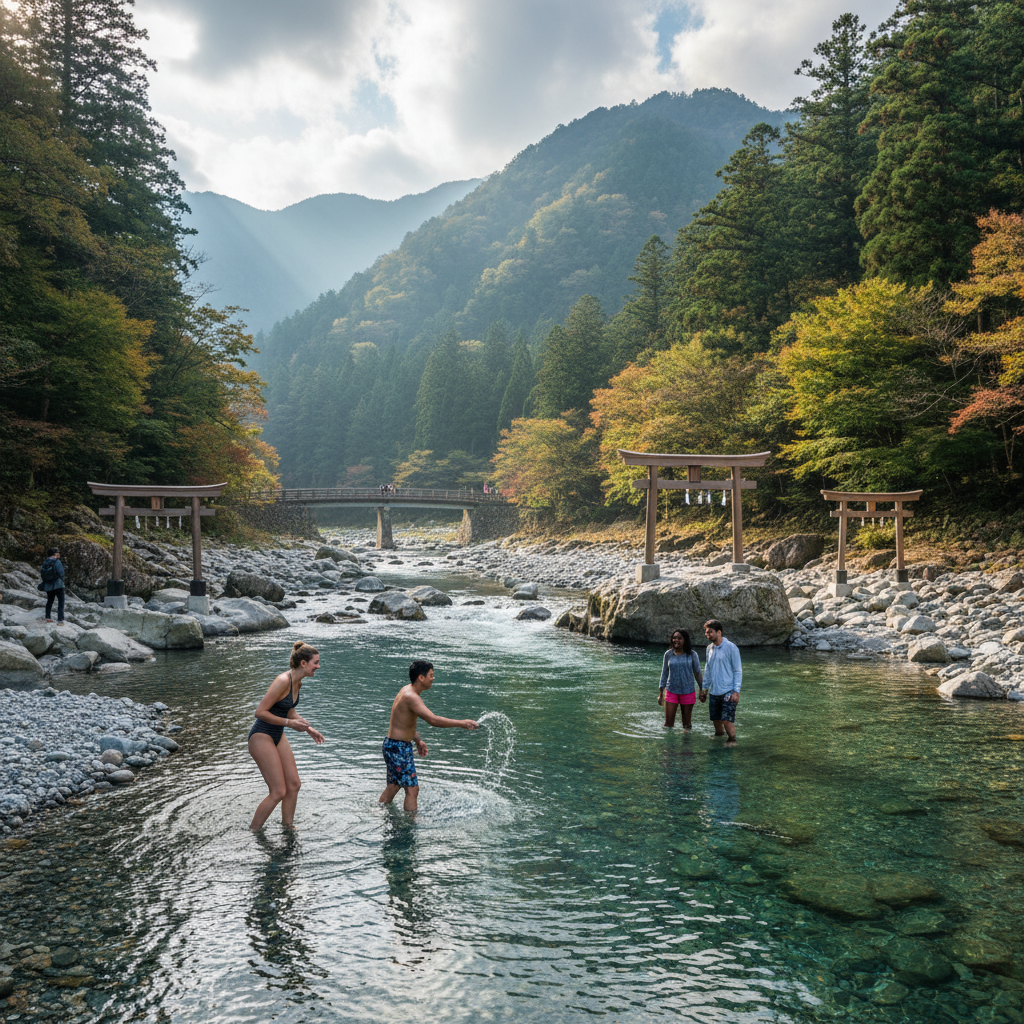
This is the centerpiece of our Nara Summer River Play. Mitarai Valley is a geological masterpiece. Huge, bleached-white boulders of granite sit in the riverbed, polished smooth by millennia of mountain runoff. The water here is a shade of emerald so deep it looks like liquid jade. Park the car at the designated lot near the suspension bridge. The walk from the car to the water is a sensory transition. You hear it first—the roar of the waterfalls cascading over the rocks—and then you feel the mist, a natural air conditioner that rivals any high-tech system.
Step into the water. It is shockingly cold, even in the height of summer. This is melted snow and deep-mountain springs, filtered through layers of limestone. This is 'river play' in its purest form. You can swim in the deeper pools beneath the falls, or simply sit on a boulder with your feet submerged, watching the 'Amago' (spotted trout) dart between the shadows. The historical significance of this area cannot be overstated; these mountains are part of the 'Sacred Sites and Pilgrimage Routes in the Kii Mountain Range,' a UNESCO World Heritage site. You are swimming in waters that have been considered sacred for over 1,300 years.
13:00 | Lunch: The Taste of the Mountains
A short drive from the valley leads you to a small, family-run eatery specializing in Amago-no-shioyaki (salt-grilled trout). These fish are caught directly from the river you were just swimming in. Grilled over binchotan charcoal until the skin is crispy and the flesh is tender and sweet, served with mountain vegetables (sansai) and rice cooked with local spring water. The simplicity of the meal reflects the purity of the environment. As a former conductor, I’ve eaten many 'Ekiben' (station bento), but nothing compares to the freshness of mountain-to-table dining.
15:00 | The Ascent to Dorogawa Onsen
We climb higher. The road narrows, becoming a series of tight hairpins that demand focus. This is where the manual transmission of the 86 or BRZ shines. Rev-matching on the downshift, feeling the torque pull you out of the apex—this is driving as an art form. We arrive at Dorogawa Onsen, a town that feels frozen in the Taisho era. At 800 meters above sea level, the air is thin and sweet. The town is famous for its 'Gofuyo-sui' (mineral water), which is said to have healing properties. Walk through the street lined with traditional wooden ryokans, their sliding doors open to the mountain air. This is where Shugendo monks have stayed for centuries before climbing the sacred Mount Omine.
18:00 | Ryokan Stay and Evening Mist
Check into a local ryokan. Dinner is a feast of venison, wild boar, and local tofu. As night falls, the temperature drops further. The sound of the river running through the center of the village becomes the soundtrack to your evening. There is no neon here, only the soft glow of lanterns and the silhouette of the mountains against a star-studded sky.
Day 2: The Hidden Valleys and the Road of the Gods
09:00 | Departure for Totsukawa Village
After a traditional breakfast, we set out toward the deeper south. Route 168 is our artery today. It follows the path of the Totsukawa River, a massive waterway that cuts through the heart of the Kii Peninsula. The road is a marvel of engineering, a mix of high-speed tunnels and vintage, cliff-clinging lanes. The 86 feels planted, its chassis communicating every nuance of the road surface. This is not a road for the faint-hearted, but for those who love to drive, it is paradise.
10:30 | Tanize Suspension Bridge
Before hitting the water again, we stop at one of Japan’s longest suspension bridges. Spanning 297 meters across the valley, it sways gently in the wind. Looking down at the river below, you see the scale of the landscape. The mountains here aren't just hills; they are steep, jagged giants draped in impenetrable green. The contrast between the mechanical precision of our car and the raw, untamed power of the geography is profound.
12:00 | Tsubogouchi: The Secret River Spot
While Mitarai is famous, Tsubogouchi is a local secret. Located near the confluence of several streams, this area offers wide, flat rocky banks perfect for a summer picnic. The water is shallower and warmer than at Mitarai, making it ideal for longer swims. The clarity is such that you can see individual pebbles on the riverbed three meters deep. Park the BRZ by the side of the road, grab your gear, and find a private cove. Here, the only sounds are the cicadas and the rushing water. This is the 'Secret Japan' I mentioned—a place where time seems to lose its grip.
14:00 | Technical Driving: The '酷道' (Kokudo) Experience
For the return leg, we take a more challenging route. Some sections of the Nara mountain roads are nicknamed 'Kokudo'—a play on words meaning 'cruel roads' because of their narrowness and steepness. For a driver in a compact JDM sports car, however, they are a playground. You learn the importance of 'waiting'—waiting for the right moment to pass, waiting for the suspension to settle after a bump. You become one with the machine. My years on the Kintetsu taught me the importance of physics and momentum; here, you apply those lessons at the limit of grip.
16:00 | Michi-no-Eki Kurotaki
Our final major stop is at the 'Roadside Station' in Kurotaki. This is not your average rest stop. It is a community hub selling 'Konnyaku' (yam cake) simmered in a secret dashi, and 'Kakinoha-zushi' (sushi wrapped in persimmon leaves), a Nara specialty. The saltiness of the sushi is the perfect recovery after a day in the sun and water. You’ll see other car enthusiasts here—bikers on vintage Kawasakis and drivers in tuned Supras—all drawn by the same magnetic pull of the Nara mountains.
19:00 | Returning to the Osaka Skyline
As we descend back toward the city, the setting sun turns the sky a bruised purple. The lights of Osaka begin to twinkle in the distance like a fallen galaxy. You feel a sense of accomplishment. You’ve conquered the passes, dived into the sacred waters, and experienced the true capability of a legendary Japanese car. The 86's engine hums contentedly as you merge back into the urban traffic, a stark contrast to the silence of the Tenkawa forests.

3. Nara Summer River Play - Expert Advice & Cultural Nuances
Driving in the deep mountains of Nara is an exercise in both skill and etiquette. Unlike the wide, predictable highways of North America or the autobahns of Europe, Nara’s mountain passes are living, breathing entities. They are often shared with local elderly residents, logging trucks, and the occasional wild deer or macaque. The first rule of the Nara road is 'Yuzuriai'—the spirit of mutual concession. If you see a local driver approaching a narrow bridge, yield. A flash of the hazard lights as a 'thank you' is the universal language of the Japanese road.
The 'Michi-no-Eki' (Roadside Station) culture is something every international visitor must experience. These are not merely gas stations; they are showcases of regional pride. In Nara, each station offers something unique: handmade cedar crafts in Kawakami, wild honey in Totsukawa, or specialized 'Amago' snacks in Tenkawa. They are the best places to get real-time information on road conditions or hidden swimming spots that aren't on Google Maps. If you speak even a few words of Japanese, the staff will often share 'secret' locations where the water is particularly clear or the crowds are non-existent.
Be aware of the 'Guerrilla Rainstorms' that can occur in summer. The Kii Peninsula is one of the wettest regions in Japan. A perfectly clear morning can turn into a torrential downpour in minutes. This is why the river play must be approached with respect. If you see the water level rising or the color changing to a muddy brown, exit the river immediately. My experience as a conductor taught me that nature doesn't follow a timetable. Always check the weather radar before heading deep into the canyons.
4. Nara Summer River Play - Detailed Logistics & Pre-Trip Tips
Preparing for a JDM road trip in 2026 requires a bit of technical foresight. First, let’s talk about the machine. If you are renting a Toyota 86 or Subaru BRZ, you are likely dealing with a manual transmission (MT). There is an unparalleled high when you nail a heel-and-toe downshift on a 10% grade descent in the Nara mountains. The mechanical connection—the weight of the clutch, the short-throw shifter—makes you part of the landscape rather than just an observer.
Logistics-wise, the ETC (Electronic Toll Collection) card is your best friend. Most rental cars come equipped with a reader, but you need to ensure the card is inserted properly. The 'bing-bong' sound as you pass through a toll gate is the soundtrack of Japanese travel. For fuel, you will be looking for 'Hai-oku' (High Octane/Premium). When you pull into a 'Full Service' station, the attendants will often greet you with a synchronized shout. Simply say 'Hai-oku, Mantan' (High Octane, Full Tank). They will even clean your mirrors and help you back out into traffic—a level of service that reflects the Japanese 'Omotenashi' spirit.
Parking in rural Nara can be tricky. Never park on the side of a narrow mountain road where you might obstruct logging trucks. Always look for designated lots near river access points. While some may charge a small fee (usually 500 to 1,000 yen), this money goes toward maintaining the trails and keeping the rivers clean. Regarding the car itself, the 86 is a low car. Be mindful of the front lip when entering gravel parking lots near the riverbanks. Slow and diagonal is the key.
5. Nara Summer River Play - Comprehensive FAQ
Q: What kind of license do I need to drive in Japan?
A: To drive in Japan, you must possess a valid International Driving Permit (IDP) issued under the 1949 Geneva Convention, along with your original home country driver's license and your passport. Residents of certain countries (like Switzerland, Germany, or France) may require a Japanese translation of their license instead. Please ensure your IDP is the correct version, as documents issued under other conventions (like the 1968 Vienna Convention) are not recognized in Japan.
Q: Is it difficult to drive a manual (MT) car on mountain roads?
A: It requires focus, but it is incredibly rewarding. The 86 and BRZ are designed for these roads. If you are comfortable with a manual, the hill-start assist and the predictable clutch take-up make it manageable even on steep Nara grades. If you are rusty, we recommend a quick practice in a flat area before heading into the mountains.
Q: Are the roads dangerous in summer?
A: The main risks are narrow lanes and sudden rain. However, the road surfaces in Japan are generally excellent. Stick to the speed limits, stay on your side of the white line, and you will find the experience exhilarating rather than frightening.
Q: Can I swim anywhere in the river?
A: Generally, yes, but look for signs that might indicate dangerous currents or private property. If you see locals swimming, it’s usually a safe bet. Always wear sturdy water shoes as the rocks can be slippery and sharp.
6. Nara Summer River Play - The Final Call: CTA
The rhythm of the rails was my past, but the freedom of the road is my present. Nara in the summer is a place of visceral beauty—the smell of cedar, the shock of cold water, and the vibration of a high-performance engine through the seat of your pants. This is the Japan that most tourists miss. It is a Japan that belongs to the driver.
At Omoshiro Rent-a-car Osaka Chuo, we don't just provide cars; we provide the keys to this hidden world. Our fleet of meticulously maintained JDM icons, including the Toyota 86 and Subaru BRZ, are waiting for you. From one car lover to another, I invite you to step out of the train station and into the driver's seat. The mountains of Nara are calling, the river is at its peak clarity, and the perfect winding road is waiting for your first gear-change. Book your JDM adventure today and experience the 'Secret Japan' that only a car can reveal.