
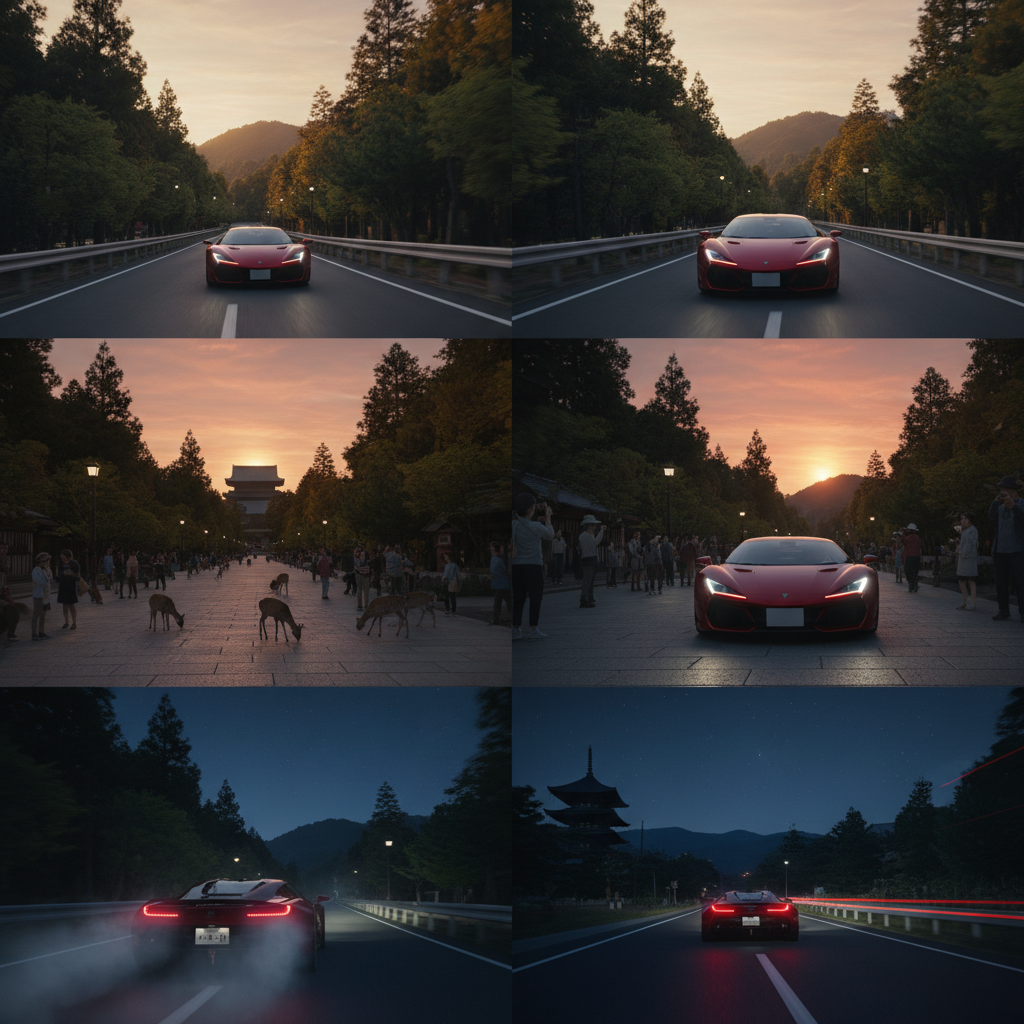
Nara Murou-ji Nyonin Koya: The Ultimate 2-Day JDM Drive Course Through Japan's Sacred Heart
1. Nara Murou-ji Nyonin Koya - The Philosophy of Driving in Japan
For over a decade, I operated the levers of a Kintetsu Railway train, navigating the steel arteries of the Kansai region with surgical precision. I loved the rhythm of the rails, the punctuality, and the view from the conductor's cabin. But as I watched the emerald forests of Nara flicker past my window, I always felt a sense of longing. There were valleys the tracks couldn't reach, peaks that remained mere silhouettes on the horizon, and ancient secrets buried deep in the mountains of Murou that no scheduled stop could ever reveal. This is the 'Secret Japan'—a realm that exists beyond the reach of the Shinkansen and the local lines. To truly touch the soul of this country, you must step off the platform and take the wheel.
Driving in Japan, especially from a base like Osaka, is an act of liberation. While the city pulses with a frantic, neon energy, the transition to the rural landscapes of Nara is profound. Many tourists remain trapped in the 'Golden Route'—Tokyo, Kyoto, and central Osaka—relying on crowded buses and trains. They see Japan through a glass pane. But when you are in the driver’s seat of a finely tuned JDM machine like a Toyota 86 or a Subaru BRZ, the relationship changes. You aren't just a passenger; you are a participant in the landscape. The mechanical feedback of the steering, the tactile click of a short-throw shifter, and the low-slung seating position allow you to feel every vibration of the ancient earth beneath you.
Nara’s topography is a playground for the driving enthusiast. It is a land of steep ridges, sudden descents, and historical weight that predates even the grandeur of Kyoto. The journey to Murou-ji, famously known as 'Nyonin Koya' (The Koya for Women), is the perfect manifestation of this philosophy. In an era where the sacred Mount Koya was strictly forbidden to women, Murou-ji opened its gates, offering a sanctuary of equality and spiritual depth. To drive there is to follow a path of inclusion and hidden beauty. By choosing a car, you bypass the logistical constraints of rural bus schedules that run only a few times a day, granting you the luxury of time—to stop by a roadside waterfall, to linger at a forest shrine, or to push the chassis of your 86 through a sequence of hairpins as the sun sets over the Yamato Basin.

2. Nara Murou-ji Nyonin Koya - The 2-Day Itinerary: Deep Dive
Day 1: From the Neon Jungle to the Cedar Sanctuary
09:00 AM | Departure from Osaka
Your journey begins in the heart of Osaka. As you pull out into the morning traffic, the immediate contrast between the urban concrete and the low, menacing growl of the 86’s Boxer engine sets the tone. We head east, aiming for the Hanshin Expressway Route 13 towards Nara. The goal isn't just the destination; it’s the transition. Within 45 minutes, the skyscrapers give way to the undulating hills of the Ikoma mountain range. The air begins to cool, and the humidity of the city is replaced by a crisp, forest-scented breeze.
10:30 AM | The Ascent of Route 165
Entering Nara Prefecture, we bypass the crowded deer park of central Nara City and head straight for the mountains. Route 165 is our primary artery today. This is where the 86 truly comes alive. The road begins to twist as it follows the path of the Hase River. The car’s low center of gravity makes every turn a joy. You aren't fighting the road; you are dancing with it. The steering rack provides telepathic communication—you know exactly where the front tires are placed on the narrow asphalt. To your left, the river sparkles; to your right, steep limestone cliffs rise up, draped in moss and ferns.
12:00 PM | Lunch: The Flavors of Yamato
Before we reach Murou, we stop in the town of Sakurai. This area is famous for Miwa Somen—thin, hand-stretched noodles that have been a local staple for over 1,200 years. We find a small, traditional restaurant with a gravel parking lot (perfect for a quick photo of the BRZ against a backdrop of wooden architecture). The noodles are served chilled with a dashi dipping sauce. The simplicity of the meal reflects the landscape: clean, refined, and deeply rooted in tradition.
01:30 PM | Arrival at Murou-ji (Nyonin Koya)
We navigate the final stretch of Prefectural Road 28, a winding path that feels like a tunnel through time. We arrive at Murou-ji. Park the car and take a moment to admire the lines of the 86 against the backdrop of the red arched bridge (Taikobashi). Murou-ji is a temple of the Shingon sect, nestled into the side of Mount Murou. Unlike the vast, masculine scale of Mount Koya, Murou-ji is intimate and delicate. The five-story pagoda here is the smallest outdoor pagoda in Japan, standing just 16 meters tall. It was built in the late 8th century and has survived over a millennium of typhoons and earthquakes. As you climb the stone steps, worn smooth by centuries of pilgrims, the silence is heavy. The cedar trees here are giants, their trunks wider than the car you just drove. The spiritual energy is palpable; it’s a place where the barrier between the physical and the metaphysical feels thin.
04:00 PM | The Hidden Magaibutsu of Ono-dera
A short 10-minute drive from Murou-ji brings us to Ono-dera. On the opposite bank of the river, carved directly into a massive cliff face, is a 13-meter tall Miroku Bosatsu (Maitreya Buddha). This 'Magaibutsu' (Cliff Buddha) is an awe-inspiring sight. Seeing it from the roadside, with the river rushing between you and the ancient carving, provides a sense of the scale of devotion that once existed in these mountains. It is a sight most tourists miss, accessible only if you have your own wheels.
06:00 PM | Overnight Stay in a Traditional Ryokan
We check into a local ryokan near the Murou area. There is no better way to end a day of driving than with a soak in an onsen. The smell of tatami mats and the sound of the evening insects provide a perfect sensory reset. Dinner is a multi-course Kaiseki meal featuring local Yamato vegetables and succulent beef, paired with Nara-produced sake. As you drift off to sleep, you can still feel the faint sensation of the 86’s steering in your palms.
Day 2: The Highlands and the High-Revs
08:30 AM | Morning Mist and the Boxer Engine
Day two starts early. The morning mist clings to the valleys of Murou, creating a scene straight out of a Sumi-e ink painting. We fire up the engine. The cold start of the 2.0L Boxer engine resonates through the quiet village—a mechanical heartbeat in an ancient land. Today, we head further into the highlands.
10:00 AM | Soni Highlands (Soni Kogen)
The drive from Murou to Soni is a masterclass in mountain road engineering. The road climbs steeply, with series of hairpins that test your heel-and-toe downshifting skills. The 86/BRZ platform is built for this. The balance of the chassis through the mid-corner is sublime. We reach the Soni Highlands, a vast plateau covered in 'Susuki' (pampas grass). In the autumn, the entire hillside turns a shimmering gold. Even in the green of summer or the starkness of winter, the panoramic views of the surrounding peaks are breathtaking. We hike to the ridge line to look back at the winding ribbon of asphalt we just conquered.
12:30 PM | The Culinary Art of Soni
Lunch is at a small farm-to-table cafe in Soni village. We enjoy handmade soba noodles and tempura made from wild mountain vegetables (Sansai). The crunch of the tempura and the earthy flavor of the buckwheat are the perfect fuel for the return journey.
02:30 PM | The Return: Prefectural Road 31
Instead of retracing our steps, we take the long way back towards Osaka, weaving through the heart of the Yamato plateau. These roads are narrow, often '1.5 lanes' wide, requiring focus and respect for the local residents. This is where the compact dimensions of the 86 are an advantage. You can navigate these paths with confidence where a larger SUV would struggle. We pass through ancient villages where the houses still have traditional 'Kayabuki' (thatched) roofs.
05:00 PM | Golden Hour on the Nishi-Meihan Expressway
As we rejoin the expressway heading back to Osaka, the sun begins to set. The sky turns a deep violet and orange. The car settles into a steady cruise. The transition back into the urban landscape is bittersweet. The lights of the Abeno Harukas building flicker in the distance, welcoming us back to the 21st century.
3. Nara Murou-ji Nyonin Koya - Expert Advice & Cultural Nuances
Driving in rural Nara is not just about speed; it is about harmony. In the mountains, you will encounter the 'Michi-no-Eki' (Roadside Stations). These are far more than mere rest stops. The Michi-no-Eki in Ouda, for example, is a destination in itself, offering local produce, a footbath (ashiyu), and incredible local snacks. It is the social hub of the driving community. Stop here, and you’ll likely see other enthusiasts—perhaps a vintage Skyline or a modified Miata—and a simple nod of the head is the universal language of the car lover.
Be aware of the 'Yamato Pace.' Life in these mountains moves slower. You might find yourself behind a small white 'Kei' truck driven by a local farmer carrying a load of bamboo. Do not tailgait. Be patient. When the road opens up, they will often pull over to let you pass. A quick flash of your hazard lights as a 'thank you' is the standard etiquette in Japan. Also, pay attention to the 'Melody Roads'—sections of asphalt with grooves cut into them that play a tune through your tires when driven at the correct speed. It’s a whimsical touch that reminds you that in Japan, even the roads have a sense of play.
Navigation is key. While Google Maps is generally reliable, it sometimes tries to send you down 'Pointless Shortcuts'—roads that are barely wide enough for a bicycle. If a road looks suspiciously narrow and overgrown, trust your instincts and stay on the main prefectural routes (indicated by yellow hexagonal signs with numbers).
4. Nara Murou-ji Nyonin Koya - Detailed Logistics & Pre-Trip Tips
As of 2026, Japan’s infrastructure remains world-class, but it requires some specific knowledge. First, ensure your rental car is equipped with an ETC (Electronic Toll Collection) card. This allows you to pass through expressway gates without stopping to pay cash, and it often provides significant discounts during late-night or weekend travel. For a JDM enthusiast, the highlight of the logistics is the gas station experience. When you pull into a full-service station, the attendants will greet you with high-energy shouts. If you want a full tank of high-octane fuel, simply say 'Haoku, Mantan' (High-octane, Full tank). They will often clean your windows and even help you navigate back into traffic with a series of bows.
Parking at ancient temples like Murou-ji is generally straightforward, but the spaces can be tight. This is where the 86’s compact footprint shines. Always carry some 100-yen and 500-yen coins, as some smaller lots still use manual coin boxes. If you are choosing a manual transmission (MT) vehicle, remember that Japan drives on the left. Shifting with your left hand might feel alien at first, but within 30 minutes, it becomes second nature. There is a profound sense of 'Jinba Ittai' (horse and rider as one) when you perfectly match a rev-match downshift while approaching a 1,000-year-old temple gate. The mechanical connection creates a memory that no train ride can ever replicate.
5. Nara Murou-ji Nyonin Koya - Comprehensive FAQ
What kind of license do I need to drive in Japan?
To drive in Japan, you must possess a valid International Driving Permit (IDP) issued under the 1949 Geneva Convention, along with your original domestic driver's license and your passport. Note that permits issued under the 1968 Vienna Convention are not recognized in Japan. If you are from certain countries like Switzerland, Germany, or France, you may need a Japanese translation of your license instead of an IDP. Always verify the specific requirements for your country before arrival.
Is insurance included?
Most reputable rental agencies include basic insurance, but I highly recommend opting for the 'Full Compensation' or 'Collision Damage Waiver' (CDW) to ensure you are fully protected in the unlikely event of an accident. Peace of mind is the best accessory for a mountain drive.
Should I be worried about driving a Manual Transmission (MT) car?
The Toyota 86 and Subaru BRZ have very forgiving clutches and precise gearboxes. If you have experience with MT in your home country, you will find these cars a joy to drive. However, if you are strictly an automatic driver, many JDM models are available with high-performance paddle-shift automatics that are equally fun in the mountains.
Are the mountain roads safe in winter?
The Murou area can experience snow and ice from late December through early March. If you plan to drive during this time, ensure your vehicle is equipped with studless winter tires. For the rest of the year, the roads are exceptionally well-maintained.
6. Nara Murou-ji Nyonin Koya - The Final Call: CTA
The tracks of the Kintetsu Railway will take you far, but they will never take you *deep*. To experience the Nara of the monks, the farmers, and the mountain spirits, you need to be in control. You need a machine that speaks to the road as much as it speaks to your soul. At Omoshiro Rent-a-Car Osaka Chuo, we don't just provide transportation; we provide the key to a Secret Japan. As a former conductor, I know the schedules, but as a car lover, I know the shortcuts. Our fleet of Toyota 86s and Subaru BRZs are meticulously maintained and ready for the hairpins of Murou. Don't just visit Japan—drive it. Book your JDM experience today at Omoshiro Rent-a-Car Osaka Chuo and discover why the best stories are found where the pavement twists and the trains don't go. Your adventure in the heart of Nara is just one gear-shift away.