
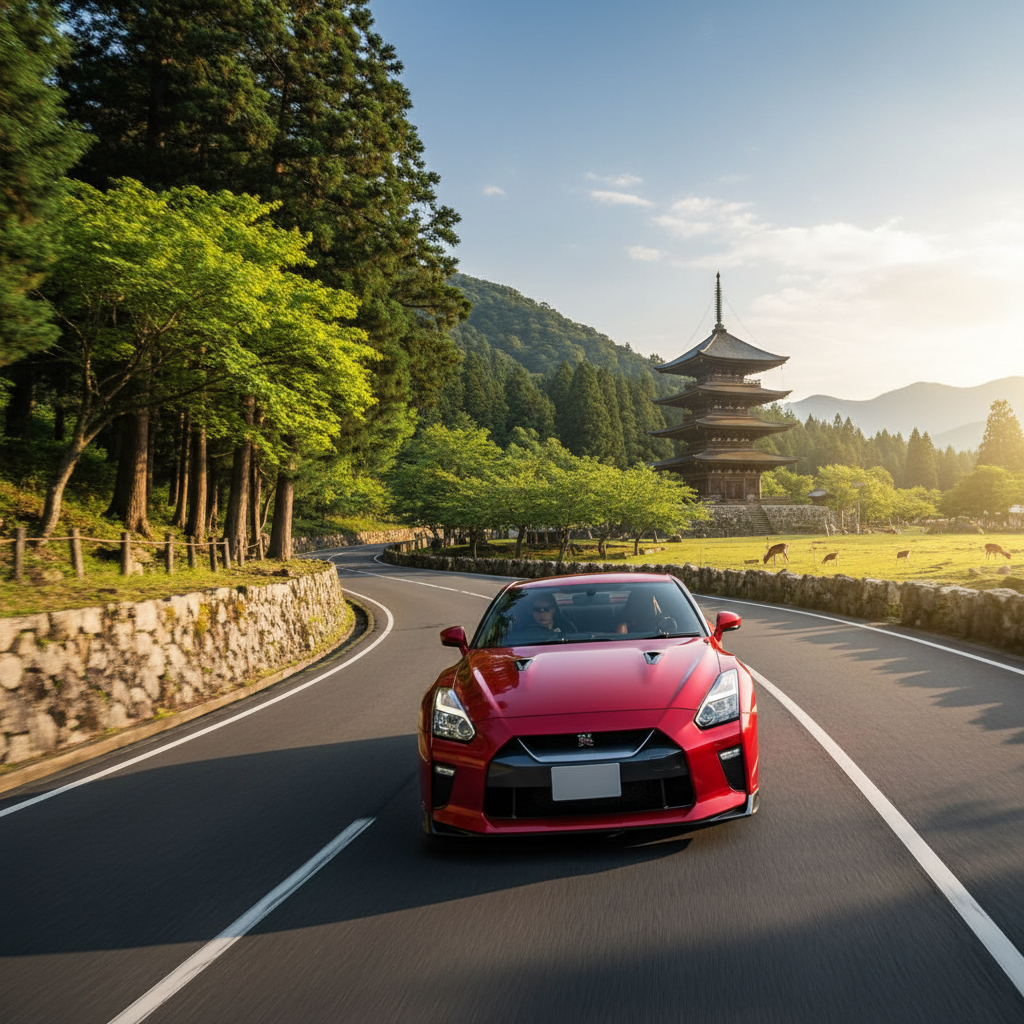
Nara Hase-dera: The Ultimate Temple of Flowers Drive Course for JDM Enthusiasts
1. The Philosophy of Driving in Japan: Beyond the Rails
For over a decade, my life was dictated by the rhythmic clicking of wheels against steel rails. As a conductor for Kintetsu Railway, I saw the beauty of the Kansai region through the framed windows of a moving carriage. I knew the timetables by heart, the exact second a train should pull into Yamato-Yagi or Sakurai station. But there was always a nagging feeling—a sense that the most beautiful parts of Japan were the ones passing by in the blur between the stations. The 'Secret Japan' isn't found on a platform; it’s found at the end of a winding mountain road where the asphalt meets the ancient forest.
When I hung up my uniform and swapped the conductor's whistle for the key to a high-revving JDM machine, my perspective shifted 180 degrees. Public transport in Japan is a marvel of engineering, but it is also a cage. To truly experience Nara, especially the legendary Hase-dera (the Temple of Flowers), you need the tactile feedback of a steering wheel and the freedom to stop whenever the light hits a pagoda just right. This is why we drive. We drive because the journey from Osaka to the heart of Nara is not just about a destination; it’s about the mechanical symphony of a Toyota 86 or a Subaru BRZ dancing through the S-curves of Highway 165.
Driving a car in Japan—specifically a lightweight, rear-wheel-drive masterpiece—allows you to penetrate the layers of history that tourists on tour buses never touch. You can smell the cedar forests of the Hase valley, feel the drop in temperature as you climb towards the mountain temples, and hear the echo of your exhaust against stone walls that have stood for a millennium. This is the philosophy of the 'Secret Japan' drive: it’s the pursuit of the intangible, the unreachable, and the unforgettable.

2. Nara Hase-dera: The 2-Day Itinerary Deep Dive
Day 1: The Ascent into Floral Paradise
08:00 AM – Departure from Osaka: The Awakening
Your journey begins in the heart of Osaka. As you slide into the cockpit of a Toyota 86, the first thing you notice is the seating position. It’s low, purposeful, and connects you directly to the chassis. Press the start button, and the 2.0-liter boxer engine barks to life. This isn't just a rental car; it’s a precision instrument. Leaving the neon skyline of Osaka behind, you head east towards the mountains of Nara. The initial stretch involves the Hanshin Expressway, but soon you transition to the Nishi-Meihan Expressway. Here, the 86 shows its highway manners—stable, responsive, and begging for the open road.
09:30 AM – The Gateway to the East: Highway 165
As you exit the expressway near Kashiba, the landscape transforms. The concrete jungle gives way to rolling hills and rice paddies. Highway 165 is the artery that leads to the soul of Nara. This road follows the ancient Hase-kaido, a pilgrimage route used by emperors and poets for over a thousand years. In the 86, every curve is an invitation. The steering is telepathic; you aren't just turning a wheel, you are pointing your intentions. The road begins to narrow as you enter the Sakurai area, the valley walls rising on either side, draped in dense greenery.
10:30 AM – Arrival at Hase-dera: The Temple of Flowers
Park your JDM machine in the designated lots near the temple entrance. As you step out, the air is different here—cooler, filled with the faint scent of incense and damp earth. Hase-dera is known as the 'Temple of Flowers' (Hana-no-tera) for a reason. Regardless of when you visit, the temple grounds are a riot of color. In spring, it’s the cherry blossoms; in early summer, the hydrangeas; in autumn, the fiery maples; and in winter, the delicate peonies protected by straw 'umbrellas.'
The highlight is the Nobori-ro, a covered wooden staircase of 399 steps that winds its way up the mountainside. As a former conductor, I appreciate the craftsmanship of these stairs—they are a slow-motion railway to the heavens. Each step takes you higher into the canopy. Reaching the Main Hall (a National Treasure), you step out onto the massive wooden stage. The view is breath-taking. You are suspended over the valley, looking down at the temple complex and the town below. The architectural genius is reminiscent of Kyoto’s Kiyomizu-dera, but without the suffocating crowds. Here, there is space to breathe, to think, and to reflect on the drive that brought you here.
12:30 PM – A Taste of Tradition: Somen and Yamato Vegetables
After descending the 399 steps, your hunger will be real. The approach to Hase-dera is lined with traditional shops. You must try the 'Miwa Somen'—thin, hand-stretched noodles that are a specialty of this region. Served cold in summer or hot in winter ('Nyumen'), the texture is incredibly delicate. Pair it with local Yamato vegetables and 'Kaki-no-ha Zushi' (sushi wrapped in persimmon leaves). The flavors are subtle, grounded in the earth, providing the perfect fuel for the afternoon’s technical driving.
02:00 PM – The Driver’s Choice: The Winding Road to Murou-ji
Now, we put the 86 to the test. From Hase-dera, we take the mountain passes heading towards Murou-ji. This is where the 'Recommended Drive Course' really shines. These aren't just roads; they are asphalt ribbons draped over the landscape. The elevation changes are frequent, requiring precise downshifts. The 86’s manual gearbox is a joy—each shift is mechanical and notch-perfect. You are carving through the cedar forests, the sun flickering through the trees like a strobe light. The balance of the car is impeccable; as you trail-brake into a tight hairpin, the front end bites, and the rear follows in a predictable, controlled arc. This is driving nirvana.
04:00 PM – Murou-ji: The Temple in the Deep Forest
Murou-ji is the 'Mount Koya for Women,' a temple that historically welcomed female pilgrims when other mountain sanctuaries did not. It is home to the smallest outdoor five-story pagoda in Japan. The atmosphere here is even more secluded than Hase-dera. The moss-covered stone steps and the towering cedars create a cathedral-like silence. It’s the perfect place to cool down after an spirited drive.
06:00 PM – Ryokan Check-in: The Yamato Plateau
End your day at a traditional Ryokan in the Soni or Uda area. There is nothing like a hot onsen soak to relax the muscles used for heel-and-toe shifting. As the sun sets over the Yamato Plateau, the sky turns a deep violet, and you realize that no train could have ever brought you to this place at this hour.
Day 2: Vistas and Technical Valleys
09:00 AM – The Morning Run: Soni Highlands
Start your day with a drive to the Soni Highlands (Soni Kogen). This is a vast meadow of pampas grass (susuki) that covers the mountainside. In the morning light, the grass glows like hammered gold. The road leading up to the highlands is a technical masterpiece. It’s a series of climbing switchbacks that allow you to feel the 86’s chassis working beneath you. The car feels alive, breathing with the mountain.
11:30 AM – The Hidden Shrine: Tanzan Jinja
Head south towards Tanzan Shrine. This shrine is famous for its unique thirteen-story wooden pagoda—the only one of its kind in the world. The drive involves traversing the Tobi-no-mura passes. These roads are narrow and require concentration. This is 'Real Japan' driving—passing through tiny villages where old ladies are tending to their gardens, and then suddenly bursting back into a forest of towering bamboo. The contrast is jarring and beautiful.
01:30 PM – Lunch in the Sky: Peak-view Dining
Find a local cafe perched on the ridges near Sakurai. Many of these spots offer 'Terrace' seating with views that stretch all the way back to the Osaka skyscrapers on a clear day. Enjoy a hearty curry or a set meal featuring local pork while looking at the route you’ve conquered.
03:30 PM – The Return Descent: Highway 166
As you begin the journey back towards Osaka, take Highway 166. It’s a broader, more flowing road than the morning’s tight passes. It’s the perfect stretch to enjoy the 86’s mid-range torque and the smooth feedback of the steering as you sweep through long, high-speed corners. The transition from the spiritual silence of Nara back to the mechanical hum of the highway is a time for reflection.
3. Expert Advice & Cultural Nuances: The Driver’s Etiquette
Driving in Nara is a privilege, and it comes with its own set of cultural nuances. One of the most important aspects is the 'Michi-no-Eki' (Roadside Station) culture. These aren't just gas stations; they are community hubs. The Michi-no-Eki in Uda (Ouda) is a fantastic stop. Here, you can find the freshest local produce, handmade crafts, and even footbaths (ashiyu) to soothe your feet. It’s the best place to mingle with local drivers—often you’ll find other car enthusiasts gathered here on weekends, admiring each other’s rides.
When driving through narrow village roads, remember the concept of 'Wa' (Harmony). If you encounter a local driver on a road only wide enough for one car, the etiquette is to find a turnout (machi-ai) and wait. A small wave of the hand or a flash of the hazards as a thank-you goes a long way. This is the difference between being a 'tourist' and being a 'traveler.' Also, be aware of the wildlife. Nara is famous for its deer, and while they congregate in the park, they are also present in the surrounding mountains. A deer jumping out on a mountain pass is a real possibility, especially at dawn and dusk.
4. Detailed Logistics & Pre-Trip Tips for 2026
As we navigate the travel landscape of 2026, several things have evolved. Technology has made driving in Japan easier than ever, but the soul of the JDM experience remains unchanged. First, let’s talk about the machine. Driving a Toyota 86 or Subaru BRZ in its natural habitat is a bucket-list item. These cars were designed for Japanese mountain roads. Their narrow width and precise handling make them the perfect tool for the Nara passes. If you are used to large SUVs or heavy sedans, the 86 will feel like a revelation—light, tossable, and incredibly communicative.
The Logistics:
1. **ETC Cards:** Make sure your rental includes an ETC (Electronic Toll Collection) card. In 2026, many expressway exits are 'ETC Only.' It saves you from fumbling with cash and provides discounts during late-night or weekend hours.
2. **Fueling Up:** When you enter a gas station (Gasorin Sutando), you will likely be asked 'Regular' or 'High-Oku' (Premium). For the 86/BRZ, always choose 'High-Oku.' If it’s a full-service station, the staff might ask 'Mantan?' (Full tank?). Just nod and say 'High-oku, mantan, kado de' (Premium, full, by card). They will even wipe your windows and mirrors—a level of service rarely seen elsewhere.
3. **Parking:** In Nara, especially around Hase-dera, use the official lots. Avoid street parking at all costs, as the roads are narrow and essential for local transit. Most lots are pay-by-the-hour or a flat daily fee.
4. **Navigation:** While Google Maps is excellent, Japanese 'MapCodes' are still very reliable for precise locations in the mountains where addresses can be vague.
5. Comprehensive FAQ: Clearing the Road Ahead
Q: What driver’s license do I need to drive in Japan?
A: This is the most critical question. You MUST have an International Driving Permit (IDP) issued under the 1949 Geneva Convention, along with your original valid home country license and your passport. Some countries (like Switzerland, Germany, France, etc.) require a certified Japanese translation instead of an IDP. Ensure you check the specific requirements for your country before arrival. Without the correct paperwork, no rental agency can legally hand over the keys.
Q: Is driving a Manual Transmission (MT) car in Japan difficult?
A: If you have basic MT experience, the 86 is a very forgiving car to drive. The clutch is light and the bite point is clear. The biggest challenge for many is driving on the left side of the road while shifting with the left hand. However, most drivers adapt within the first 30 minutes. The pedals are perfectly spaced for heel-and-toe downshifting if you're feeling spirited!
Q: What about insurance?
A: Always opt for the maximum coverage (Collision Damage Waiver and Non-Operation Charge waiver). Mountain roads can be unpredictable—a stray rock or a tight corner can cause minor scratches. Peace of mind is worth the extra few thousand yen.
Q: Are the mountain roads safe in winter?
A: Nara can get snow, especially in the higher elevations like Soni. From late December to early March, ensure your car is equipped with winter tires (studless tires). If you aren't experienced with snow driving, stick to the main routes or visit during the spectacular spring and autumn seasons.
6. The Final Call: Your Key to the Secret Japan
The 399 steps of Hase-dera are waiting. The scent of the Temple of Flowers is calling. But more importantly, the winding roads of Nara are screaming for the sound of a boxer engine. You’ve read the guide, you’ve visualized the curves, and you can almost feel the leather of the steering wheel in your hands. Don't settle for the window of a train. Don't be a spectator to the beauty of Japan. Be the protagonist of your own journey.
At Omoren Osaka Chuo (Omoshiro Rent-a-car Osaka Chuo), we don’t just provide cars; we provide the keys to the experiences I’ve described here. As a former Kintetsu conductor, I know every inch of this region, and I’ve curated a fleet of JDM icons like the Toyota 86 and Subaru BRZ specifically for these roads. Our shop is located in the heart of Osaka, perfectly positioned for your Nara departure. We speak your language, we share your passion for driving, and we are ready to help you discover the 'Secret Japan' that only a driver can know. Book your JDM machine today at Omoren Osaka Chuo and let the flowers of Hase-dera be the backdrop to your greatest drive yet.