
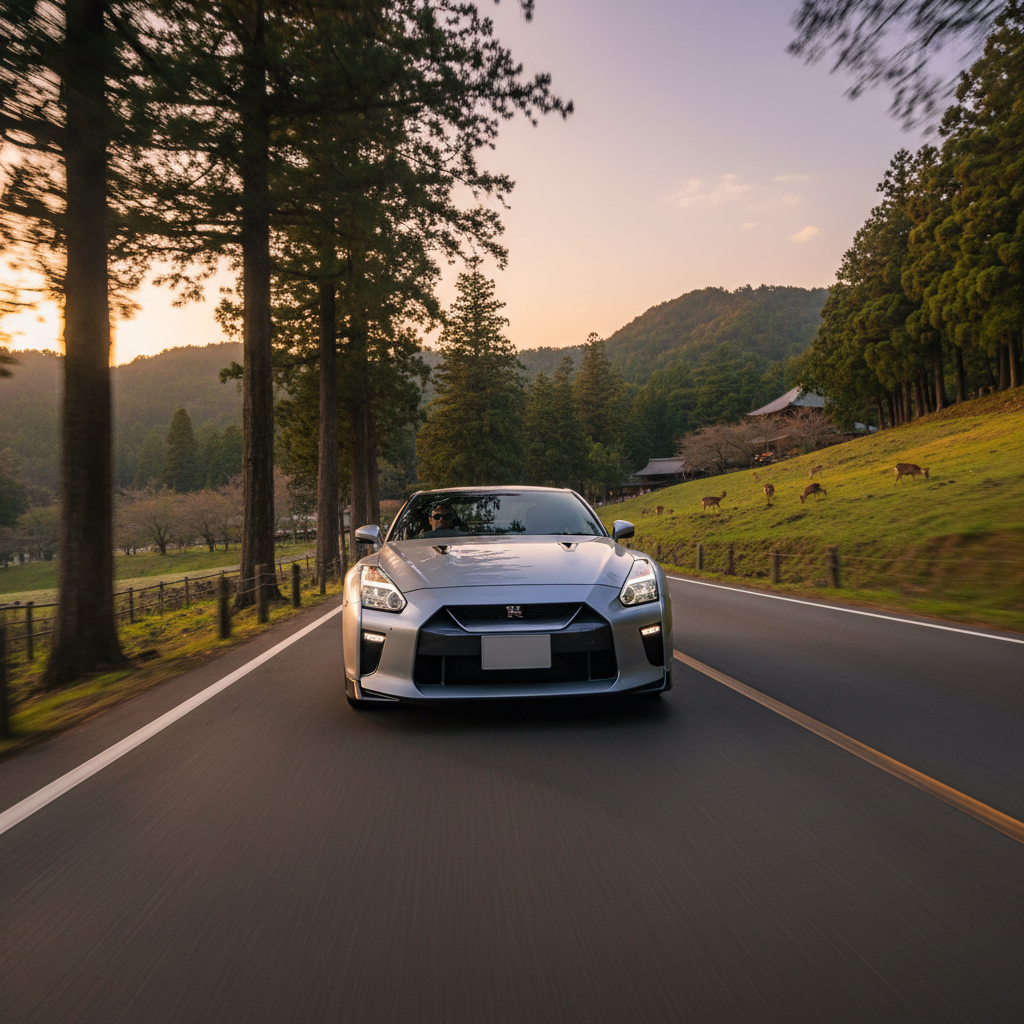
Nara Hannyaji Temple Cosmos: The Ultimate Recommended Drive Course for JDM Enthusiasts
1. The Philosophy of Driving in Japan: Beyond the Rails
For years, I lived my life by the second. As a conductor for Kintetsu Railway, one of Japan’s most storied private rail lines, my world was governed by the rhythmic click-clack of steel on steel and a silver pocket watch that brooked no delay. I saw the Japanese landscape through the rectangular frame of a train window—a beautiful, fleeting gallery of mountains, rice paddies, and ancient shrines. But there was always a limitation. The tracks go where the tracks go. You are a passenger to the schedule, a witness to the pre-ordained.
When I hung up my uniform and traded the conductor’s whistle for the keys to a high-revving boxer engine, my entire perspective on Japanese travel shifted. This is what I call the "Philosophy of the Open Road." While Japan’s rail network is arguably the best in the world, it creates a sanitized version of travel. To truly touch the soul of the Yamato region—the cradle of Japanese civilization—you must break free from the rails. You need a machine that responds to your touch, a vehicle that allows you to stop at a roadside stand selling persimmons just because the mist on-screen GPS shows a promising squiggle of a mountain pass nearby.
Driving in Kansai, specifically using Osaka as your base to reach Nara, is an exercise in contrast. You leave the neon-drenched, chaotic energy of the metropolis and, within forty minutes of rowing through gears, you find yourself on roads that have existed for over a millennium. This is "Secret Japan." It is the Japan of mist-shrouded valleys, hidden bamboo groves, and temples like Hannyaji that feel like they belong to another dimension. In a car—specifically a lightweight, rear-wheel-drive JDM icon like the Toyota 86 or Subaru BRZ—you aren't just observing the scenery; you are participating in it. The elevation changes, the centrifugal force of a well-executed apex, and the smell of the mountain air are things no train passenger will ever truly experience.
2. The 2-Day Itinerary: A Deep Dive into the Nara Hannyaji Drive
This isn't just a trip; it’s a pilgrimage. We are targeting the peak of the cosmos season at Hannyaji, typically from late September to October, where the temple grounds are transformed into a sea of pink, white, and purple. For this journey, we have selected the Toyota 86. Its low center of gravity and communicative steering make it the perfect surgical instrument for Nara’s undulating topography.

Day 1: The Ascent to the Flower Temple
09:00 AM – Departure from Osaka
We begin in central Osaka. The engine of the 86 settles into a smooth idle. Our route takes us onto the Hanshin Expressway Route 13, the Higashi-Osaka Line. As you head east, the concrete jungle begins to give way to the formidable silhouette of Mount Ikoma. Here, the drive is about anticipation. You’ll feel the car’s suspension working over the expansion joints of the elevated highway, a reminder that this is a driver's machine.
10:30 AM – Hannyaji Temple: The Cosmos Sanctuary
Arriving at Hannyaji, located in the northern reaches of Nara City, you’ll immediately understand why this is called the "Flower Temple." Founded in the 7th century, Hannyaji is home to a magnificent 13-story stone pagoda, a National Important Cultural Property. During autumn, over 150,000 cosmos flowers bloom, creating a surreal contrast between the weathered, ancient gray stone and the vibrant, delicate petals swaying in the breeze.
The scent is subtle—a light, honey-like sweetness that fills the air. Walk through the "Cosmos Glass" path, where the monks have placed colorful glass spheres among the flowers, reflecting the sky and the blooms in a kaleidoscope of light. As a former conductor, I appreciate the precision with which these gardens are maintained; it’s the same dedication to perfection I saw in the rail yards, but here, it serves beauty rather than transit.
01:00 PM – Local Flavors: Yamato Vegetables
Drive ten minutes south into Nara City to find a hidden Soba (buckwheat noodle) shop. Look for places serving "Yamato Yasai"—ancient varieties of vegetables native to Nara. The crispness of a locally grown radish or the earthy sweetness of Nara-grown eggplant provides the fuel you’ll need for the afternoon’s technical driving.
03:00 PM – The Nara Okuyama Driveway
This is where the 86 truly shines. This toll road is a hidden gem. It winds through the Kasugayama Primeval Forest, a UNESCO World Heritage site. The road is narrow and requires focus. Downshift into second gear, let the engine revs climb toward the 7,000 RPM redline, and listen to the mechanical symphony echoing off the ancient cedars. The light here is ethereal; "Komorebi" (sunlight filtering through leaves) dances across your dashboard as you navigate the hairpins.
06:00 PM – Nara-machi Evening
Check into a traditional Ryokan in Nara-machi, the old merchant district. The streets are narrow—thankfully, the 86 is compact and easy to maneuver. Spend the evening walking through the lantern-lit streets, where the sound of wooden Geta sandals replaces the hum of the tires.
Day 2: The Ridge Lines and the Ancient Capital
09:00 AM – The Shigi-Ikoma Skyline
After a traditional breakfast, we head to the Shigi-Ikoma Skyline. This is one of the premier driving roads in Western Japan. It runs along the ridge of the mountains separating Osaka and Nara. On a clear day, you can see the skyscrapers of Osaka to your left and the sprawling, mist-covered temples of the Nara basin to your right.
The road is a series of high-speed sweepers and tight technical sections. The Subaru BRZ/Toyota 86 chassis is in its element here. The balance is sublime. You can feel exactly how much grip the rear tires have as you power out of a corner. It’s a physical conversation between you and the road, something that reminds me of the tactile feel of the old brake handles on the Kintetsu trains, but with a thousand times more soul.
12:00 PM – Mount Wakakusa Lookout
Stop at the summit of Mount Wakakusa. From here, the entire history of Japan lies beneath you. You can see the massive roof of Todai-ji Temple, housing the Great Buddha. The scale is staggering. You realize that while empires rose and fell down there, these mountains remained. The 86, sitting in the parking lot with its cooling engine ticking, looks like a modern intruder in this ancient landscape, yet it’s the perfect vessel for this exploration.
02:30 PM – Exploring the Hidden Temples of South Nara
Instead of heading straight back, drive south toward Asuka. This is the heart of early Japan. The roads here are rural and peaceful. You’ll pass terraced rice fields that are turning gold for the harvest. Stop at a roadside "Michi-no-Eki" (Roadside Station) to try Kaki-no-ha Zushi—sushi wrapped in persimmon leaves, a local specialty designed to be portable and long-lasting.
05:00 PM – The Return Descent
As the sun begins to set, the sky turns a deep crimson, mirroring the "Velocity Orange" or "Pure Red" paint of a JDM sports car. We take the Hanna Road back toward Osaka. This is a fast, flowing descent. The engine braking of the manual transmission allows you to modulate your speed without overusing the brakes, a technique every mountain driver must master.
3. Expert Advice & Cultural Nuances: The Driver’s Code
Driving in Japan, especially in a performance car, requires an understanding of the local etiquette. It’s not just about speed; it’s about wa (harmony). When you are on these narrow Nara mountain roads, you will often encounter local residents or elderly drivers. The "Hachiroku" (86) has a reputation, but we drive with respect. A quick flash of the hazard lights as a "thank you" when someone pulls over to let you pass is the universal language of the Japanese road.
The "Michi-no-Eki" culture is something you won't find anywhere else. These aren't just rest stops; they are community hubs. In Nara, these stations often sell handcrafted pottery or seasonal fruits like Nashi (Japanese pears). Parking your 86 or BRZ at one of these will often strike up a conversation. Don't be surprised if an elderly Japanese man approaches you; many of them were the original street racers of the 80s and 90s and have a deep affection for JDM heritage.
One critical tip for the Nara area: Beware of the deer. In Nara Park and the surrounding mountain roads, the sacred deer have the right of way. They are fearless and will not move for your car. Keep your eyes peeled, especially at dawn and dusk. Your 86’s LED headlights are excellent, but they are no match for a 200-pound buck jumping out of the treeline.
4. Detailed Logistics & Pre-Trip Tips: 2026 Edition
As we navigate 2026, the logistics of a Japanese road trip have become seamless, yet the thrill of the manual transmission remains a tactile luxury. If you are renting a JDM legend, you are likely looking for that analog connection. The Toyota 86 and Subaru BRZ offer a short-throw shifter that clicks into gear with bolt-action precision. For those used to modern automatics, remember that Japanese hills are steep; mastering the hill-start or using the handbrake effectively is part of the charm.
The ETC System: Electronic Toll Collection is non-negotiable. Most highways around Osaka and Nara are tolled. Ensure your rental comes with an ETC card inserted. You’ll hear a pleasant female voice say "ETC kaado ga sounyuu saremashita" when you start the car. This means you can glide through toll booths without stopping, the gates lifting like magic as you approach at 20km/h.
The Gas Station Experience: Most stations in the countryside are "Full Service." Pull up to the pump, and an attendant will likely greet you. If you want a full tank of high-octane (premium) gas, look them in the eye and say, "High-oku, Mantan!" (High-octane, Full!). They will often wipe your mirrors and windows while the car fills. It’s a level of service that harkens back to the golden age of motoring.
Navigation: While most cars have built-in GPS, I recommend using a phone mount and Google Maps or Waze, as they often have more real-time traffic data for the narrow backroads of Nara. However, don't follow them blindly into a 1.5-meter wide alleyway—always trust your eyes over the screen.
5. Comprehensive FAQ: Your Driving Concerns Answered
What kind of license do I need?
To drive in Japan, you must possess a valid International Driving Permit (IDP) issued under the 1949 Geneva Convention, along with your original home country license and your passport. Please note that permits issued under the Vienna Convention or other treaties are not recognized. If you are from certain countries like Germany, Switzerland, or France, you may need an official Japanese translation of your license instead. Always check your local automobile association before departure.
Is driving a manual (MT) car difficult in Japan?
Japan drives on the left side of the road, meaning the gear stick is on your left. For those from right-hand-drive countries, it’s a natural transition. For others, it takes about 30 minutes to rewire your brain. The pedal layout in the 86/BRZ is perfect for heel-and-toe downshifting, making the learning curve a joy rather than a chore.
What about insurance?
Full coverage is essential. Japanese repair costs for specialized JDM parts can be high. Ensure your rental agreement includes a Collision Damage Waiver (CDW) and Non-Operation Charge (NOC) coverage to ensure a stress-free trip.
Are the roads safe in winter?
While Nara city rarely sees heavy snow, the mountain passes like the Shigi-Ikoma Skyline can freeze. During the cosmos season (autumn), the roads are generally clear and perfect for high-performance summer tires.
6. The Final Call: Your JDM Adventure Awaits
The sun sets over the Yamato Basin, casting long shadows across the stone lanterns of Hannyaji. You sit back in the bolstered seat of your 86, the heat from the engine shimmering in the cool Nara air. You’ve seen things today that no train could ever show you. You’ve felt the texture of Japan—the vibration of the road, the scent of the cosmos, the precision of a machine built for the love of driving.
This is the Japan I want you to experience. Not as a spectator, but as a protagonist. The roads are waiting, the flowers are in bloom, and the perfect car is ready for you. Don't settle for a seat on a train when you can have the steering wheel of a legend.
To turn this dream into a reality, visit Omoshiro Rent-a-Car Osaka Chuo. We specialize in providing the finest JDM machines, from the Toyota 86 to the Subaru BRZ, all maintained to the exacting standards of a former rail professional. Book your Nara drive course today and discover the soul of Japan through the windshield of a masterpiece.