
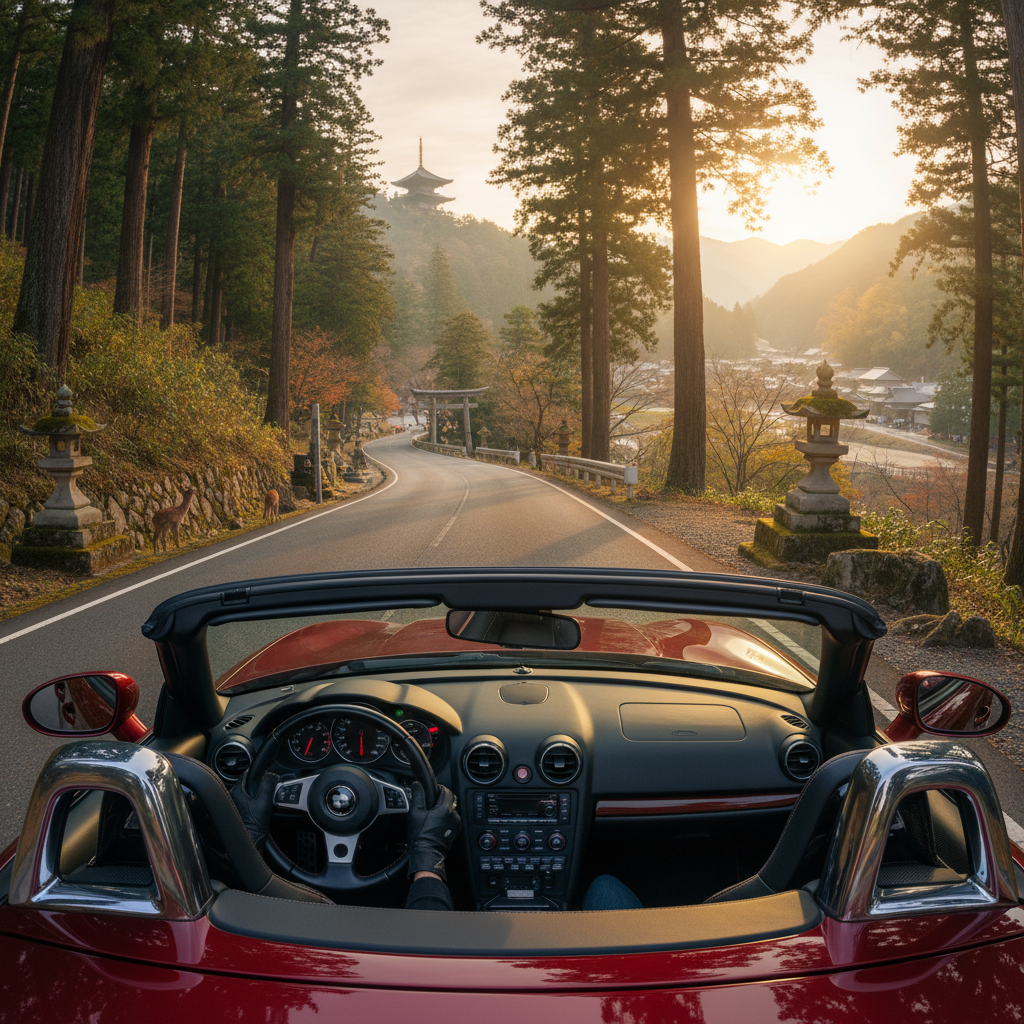
Nara Dorogawa Onsen: A Sacred Journey Through the Winding Heart of Yamato
Japan is a country defined by its rails. As a former conductor for Kintetsu Railway, I spent years observing the Japanese landscape through the uniform, rhythmic frame of a train window. I knew the schedules to the second, the sound of every switch, and the specific pitch of the motors as we climbed the grades toward Nara and Ise. But there was always a sense of longing for the spaces between the stations—the hidden valleys, the mist-shrouded peaks, and the ancient villages that the tracks could never reach. To truly understand the soul of Japan, you need to step off the platform and get behind the wheel. Specifically, you need to be in the cockpit of a Japanese Domestic Market (JDM) legend like the Toyota 86 or Subaru BRZ, feeling the mechanical heartbeat of the car as it dances through the geography of the gods.

The Philosophy of Driving in Japan: Why the Road Trumps the Rail
For most travelers, Osaka is a hub for the Shinkansen and the bustling local lines. But for those of us who live for the scent of high-octane fuel and the tactile feedback of a short-throw shifter, Osaka is the gateway to some of the most technical and spiritually resonant roads on the planet. The Kii Peninsula, which houses the southern reaches of Nara Prefecture, is a mountainous labyrinth that has served as a site of ascetic training for over a millennium. While a train can take you to the base of these mountains, it cannot deliver you to the mystical 'Secret Japan' that exists at the end of a narrow, winding asphalt ribbon.
Driving a Toyota 86 in this environment is not just about transportation; it is a philosophical choice. The 86 is a car designed for balance, not raw power. It mirrors the Japanese aesthetic of 'Jinba Ittai' (horse and rider as one). In the tight hairpins of Nara’s interior, a massive supercar is a burden, but a lightweight JDM machine is a surgical instrument. As we prepare to head toward Dorogawa Onsen, we aren't just looking for a destination; we are looking for a dialogue between the driver, the machine, and the ancient landscape. The rail follows the path of least resistance; the road follows the path of most beauty.
The 2-Day Itinerary: A Deep Dive into the Nara Interior
Day 1: Leaving the Grid and Climbing the Clouds
08:00 AM – Departure from Central Osaka
We begin our journey in the heart of Osaka. The city is still waking up, but the low thrum of the 86’s boxer engine is already a call to adventure. We merge onto the Hanshin Expressway, heading southeast toward the Minami-Kawachi region. This initial stretch is about clearing the urban clutter. As the skyscrapers of Namba fade in the rearview mirror, the horizon begins to ripple with the silhouette of the Kongo and Katsuragi mountain ranges. The transition from the steel-and-glass reality of Osaka to the lush greenery of Nara is a palpable shift in energy.
09:30 AM – The Gateway: Route 309 and the Ascent
Our true drive begins as we exit the expressway and find Route 309. For a driver, this is where the symphony starts. Route 309 is legendary among local enthusiasts. It transitions from a wide suburban road into a challenging, serpentine mountain pass. Here, the Toyota 86 comes alive. The steering rack transmits every pebble and texture of the asphalt to your fingertips. As we climb, the air cools, and the cedar forests of Nara begin to close in. The scent of Hinoki (Japanese cypress) begins to waft through the vents—a natural aromatherapy that signals your entry into sacred territory.
11:30 AM – Shimoichi and the Spirit of Yamato
Before the final push into the high mountains, we stop in Shimoichi. This town was historically the entrance to the sacred mountains of Yoshino and Omine. It is the perfect place to grab a local lunch. Look for 'Kakinoha-zushi' (persimmon leaf-wrapped sushi), a Nara specialty. The saltiness of the cured mackerel and the subtle fragrance of the leaf provided the necessary electrolytes for pilgrims centuries ago, and it provides the perfect fuel for a driver today. We eat by the side of the Yoshino River, watching the turquoise water rush over limestone boulders, the 86 parked nearby, its radiator fan humming softly as it cools down.
01:30 PM – The Technical Challenge: The New and Old Tunnels
Continuing on Route 309 toward Dorogawa, we face the Mizuha Pass. The road here requires focus. It is narrow—sometimes barely wide enough for two cars—and the elevation changes are dramatic. This is where the 86 shines. The low center of gravity allows you to trail-brake into corners with surgical precision. We pass through a series of tunnels; the sound of the exhaust bouncing off the damp concrete walls is a visceral reminder of why we drive manual cars. The 'Old Route 309' is often closed due to landslides, but even the main route offers enough technical hairpins to satisfy any driving purist.
03:30 PM – Entering the Realm of the Ascetics: Dorogawa Onsen
As we crest the final ridge, the valley opens up to reveal Dorogawa Onsen. Located at an altitude of about 820 meters, this village feels like a place that time forgot. It is the base for Shugendo practitioners—mountain ascetics who climb the sacred Mt. Omine. The town is built along a single main street, lined with traditional wooden inns (ryokan) featuring 'Engawa' (open verandas) that spill out onto the road. There is no neon here. There are no convenience stores with buzzing white lights. There is only the sound of the stream and the occasional ring of a pilgrim's bell.
05:00 PM – The Twilight Streetscape
The streetscape of Dorogawa Onsen is at its most magical during the 'magic hour.' As the sun dips behind the surrounding peaks, the lanterns (chochin) hanging from every inn begin to glow. The light is warm, amber, and inviting. We park the car—now a sleek, modern contrast to the 300-year-old architecture—and walk the street in yukatas. The sound of 'geta' (wooden sandals) clicking on the pavement is the only percussion you need. This streetscape is unique because it remains functional; it is not a museum piece, but a living, breathing community dedicated to the spiritual rigors of the mountain.
07:30 PM – Dinner: The Bounty of the Mountain
Dinner in a Dorogawa ryokan is a lesson in terroir. We are served 'Iwana' (mountain trout) grilled over charcoal with salt, and an array of wild mountain vegetables (sansai) foraged from the surrounding slopes. The water here is famous—'Goro-goro mizu' is a mineral-rich spring water that makes the local tofu incredibly creamy. For a former conductor used to eating quick station bento, this slow, deliberate feast is a revelation. The connection between the land and the plate is direct and unadulterated.
Day 2: Waterfalls, Caves, and the Long Way Home
09:00 AM – The Chilled Silence of Menfudo Limestone Cave
After a morning soak in the sulfur-rich waters of the onsen, we drive a short distance to the Menfudo Limestone Cave. The road up is steep, giving the 86’s limited-slip differential a bit of work. The cave itself is a subterranean cathedral of stalactites and stalagmites, kept at a constant 8 degrees Celsius year-round. It is a reminder of the geological forces that shaped this rugged landscape—the same forces that created the challenging grades we enjoyed the day before.
11:00 AM – The Mitarai Valley: Nature’s Engineering
From the cave, we head to the Mitarai Valley (Mitarai Keikoku). This is perhaps the most scenic spot in Nara for a driver to stop. We park at the trailhead and take a short hike. The valley features suspension bridges hanging over massive emerald pools and crashing waterfalls. The sheer scale of the limestone cliffs is humbling. As a car lover, I appreciate the engineering of the bridges, but as a human, I am awestruck by the raw power of the water. The contrast between the mechanical precision of our car and the chaotic beauty of the waterfall is the essence of a Japanese road trip.
01:00 PM – Lunch: Kurotaki Konnyaku and the 'Michi-no-Eki' Experience
We begin our descent back toward the plains, stopping at the Michi-no-Eki (Roadside Station) Kurotaki. These are not your average gas stations. They are cultural hubs. Here, we wait in line for the famous 'Kurotaki Konnyaku'—skewers of konjac simmered in a secret spicy dashi. It is simple, hot, and bursting with umami. We watch other drivers—bikers on sportbikes, elders in their 'Kei' trucks, and fellow JDM enthusiasts—all sharing the same space, unified by the road.
03:00 PM – The Scenic Detour: Route 169 and the Ginsha Lake
Instead of heading straight back to Osaka, we take a wide loop through Route 169. This road offers longer, faster sweepers compared to the tight technicality of 309. It follows the shoreline of various dams and lakes, including Ginsha Lake. Here, we can let the 86 breathe a little more. The sight of the red bridges reflecting in the still water, framed by the deep green of the forests, is a postcard-perfect moment. We are not just driving; we are participating in the landscape.
06:00 PM – Returning to the Neon Glow
As we re-enter the Osaka city limits, the orange glow of the mountain lanterns is replaced by the vibrant LEDs of the Dotonbori district. The 86 is covered in a light dusting of mountain pollen and road grime—badges of honor from a journey well-traveled. The car feels different now; the engine is smoother, the gearbox more broken-in, and the driver more at peace. We have traveled only a few hundred kilometers, but we have crossed centuries of history.
Expert Advice: Cultural Nuances and Driving Tips
Driving in the Nara mountains is a privilege, and it comes with a set of unwritten rules. Firstly, understand the concept of the 'Michi-no-Eki.' These are essential for any drive course. They offer clean restrooms, local produce, and a place to rest without the pressure of a commercial parking lot. Always try the local specialty; in Nara, that means anything involving persimmons or mountain vegetables.
When driving narrow mountain passes (toge), keep an eye on the mirrors. Local foresters in their white Kei trucks know these roads better than you ever will. If you see one approaching from behind, find a wider spot in the road, use your left blinker, and let them pass. This is the 'Omotenashi' of the road. In return, you will likely get a thankful wave or a quick hazard light flash—the secret language of Japanese drivers.
Also, be aware of the weather. The Nara interior is notorious for sudden fog and heavy rain. In a rear-wheel-drive car like the 86 or BRZ, respect the moisture on the road. The beauty of these cars is their transparency; they will tell you when grip is low, but you must be listening.
Detailed Logistics & Pre-Trip Tips for 2026
As we navigate the world of 2026, driving in Japan has become more accessible yet requires more tech-savviness. Most rental cars now come equipped with advanced GPS, but I recommend using a smartphone mount and Google Maps for real-time traffic updates. Ensure your rental includes an ETC (Electronic Toll Collection) card. In Japan, cash toll booths are becoming a rarity, and the ETC allows you to glide through checkpoints, with the total balance settled when you return the car.
When it comes to refueling, you will likely visit a 'Full Service' station at least once. Pull up, and a staff member will greet you with a shout of "Irasshaimase!" (Welcome!). Tell them "Regular Mantan" (Regular fuel, full tank). They will often wipe your mirrors and windows while you wait—a level of service that shocks most international visitors. If you are using a self-service station (look for the 'セルフ' sign), the interface is usually available in English, but the color-coding is universal: Red is Regular, Yellow is High Octane (Premium), and Green is Diesel.
Parking in Dorogawa Onsen is limited. Most ryokans have dedicated spots, but they are tight. This is where the compact dimensions of the 86 are a godsend. If you are day-tripping, use the large public parking lot at the entrance of the village. Never park on the narrow main street; it ruins the view and blocks the path for the pilgrims.
Driving a JDM manual car is the ultimate way to experience this. The tactile click of the gear into place, the blip of the throttle on a downshift—it connects you to the machine in a way an automatic never can. If you are worried about driving on the left side of the road, don't be. The pedals are in the same order, and the narrowness of the mountain roads naturally forces you to stay centered.
Comprehensive FAQ for the Nara Adventurer
What kind of license do I need to drive in Japan?
To drive in Japan, you must possess a valid International Driving Permit (IDP) issued under the 1949 Geneva Convention, along with your valid domestic driver's license and your passport. Residents of certain countries (like Switzerland, Germany, France, etc.) require a Japanese translation of their license instead of an IDP. Always verify that your IDP is from a country that is a signatory to the Geneva Convention; permits issued under the Vienna Convention are not recognized in Japan. You must present these physical documents at the time of rental.
Is insurance included?
Standard rental agreements include basic insurance, but I highly recommend opting for the 'Collision Damage Waiver' (CDW) and 'Non-Operation Charge' (NOC) coverage. This ensures that even if you have a minor scrape on those narrow Nara stone walls, you won't be hit with a massive bill or lose your deposit.
Should I be worried about driving a Manual Transmission (MT) car?
If you haven't driven MT in a while, the 86 is a very forgiving car to start with. The clutch is light, and the hill-start assist prevents you from rolling backward on Nara’s steep inclines. However, if you are completely new to manual, it is best to practice before hitting the technical mountain passes.
What are the road conditions in winter?
From late December to March, Dorogawa Onsen can see significant snowfall. During this time, winter tires are mandatory, and even then, a rear-wheel-drive sports car is not the ideal tool for the job. Our Nara drive course is best enjoyed from April to November, when the roads are clear and the grip is high.
The Final Call: Your Key to the Secret Japan
The road to Dorogawa Onsen is more than just a route on a map; it is a transition from the noise of the modern world to the profound silence of the ancient. It is a journey that demands a car with soul—a car that wants to be driven. As someone who has spent a lifetime in the Japanese transportation industry, from the precision of the Kintetsu trains to the high-performance world of JDM rentals, I can tell you that there is no substitute for the freedom of the open road.
Stop being a passenger in your own vacation. Don't just watch the mountains from a distance; carve your way through them. At Omoresha (Omoshiro Rent-a-Car) Osaka Chuo, we specialize in providing the tools for this exact experience. Our fleet of meticulously maintained Toyota 86s and Subaru BRZs is waiting for you in the heart of Osaka. Whether you want to master the hairpins of Route 309 or simply experience the glow of the Dorogawa lanterns reflected in a polished hood, we have the keys ready. Book your JDM adventure today and discover the Japan that the trains could never show you. The mountains are calling, and the 86 is ready to roar. Are you?