
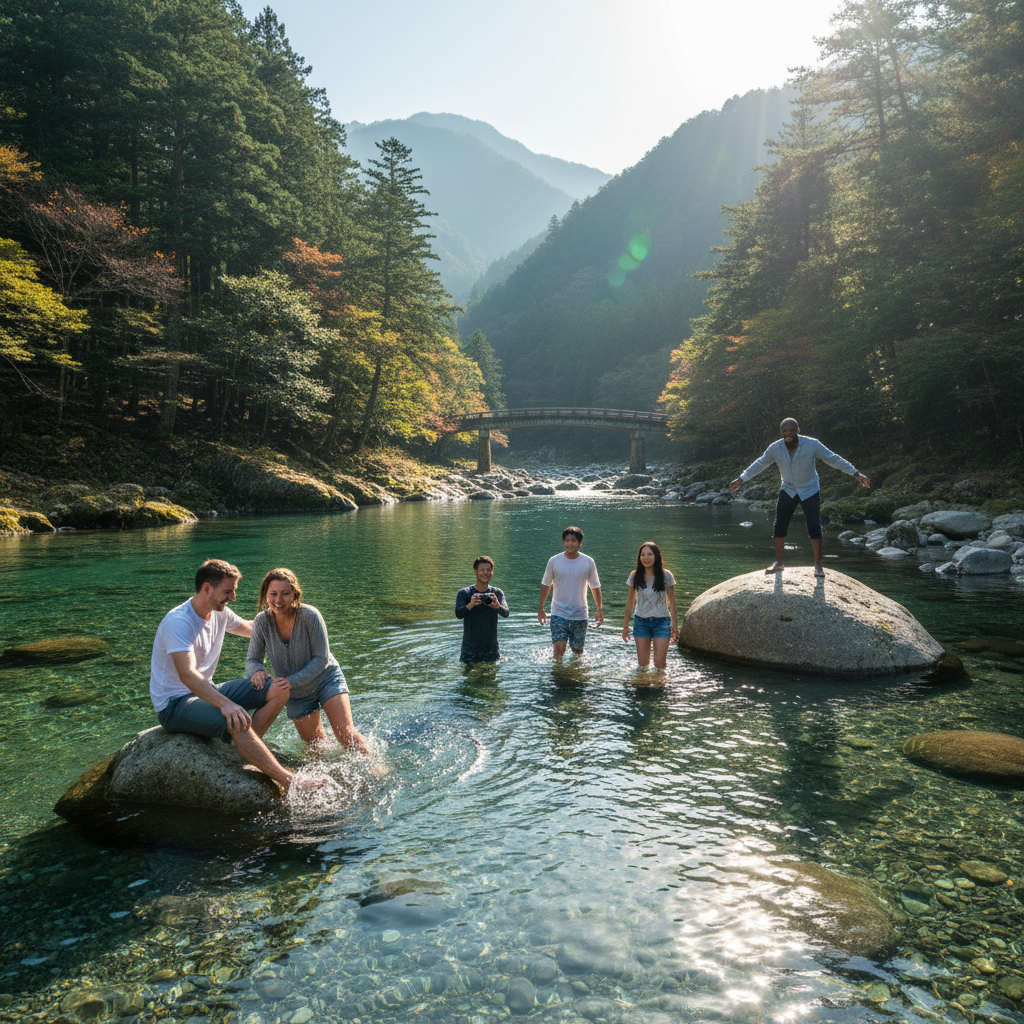
Nara Summer River Swimming and Recommended Drive Courses: The Philosophy of the Open Road
For over a decade, I navigated the iron veins of the Kansai region as a conductor for the Kintetsu Railway. I lived by the second, governed by the rhythmic clatter of steel on rail and the predictable transit between polished stations. I loved it—the engineering, the punctuality, the view of the Yamato landscape from the cab. But there was always a pull toward the horizon that the tracks couldn't reach. Beyond the stations of Yoshino and the terminals of Nara lay a world of vertical landscapes, emerald waters, and winding asphalt ribbons that no train could ever traverse. To truly see Japan—especially the rugged, mystical heart of Nara in the sweltering heat of summer—you must trade the passenger seat for the cockpit of a performance machine.
When you are looking for a Nara Summer River Swimming and Recommended Drive Course, you aren't just looking for a map; you are looking for liberation. The humidity of a Japanese summer is legendary, a thick, palpable weight that clings to the city streets of Osaka and Kyoto. To escape it, the locals know you must head south, deep into the Kii Peninsula, where the air thins, the cedar forests breathe, and the crystal-clear mountain streams offer a sanctuary of cool, pristine water. This isn't the Nara of bowing deer and crowded temples; this is the Secret Japan. This is the Japan of the Toyota 86, where the low center of gravity and the mechanical symphony of a boxer engine become your conduit to the soul of the mountains.

The Philosophy of Driving: Why the Car is the Ultimate Key to Nara
As a former conductor, I have a deep respect for public transport. But in Nara’s southern reaches—Tenkawa, Totsukawa, and Kamikitayama—the train lines simply stop. They are barred by the sheer geological defiance of the mountains. Relying on buses in these regions means living by an infrequent schedule, missing the hidden turn-offs, and being tethered to the tourist path. A Nara Summer River Swimming and Recommended Drive Course demands a vehicle that communicates with the road. Why a Toyota 86? Because these roads are narrow, technical, and emotionally evocative. A heavy SUV would feel like a bull in a china shop here. The 86, with its rear-wheel-drive purity and manual gearbox, allows you to feel the micro-adjustments of the asphalt as you climb toward the clouds. It transforms the journey from a mere transfer into a visceral experience.
The concept of "Secret Japan" is found in the gaps between the waypoints. It is the mist rising from the Amanogawa River at dawn, the smell of damp moss on ancient stone retaining walls, and the sudden drop in temperature as you enter a tunnel carved through solid granite. These are things you cannot experience through a train window. You need to be able to pull over, kill the engine, and listen to the silence of the forest interrupted only by the cicadas and the distant rush of falling water.
Nara Summer River Swimming and Recommended Drive Course: The 2-Day Deep Dive
Day 1: Leaving the Concrete Jungle for the Emerald Valley
08:00 AM – Departure from Central Osaka
The journey begins in the heart of the city. As you slide into the bucket seat of the Toyota 86, the first thing you notice is how low you are to the ground. You aren't just sitting in the car; you are part of it. We navigate the Hanshin Expressway, leaving the skyscrapers behind as the skyline begins to fold into the rolling hills of the Habikino area. We head toward the Minami-Hanna Road, the gateway to Nara Prefecture.
09:30 AM – The Gateway: Route 309 and the Climb to Tenkawa
Once we pass through the city of Gose, the landscape changes dramatically. We transition onto Route 309. This is where the drive truly begins. The road begins to twist like a serpent, following the natural contours of the mountains. For a JDM enthusiast, this is hallowed ground. The 86’s steering is telepathic here. You aren't fighting the road; you are dancing with it. As we gain altitude, the air cools significantly. The humidity begins to break, replaced by the scent of Sugi (Japanese Cedar) and Hinoki (Cypress).
11:00 AM – Arrival at Tenkawa Village: The Spiritual Water
Tenkawa Village (Heaven’s River Village) is our primary destination. This area is steeped in Shugendo—a tradition of mountain asceticism. The water here isn't just liquid; it is considered sacred. We pull into a small parking area near the Mitarai Valley. This is the pinnacle of any Nara Summer River Swimming and Recommended Drive Course. The water is a shade of emerald so vibrant it looks photoshopped. It is filtered through layers of ancient limestone, resulting in a clarity that is breathtaking.
12:30 PM – Lunch: The Taste of the Mountains
We stop at a local shack where they grill Ayu (Sweetfish) over charcoal right by the roadside. The fish are caught in the very river you just stared at. Salted and skewered, the skin is crispy, the meat delicate and sweet. Pair this with Mehari-zushi—rice balls wrapped in pickled mustard leaves, a traditional fuel for forest workers. Eating this while sitting on a sun-warmed boulder by the river, with the mist from a nearby waterfall cooling your face, is a sensory experience no Michelin-star restaurant in Osaka can replicate.
02:00 PM – The Deep Dive: Swimming at Mitarai Valley
Now, for the main event. The river swimming here is unlike any beach. The water is cold—shockingly so at first—but in the 35-degree Celsius heat of a Japanese summer, it is life-giving. There are deep pools where you can dive from rocks, and shallow areas where the water ripples over smooth pebbles. The current is gentle in the swimming holes, but you can feel the immense power of the mountain runoff. You are swimming in the literal lifeblood of the Kii Peninsula.
04:30 PM – The Road to Dorogawa Onsen
As the sun begins to dip, we climb further into the mountains toward Dorogawa Onsen. The road narrows, becoming a "coolant-testing" series of switchbacks. This is where you appreciate the 86’s manual transmission. Rev-matching on the downshifts, the blip of the throttle echoing off the rock faces—it’s pure mechanical joy. Dorogawa is a village that feels frozen in the Taisho era. Wooden inns with glass lanterns line the street, and the sound of wooden geta (sandals) clacking on the pavement replaces the sound of engines.
07:00 PM – Nightfall and Mountain Serenity
After a soak in the mineral-rich waters of a local hot spring, you dine on mountain vegetables and deer meat (gibier). The night air in Dorogawa is so cool you might actually need a light jacket—a miracle in the middle of August. The stars here are piercingly bright, far from the light pollution of the Kansai plains.
Day 2: The High Ridges and the Secret Pools
09:00 AM – The Morning Run: Gyojare-no-michi
We wake up early to beat the crowds. The morning air is crisp, and the engine of the 86 settles into a smooth idle. We take the mountain pass toward the Gyojare-no-michi. This road is technical, demanding focus and precision. The grip from the tires on the cool asphalt provides immense feedback. We reach a viewpoint where you can see the "Roof of Kansai"—the Omine Mountain range. The peaks are often shrouded in a sea of clouds (Unkai), creating an ethereal landscape that looks like a traditional ink wash painting.
11:00 AM – Hidden Gem: The Amanogawa River Pools
While Mitarai is famous, there are hundreds of unnamed pull-offs along the Amanogawa River. We find a spot where a small bridge crosses the stream. Here, there are no tourists. Just us, the 86 parked on a gravel patch, and a private natural swimming pool. The water is so clear you can count the spots on the trout swimming three meters below the surface. This is the essence of a Nara Summer River Swimming and Recommended Drive Course—the freedom to find your own paradise.
01:00 PM – Technical Driving: The Descent toward Totsukawa
We push further south toward Totsukawa, Japan's largest village by area. The roads here are a masterclass in civil engineering, featuring massive bridges that span deep gorges. The 86 feels stable at high speeds, its aerodynamics keeping it planted as we cross the Tanize Suspension Bridge—one of the longest in Japan. Walking across it is a test of nerves, but the view of the river below is worth the vertigo.
03:30 PM – The Return Journey: Scenic Route 168
Instead of backtracking, we loop back toward Osaka via Route 168. This road follows the Shingu River and offers long, sweeping curves that allow the 86 to stretch its legs. The transition from the high-mountain technicality to the riverside flow is a perfect way to end the driving portion of the trip. The landscape slowly flattens as we return toward the civilization of Gojo City.
06:00 PM – The Sunset over the Nara Plains
As we merge back onto the expressways, the sun sets over the Kongo Mountain range, painting the sky in hues of violet and gold. The heat of the city returns, but you are transformed. You have the smell of cedar in your clothes and the memory of cold mountain water in your bones.
Nara Summer River Swimming and Recommended Drive Course: Expert Advice & Cultural Nuances
Driving in the deep mountains of Nara requires a different mindset than city driving. Here are some pro-tips from a local who has spent years traversing these routes:
The Magic of 'Michi-no-Eki'
Japan’s "Roadside Stations" (Michi-no-Eki) are not your average gas stations. In Nara, they are cultural hubs. Places like Michi-no-Eki Yoshinoji Kurotaki are essential stops. Try the "Kurotaki Konyaku"—triangular pieces of konjac simmered in a secret spicy broth. It’s a local soul food that provides the perfect salt intake for a hot summer day. These stations also provide the most up-to-date information on road closures or river conditions.
The Etiquette of the Narrow Road
Many roads in our Nara Summer River Swimming and Recommended Drive Course are "1.5-lane" roads. This means they are too wide to be one lane but too narrow for two cars to pass comfortably. You will see small pull-out sections marked with a sign. If you see a local driver or a truck approaching, pull into the space early and flash your hazards as a thank you. This "mountain politeness" is the secret to a stress-free drive. As a former conductor, I can tell you that timing and spatial awareness are everything.
River Safety: Respect the Rain
Nara’s mountains are beautiful but can be volatile. Even if it is sunny where you are, heavy rain at the mountain peak can cause a "flash flood" downstream. If you see the river water becoming murky or see branches floating down, get out of the water immediately. The clarity of the water is your best safety gauge.
Nara Summer River Swimming and Recommended Drive Course: Detailed Logistics & Pre-Trip Tips
To execute this trip perfectly in 2026, you need to be prepared for the realities of Japanese mountain driving. While the tech in cars has advanced, the basics of the road remain the same.
The JDM Experience: Driving a Manual (MT) Car
In an era of electric cars and seamless automatics, why choose a manual Toyota 86 or BRZ? Because Nara’s mountains demand engagement. Using the engine brake to control your descent on a 10% grade slope isn't just safer; it makes you feel like an athlete. The tactile click of the gear shifter and the weight of the clutch pedal connect you to the machine. If you haven't driven a manual in a while, don't worry—the 86 is incredibly forgiving, with a light clutch and a hill-start assist that makes mountain driving accessible even for those out of practice.
Gas Station Lingo: The "Mantan" Protocol
When you head into the deep mountains, gas stations become rare. Never let your tank drop below half. When you find a station, pull up and say "Regular Mantan" (Regular fuel, full tank). Most JDM sports cars like the 86 run on high-octane fuel, so you would say "Hi-oku Mantan". The staff will often clean your windows and offer to take your trash—a level of service that reflects the Japanese spirit of Omotenashi.
The ETC System
The Electronic Toll Collection (ETC) system is mandatory for a smooth trip. Most expressways around Osaka and Nara are cashless. Ensure your rental car comes with an ETC card inserted. This allows you to breeze through the gates, with the tolls calculated and paid when you return the vehicle. It saves time and the hassle of fumbling for coins at a toll booth while sitting on the "wrong" side of the car.
Parking in Nature
In Tenkawa and other river spots, do not park on the side of the road where it blocks traffic. Local police are surprisingly active in summer. Always use designated parking lots (often 500-1000 yen). It supports the local community and ensures you don't return from your swim to find your 86 being towed away.
Nara Summer River Swimming and Recommended Drive Course: Comprehensive FAQ
Q: What do I need to legally drive in Japan?
A: To drive in Japan, you must possess a valid International Driving Permit (IDP) issued under the 1949 Geneva Convention, along with your original domestic driver's license and passport. Some countries (like Germany, Switzerland, France, Taiwan, etc.) use a different system and require an official Japanese translation of their license instead of an IDP. Always verify your country's status before traveling.
Q: Is driving a Manual Transmission (MT) car difficult in the mountains?
A: It requires more focus, but it is infinitely more rewarding. Our Toyota 86 and BRZ fleet are maintained to perfection, ensuring the gear shifts are smooth. If you are nervous, we recommend practicing for 15 minutes in a quiet area before heading to the mountains.
Q: What about insurance and breakdowns?
A: Modern JDM cars are incredibly reliable. However, comprehensive insurance is a must. Ensure your rental includes collision damage waivers and roadside assistance. In the remote parts of Nara, having a professional support network is vital.
Q: Are the roads open in winter?
A: While this guide focuses on summer, please note that these mountain roads often require snow tires or chains from December to March. For the Nara Summer River Swimming and Recommended Drive Course, however, you have nothing to worry about except the occasional summer rain.
Q: Is there mobile reception in the mountains?
A: Major roads have good coverage, but deep in the valleys like Mitarai, signals can drop. We recommend downloading offline maps (Google Maps) before you leave the city.
The Final Call: Your JDM Adventure Awaits
The heat of the city is an anchor. The trains, as efficient as they are, are a cage. To truly understand the heart of Japan, you need to feel the vibration of a boxer engine through your palms and the chill of a mountain stream on your skin. Nara's southern wilderness is a place of magic, accessible only to those willing to take the wheel.
At Omoren Osaka Chuo (Omoshiro Rent-a-Car Osaka Chuo), we don't just rent cars; we provide the keys to a different dimension of Japanese travel. As a former Kintetsu conductor, I know every inch of these rails, but I chose to open this shop because I know that the real soul of Japan is found where the tracks end. Our fleet of 86s and BRZs are waiting for you, tuned and polished for the technical curves of the Nara mountains. Don't settle for a generic hatchback. Don't settle for a crowded train. Book your JDM legend today and discover why a summer drive in Nara is the ultimate Japanese pilgrimage. The river is calling. The mountains are waiting. We are ready when you are.