
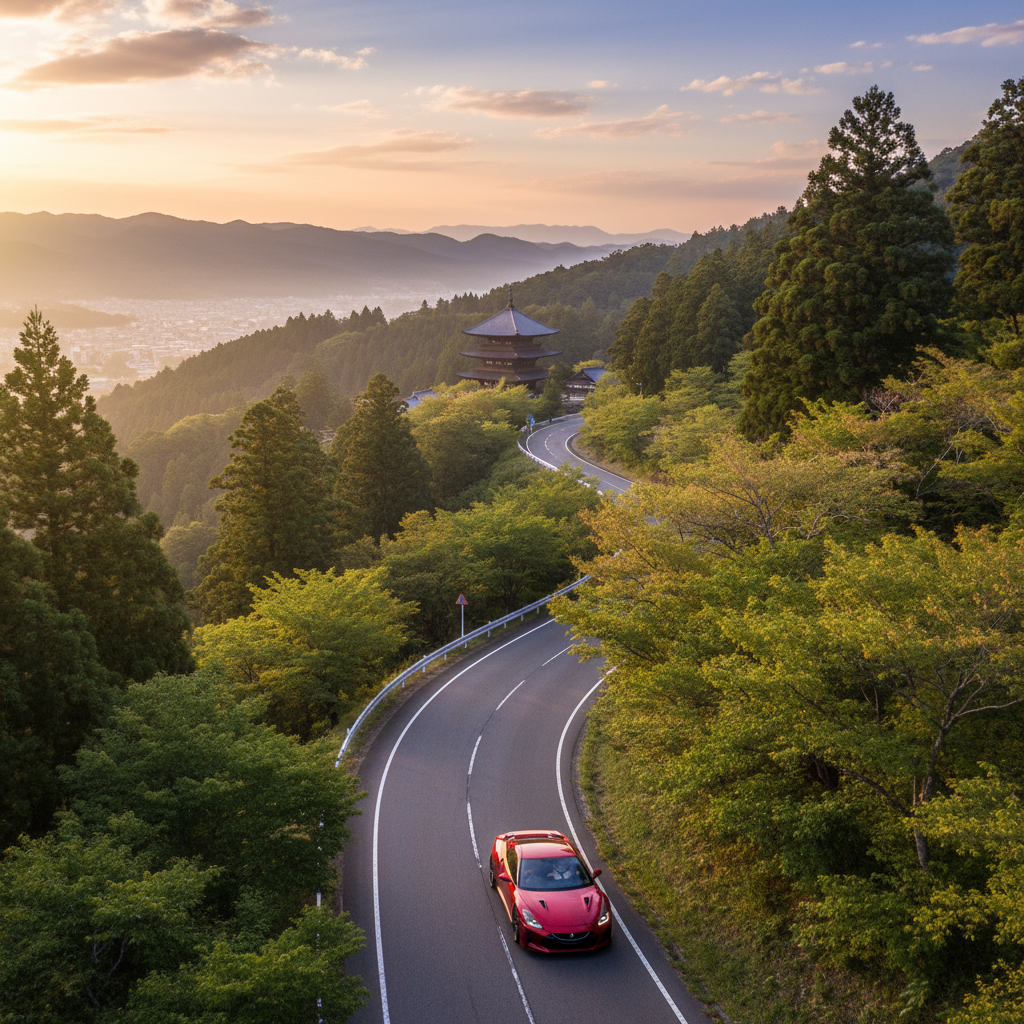
Driving the Cradle of Japan: The Ultimate Asuka Kofun Recommended Driving Course
1. The Philosophy of Driving in Japan: Why the Road Trumps the Rail
For years, I lived my life by the second. As a conductor for Kintetsu Railway, one of Japan’s most prestigious private rail networks, my world was defined by the rhythmic clicking of tracks and the absolute precision of a timetable. I loved the railway—the way it connects the neon sprawl of Osaka to the silent, misty peaks of Nara. But even then, looking out the window of a Limited Express train, I felt a pull toward the serpentine roads that vanished into the forests, places where no station exists and no whistle blows. I knew that the 'Secret Japan'—the soul of this country—wasn't found on a platform, but behind the wheel of a driver-centric machine.
Now, as an owner of a JDM (Japanese Domestic Market) specialized rental shop in the heart of Osaka, I’ve traded my conductor’s hat for a steering wheel. When people ask for an Asuka Kofun recommended driving course, they aren't just asking for a map; they are asking for liberation. Public transport in Nara is wonderful, but it is a cage. To truly see the Kofun (ancient burial mounds), to feel the weight of 1,400 years of history, you need the tactical feedback of a Toyota 86 or a Subaru BRZ. You need to be able to stop at a nameless roadside shrine or dive into a narrow mountain pass because the light hit the trees just right. This is about the harmony of 'Jinba Ittai' (horse and rider as one) applied to the ancient landscape of the Yamato Dynasty.
Osaka is the perfect launchpad. Within 60 minutes of leaving the city’s concrete canyons, the urban grit dissolves into the rolling green hills of the Asuka region. By choosing a car over a train, you reclaim your time. You aren't beholden to the hourly bus that stops miles from the actual megaliths. You are the master of your journey. In an 86 or BRZ, the low center of gravity and the telepathic steering make the transition from the Hanshin Expressway to the winding backroads of Nara an orchestral experience. This guide isn't just a travelogue; it is a manifesto for the modern adventurer who demands more than a postcard view.

2. The 2-Day Itinerary: A Deep Dive into the Asuka Kofun Recommended Driving Course
Day 1: The Megaliths and the Morning Mist
08:00 | Departure from Central Osaka
The journey begins in the shadow of Osaka’s skyscrapers. Sliding into the bucket seat of a Toyota 86, the first thing you notice is the intimacy of the cockpit. Everything is designed for focus. You start the engine, and that signature Boxer rumble echoes off the surrounding buildings. We head toward the Hanshin Expressway Route 14, transitioning onto the Minami-Hanna Road. This is where the 86 shines. As the road begins to climb toward the Katsuragi mountains, the car feels light, eager. The air changes; the humidity of the city is replaced by the crisp, cedar-scented breeze of the Nara basin.
09:30 | The Stone Stage: Ishibutai Kofun
Our first major stop on this Asuka Kofun recommended driving course is the iconic Ishibutai Kofun. Driving into the Asuka village area, the roads narrow, lined with traditional wooden homes and rice paddies that look like mirrors in the morning sun. Ishibutai is a massive megalithic tomb, believed to be the resting place of Soga no Umako, a powerful political figure of the 6th century. The earth that once covered it is gone, leaving thirty massive granite boulders exposed. The largest weighs 77 tons. Parking the 86 nearby, the contrast between the sharp, modern lines of the JDM car and the raw, ancient power of the stones is breathtaking. You can enter the burial chamber; the air inside is cool and still, carrying the scent of damp earth and centuries of silence.
11:00 | Shobu-ike Kofun: The Hidden Gem
Just a short drive away lies Shobu-ike. This is why you need a car. Most tourists skip this because it’s a bit of a hike from the bus stop, but with the 86’s nimble handling, navigating the village lanes is a joy. This tomb features two stunning stone sarcophagi made of house-shaped tuff. The geological detail here is fascinating; the stones were transported from miles away, a testament to the engineering prowess of ancient Japan. The drive between these sites takes you through 'S-curves' where you can feel the 86’s rear-wheel-drive dynamics. It’s not about speed; it’s about the flow.
12:30 | Lunch: Yamato Soba and Local Delicacies
We pull over at a small, family-run eatery tucked behind a grove of bamboo. In Asuka, food is an extension of the land. I recommend the 'Asuka Nabe' if it's available—a milk-based hot pot with local chicken and vegetables, or simple, handmade Soba. The texture of the noodles, the umami of the dashi, and the view of your car parked outside in the sunlight create a moment of pure Zen. As a former conductor, I used to eat quickly on the go. Now, I advocate for the 'slow drive'—take the time to taste the terroir.
14:00 | Takamatsuzuka and Kitora Kofun: The Painted Wonders
The afternoon is dedicated to the masterpieces of Kofun art. We drive toward the Takamatsuzuka Mural Museum. These tombs are famous for their vivid wall paintings depicting the Four Divine Monsters (Azure Dragon, White Tiger, Vermilion Bird, and Black Tortoise) and courtly life. The road connecting these two sites is a beautiful winding path that offers panoramic views of the Yamato Sanzan (the three mountains of Nara). In the 86, as you downshift into a corner, the rev-matching blip of the throttle harmonizes with the rustle of the trees. The murals represent a time when Japan was deeply connected to the Asian mainland, a golden age of cultural exchange.
16:30 | Tanzan Shrine: The Winding Ascent
To finish the day’s driving, we head south toward Tanzan Shrine. This is a driver’s paradise. The road climbs steeply, featuring hairpins that test your steering precision. The 86 is in its element here, the suspension soaking up the undulations while keeping the car flat through the turns. Tanzan Shrine is famous for its thirteen-story wooden pagoda—the only one of its kind in the world. In autumn, the maples turn a fiery red that rivals the paint job on a customized BRZ. The sunset here, viewed from the mountainside, casts long shadows over the ancient burial mounds in the valley below.
19:00 | Overnight in Sakurai: Ryokan Living
Check into a traditional Ryokan in nearby Sakurai. After a day of mechanical engagement and historical immersion, soaking in an onsen (hot spring) is the only way to reset. The smell of tatami mats and the meticulous presentation of a Kaiseki dinner provide the perfect bookend to the first leg of our Asuka Kofun recommended driving course.
Day 2: The Spirit of the Road and the Mountain Gods
09:00 | Mt. Miwa and the Omiwa Shrine
Day two begins at the foot of Mt. Miwa. This is one of Japan’s oldest Shinto shrines. There is no main hall here because the mountain itself is the deity. The energy is palpable. Parking the car in the large lot, you see other enthusiasts—Nara is a magnet for people who love to drive. The road that skirts the base of the mountain is part of the 'Yamanobe-no-michi', the oldest road in Japan. While the original path is for hikers, the adjacent driving routes offer stunning vistas of ancient orchards and tumuli that appear like small forested islands in the midst of modern development.
11:00 | Hashihaka Kofun: The Mystery of Himiko
We drive toward the massive Hashihaka Kofun. This keyhole-shaped tomb is legendary, often associated with Queen Himiko, the shamaness-queen of ancient Yamatai. Its scale is monumental. Seeing it from the road, the 86 looks like a toy in comparison to this man-made mountain. The sheer logistics of building this in the 3rd century boggles the mind. As we circle the perimeter, the road opens up, allowing for a steady cruise where you can appreciate the mechanical harmony of your vehicle.
13:00 | Lunch: Kaki-no-ha Sushi
A must-try in Nara is Kaki-no-ha Sushi—sushi wrapped in persimmon leaves. The leaves have antibacterial properties, a traditional wisdom from the days before refrigeration. It’s the perfect 'driver’s lunch'—compact, flavorful, and historic. We eat by the side of a small stream, the 86’s engine ticking as it cools, the metallic 'ting-ting' sound a reminder of the heat generated by a spirited drive.
14:30 | Exploring the 'Secret' Small Tombs
The beauty of an Asuka Kofun recommended driving course is finding the sites not on the main maps. Using the car’s GPS and local knowledge, we hunt for the smaller, 'wild' kofun. Some are located in the middle of farm fields, others hidden behind neighborhood shrines. Negotiating these tiny lanes requires the precision of a JDM sports car. The 86’s visibility and compact dimensions make it surprisingly practical for Japanese rural exploration. Each small mound tells a story of a local clan, a fragment of the larger Yamato puzzle.
16:00 | The Return Journey: The Skyline Route
Instead of taking the highway straight back, we take a detour through the mountain passes leading toward Osaka. This is the 'victory lap'. The road is a series of sweeping curves and elevation changes. In a BRZ or 86, this is pure euphoria. You aren't just moving through space; you are interacting with it. The feedback through the steering wheel tells you exactly how much grip the tires have. The sound of the exhaust echoing off the stone walls of the mountain is a symphony of 21st-century engineering in a land of 6th-century ghosts.
3. Expert Advice & Cultural Nuances: Mastering the Nara Roads
Driving in the Asuka and Nara region is a unique experience that requires a blend of technical skill and cultural sensitivity. First, let’s talk about the 'Michi-no-Eki' (Roadside Stations). These are not your typical highway rest stops. In Nara, places like 'Michi-no-Eki Asuka' are cultural hubs. Here, you can find locally grown vegetables, ancient grains that were eaten by the Kofun builders, and unique crafts. As a driver, these are essential stops for refreshing your spirit and checking your maps. They often have dedicated parking for enthusiasts, and don't be surprised if a local strikes up a conversation about your 86.
One cultural nuance to remember: the roads in Asuka are often shared with elderly residents and cyclists. Speed is rarely the goal; precision and etiquette are. When you encounter a narrow section where two cars cannot pass, the '譲り合い' (Yuzuriai - mutual yielding) spirit is vital. A small bow or a wave of the hand goes a long way. This is the 'Secret Japan'—a place where the fast pace of modern life slows down to a human rhythm. Also, be aware of the 'Hidden Shops'. Some of the best coffee and wagashi (Japanese sweets) are found in converted storehouses (kura) that have no large signs. Look for the small 'noren' curtains. Parking might be tight, but that’s why we drive compact JDM icons.
Regarding the driving itself, be mindful of the agricultural cycles. During rice planting or harvest seasons, you might find small tractors on the roads. Treat them with the same respect you would a fellow sports car. The farmers are the guardians of this landscape. Without them, the Kofun would be lost to the forest. Finally, always carry some small change (100-yen coins) for the 'unmanned vegetable stands'. You can buy fresh fruit just by leaving money in a wooden box—a testament to the incredible safety and trust inherent in Japanese society.
4. Detailed Logistics & Pre-Trip Tips: The 2026 Driving Reality
As we navigate 2026, the logistics of a Japanese road trip have become more streamlined yet remain deeply rooted in tradition. For the international traveler, the first hurdle is the license. To drive in Japan, you **must** possess a valid International Driving Permit (IDP) issued under the **1949 Geneva Convention**, alongside your home country’s driver's license and your passport. Note that permits issued under the 1968 Vienna Convention are not recognized in Japan. If you are from countries like Switzerland, Germany, or France, you may need an official Japanese translation of your license instead. Always verify this before you land.
When you pick up your JDM machine, usually an 86 or BRZ in our fleet, you'll be dealing with a manual transmission (MT) if you’re a true enthusiast. There is nothing like the mechanical 'snick-snick' of a short-throw shifter as you navigate the Nara hills. The high-revving nature of the Boxer engine requires a bit of finesse, but the payoff is a visceral connection to the road. For fueling, most of these performance cars require 'High-oku' (Premium/High Octane) gasoline. When you pull into a station, the attendant will likely ask 'Mantan?' (Full tank?). You can reply, 'High-oku, mantan, genkin de' (High-octane, full, with cash) or 'kado de' (by card). They will often even wipe your mirrors and help you back out into traffic—service that reflects the hospitality of the rail industry I once worked in.
Parking is another consideration. In Asuka, use designated lots. While it’s tempting to pull over for a photo of your car in front of a tomb, the roads are narrow. Use the ETC (Electronic Toll Collection) card provided with your rental. It allows you to pass through highway gates without stopping, with the tolls tallied up at the end of your trip. It saves time and prevents the stress of fumbling for yen at a busy interchange. Lastly, 2026 has seen a surge in 'Smart Interchanges'—small exits on expressways that only work with ETC cards. They often lead directly to scenic rural areas, bypassing the congested main gates.
5. Comprehensive FAQ: Clearing the Path to Adventure
Q: Is it difficult to drive a manual (MT) car in Japan?
A: If you have experience with MT, you will find Japanese cars very intuitive. The 86 and BRZ have excellent clutch feel. However, remember we drive on the **left** side of the road. The gear shifter will be on your left. It takes about 20 minutes to adjust, then it becomes second nature.
Q: What happens if I don't have the 1949 Geneva Convention IDP?
A: Unfortunately, Japanese rental agencies are legally forbidden from handing over a car without the correct paperwork. Please check your IDP carefully; it must specifically mention the 1949 convention. This is the most common reason travelers are unable to start their road trip.
Q: Is insurance necessary?
A: Absolutely. We provide comprehensive insurance, but we always recommend 'Full Coverage' or 'Collision Damage Waiver' (CDW) to minimize your out-of-pocket costs in the rare event of a scrape on those narrow Nara lanes.
Q: What about winter road conditions in Nara?
A: While the Nara basin rarely gets heavy snow, the mountain passes toward Tanzan Shrine can be icy in January and February. We equip our cars with winter tires during this season, but always check the forecast. For this Asuka Kofun recommended driving course, spring and autumn are the absolute peaks for beauty and grip.
Q: Can I use my phone for navigation?
A: Our cars come with high-end GPS units, but using Google Maps or Apple Maps via a phone mount is very common. Just ensure you don't operate the device while driving, as Japan has strict 'distracted driving' laws.
6. The Final Call: Your Journey Starts in Osaka
You’ve spent your life following the tracks laid down by others—metaphorically and perhaps literally. But the ancient heart of Japan, the silent mounds of Asuka, and the screaming redline of a JDM legend are calling for something different. They are calling for you to take the wheel. This Asuka Kofun recommended driving course isn't just about the destination; it’s about the person you become when you’re carving through a mountain pass at dawn, the smell of the forest in your lungs and the vibration of a finely tuned engine in your palms.
I know the railways of Japan like the back of my hand, and I can tell you: the train will show you the surface, but the car will show you the soul. When you're ready to stop being a passenger and start being a driver, come find us. At Omoshiro Rent-a-car Osaka Chuo, we don't just rent cars. We provide the keys to a Japan you never knew existed. Our fleet of 86s, BRZs, and other JDM icons are meticulously maintained by people who love driving as much as you do. Your adventure through the cradle of Japanese civilization is waiting. Book your machine today, and let’s write your own history on the roads of Nara.